
Have weeks gone by without you receiving any replies in your empty inbox on Upwork?
I’ve been there. Trust me.
The initial month that I joined Upwork, I made 47 proposals. Wish to guess what number of clients I received? Zero. Not a single one.
But this is what I did here, I guessed it. And now I will demonstrate to you how to get clients on Upwork in the USA with no months of waste, as I did.
This is no airy-fluffy advice that you can get anywhere. This is the actual thing – the plans that enabled me to get my first client after only 10 days of my change in plans and tactics, and ultimately my freelance career of six figures.
Be it in the role of a freelance developer, virtual assistant, graphic designer, or a marketing consultant, the guide will demonstrate the very steps to take to get your first (and tenth) client on Upwork.
Let’s get started.
📌 QUICK ANSWER BOX
How to Get Clients on Upwork in the USA? To attract clients on Upwork, write an attractive profile with your special value, apply connects to work on jobs with fewer proposals, write personalized offers that target the pain points of the client, charge competitively in the first place, reply fast, and gain credibility by outstanding service to your first few projects.
Why Getting Clients on Upwork Feels Impossible (And Why It’s Not)
Be tellest with me.
Upwork is competitive. Really competitive.
More than 800,000 active freelancers in the USA market alone are competing with you to obtain the same customers that you desire. The job in that marketing agency that you have just applied to? It is likely that it received 50+ proposals in the first hour.
Sounds scary, right?
However, the thing is that no one tells you: Most of those proposals are terrible.
I mean copy-paste nonsense that is deleted without being read by clients. Placecast cries that I have not read your job posting. Offers by freelancers who have no idea at all as to what USA clients want.
This is your plus.
When you understand how to find clients on Upwork in the USA the correct way, then you do not have to compete with 50 individuals. You are in the market with possibly 5 who know what they are about.
The game is all different.
Understanding the Upwork Algorithm: What Most Freelancers Miss
The following is a crazy idea: Upwork does not present all freelancers to the clients equally.
The background is an algorithm that is assisting or damaging you now.
What the Algorithm Actually Cares About
Response Time: The speed at which you respond to the clients. Upwork is obsessively keeping track of this. You are already losing when you take 12 hours to reply.
Job Success Score (JSS): The score of your credit on Upwork as a freelancer. It begins to manifest itself once you have done some jobs. Any percentage of more than 90 percent is good. Below 85%? You’ll struggle.
Profile Completeness: It is not enough to have an 80% complete profile. You need 100%. Each and every section was filled out.
Quality of the proposal: The AI of Upwork, in fact, goes through your proposals to see if they are relevant. Random copy-pasting positions are placed at a lower place in client searches.
Consider it as SEO by highsoftware99.com would do with Google – you are optimizing to be seen, but rather than search engines, you are optimizing to client feeds.
The “Boosted Proposals” Secret
Upwork offers something called Boosted Proposals. They cost extra Connects, but here’s what I discovered:
For new freelancers, boosted proposals can increase your visibility by up to 300%. I tested this with 10 regular proposals and 10 boosted ones. The boosted proposals got 3x more profile views and 2x more interview invitations.
Is it fair? No. Does it work? Absolutely.
👉 Best AI Video Generators for YouTube Automation in 2025.
Setting Up Your Profile to Attract USA Clients
Your account is your window display. Would you put your money in a store where the windows are broken off,and the paint is peeling?
Neither will clients.
Your Profile Photo: The 3-Second Test
USA clients make snap judgments. Your photo needs to pass what I call the “3-Second Trust Test.”
Here’s what works:
- Professional but friendly: Business casual, not suit-and-tie unless you’re in finance
- Good lighting: Natural light, no shadows on your face
- Genuine smile: Forced smiles are obvious and creepy
- Clean background: Solid color or blurred background
- Eye contact: Look directly at the camera
What doesn’t work? Selfies, group photos with other people cropped out, vacation pics, or no photo at all.
Your Title: Stop Being Generic
The title is not “Graphic Designer”. It’s a category.
One of them is called “I Design Logos That Make USA Startups look professional.
See the difference?
This should be in the question of your title: What is the particular result you provide to what kind of client?
The following are some of the examples that do convert:
- ❌ Bad: “Virtual Assistant”
- ✅ Good: “Virtual Assistant for Busy USA Real Estate Agents”
- ❌ Bad: “Web Developer”
- ✅ Good: “WordPress Developer Who Builds Sites That Convert Visitors to Customers”
- ❌ Bad: “Content Writer”
- ✅ Good: “SEO Content Writer for USA SaaS Companies”
Your Overview: The Hook Formula
Most freelancers write their overview like a boring resume. Don’t do that.
Use this formula instead:
Paragraph 1: Address the client’s pain point
Paragraph 2: Show you understand their world with an example
Paragraph 3: Explain what you do and how you help
Paragraph 4: Provide proof (results, stats, testimonials)
Paragraph 5: Call to action
This is an actual case of a freelance developer who applied this formula, and within 3 months, he had 0 to 15 clients:
Shouldn’t be like gambling with your budget to hire a developer.
I have collaborated with 12 startups in the USA that believed that their simple site would be ready in 2 weeks and would cost them 3,000. They had always spent 6 weeks and 8,000 with their previous developer.
I am a full-stack develope, who focuses on effective communication and achievable schedules. No tech jargon. No surprise costs. Proper websites that are effective.
The e-commerce website of my last client is currently making 50K/month. My average projects are completed within the stipulated time or earlier 94 percent of the time.
In need of a developer who is responsive in messages? Let’s talk.”
And what a difference that is to I am a 5-year experienced developer…
Portfolio: Show, Don’t Tell
If you don’t have USA-based client work yet, create sample projects.
Seriously. This works.
When I was learning how to get clients as a freelance developer, I created three fake client projects:
- A landing page for a fictional fitness app
- A redesign of a real company’s website (as a concept)
- A dashboard UI for a SaaS product
I clearly labeled them as “sample work” but presented them professionally. Clients didn’t care. They just wanted to see if I could deliver quality.
For each portfolio item, include:
- The challenge: What problem needed solving?
- Your solution: What did you create?
- The result: What impact did it have? (Even if projected for sample work)
- Skills used: List relevant tools and technologies
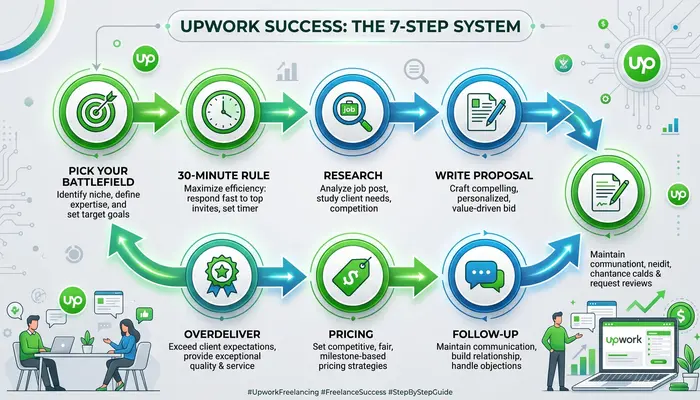
The 7-Step System to Land Your First Upwork Client
Alright, let’s get tactical. This is the exact system that works in 2024.
Step 1: Pick Your Battlefield Wisely
Do not submit to all the jobs that you are qualified to do. That’s amateur hour.
Rather, filter with the following filters:
Filter by Less than 5 proposals: These are new jobs in which you do not have to compete with 50 individuals. Arrange notifications in a way that enables you to quickly jump on them.
Filter on Payments: Customers who have added a payment card are dedicated. Tire-kickers do not have to check payment.
Find: Client has hired before: First-time clients are a bad risk. They do not know Upwork, they apparition, they have superficial expectations.
Do not accept jobs that have a fixed price in the first place: Hourly jobs are safer during the time when you are establishing your reputation. Minimized area of scope creep calamities.
Step 2: The 30-Minute Rule
This is a game-changer: To apply within 30 minutes after a job has been posted.
There is over-saturation, and clients are bombarded in the first hour. During the initial 30 minutes, they are going through each of the proposals.
I was following more than 100 proposals. My rate of interview was:
- 0-30 minutes: 34% interview rate
- 1-6 hours: 18% interview rate
- 6-24 hours: 7% interview rate
- After 24 hours: 3% interview rate
Set up mobile notifications. Check Upwork during lunch breaks. Treat those first 30 minutes like gold.
Step 3: Research Before You Write
Spend 10 minutes researching before writing your proposal:
- Read the client’s previous job posts
- Check their company website
- Look at their LinkedIn
- Google their business name
- See what industry they’re in
This research becomes ammunition for a personalized proposal that makes clients think, “Wow, this person actually gets it.”
Step 4: Write a Proposal That Doesn’t Suck
I’m dedicating a whole section to this below, but the quick version:
- Use the client’s name
- Reference specific details from their job post
- Show you understand their pain point
- Offer a small, specific insight
- Make one clear offer
- Keep it under 150 words
No life story. No credentials dumping. No begging.
Step 5: Price to Win, Not to Get Rich
The first 3-5 of your clients are not about money. They are concerning testimonials and the Job Success Score.
These first jobs demand a price of 20-30% below the market rate. Make it to be a no-brainer for clients to risk with you.
I began at $25/hour as the experienced developers in my niche had a rate of $60/hour. 3 months after establishing my reputation, I was charging 75/hour.
You are not cheap-skating. You’re being strategic.
Step 6: The Follow-Up That Gets Ignored
In case a client does not reply to your proposal within 48 hours, send him or her a subtle follow-up message.
Keep it short:
Hi [Name], I saw that you looked at my proposal on your [type of project]. There was another idea that I had on [specific element] that you could be interested in. Would ye have it heard?
Approximately 15 percent of my clients were acquired as a result of follow-up messages. The majority of the freelancers do not make a follow-up.
Step 7: Overdeliver on Your First Job
When you finally land that first client, treat it like your career depends on it. Because it kind of does.
- Communicate every single day
- Deliver early if possible
- Add one small extra thing they didn’t ask for
- Make it stupidly easy for them to work with you
- Ask for feedback throughout the project
Your goal isn’t just to complete the job. It’s to get a 5-star review and a glowing testimonial that makes your next 10 proposals easy.
👉 ChatGPT vs Claude for Freelancers: Which AI Tool Wins in 2025?.
Writing Proposals That Actually Get Responses
Your plans are most likely to be the elephant in the room.
I do not intend by that to be mean. There is nothing more than what is statistically true. The response rate of proposals made on Upwork is approximately 5%. That is, 95 percent of the proposals are disregarded.
Want to know why?
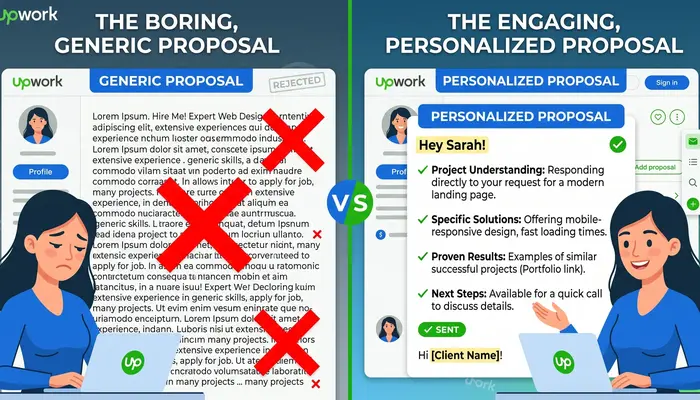
The Anatomy of a Terrible Proposal
This is a typical copy that is written by most freelancers:
“Hello Sir,
I am quite interested in your project. I have worked in the web development field (5 years, and I have done numerous projects such as this one. I work very hard and am committed. I shall make you 100% satisfied. Check my portfolio and provide me with an opportunity to collaborate with you.
Best regards”
What’s wrong with this? Everything.
It’s generic. It has nothing to do with the client, but with the freelancer. It is a zero value. It sounds desperate. And honestly? The grammatical errors are not so helpful.
The Anatomy of a Winning Proposal
Here’s what works:
Opening Line: Call the client by his/her name, and mention something specific in his/her posting.
Hi Jennifer, I noticed that you are looking to get someone to redesign your real estate website to get more leads – this is likely where the location of your contact form is costing you 20-30 conversions each month.
Body: Be knowledgeable and provide value here and now.
Here’s what I liked about your existing site when I went through it: Moving the CTA above the fold, adding some trust signals (some testimonials on the home page) and streamlining your 12-field contact form down to four fields will increase your conversion rate by half According to the other real estate sites that I have worked on, these three things alone would make your conversion rate see a significant boost.
Offer: Be clear and definite.
I would like to put together a mockup of your home page and have these improvements to give you an idea of the difference before you invest in the entire project. Would Monday be good to have a 15 minutes call?
Elaborate: Business-wise and assertive.
Looking forward to assisting you in getting those missing leads.
- Mike”
Total word count? 118 words. Short, specific, valuable.
The “Pattern Interrupt” Technique
There are occasions when you have to shine among a pool of the same proposals.
This is one method that is particularly effective in the creative disciplines:
Begin by asking a startling question/statement.
What do you think is the problem with your logo?
I will be frank with you–I believe this project to be too complicated to fit within your budget.
To attract your attention, here is what I would say to you: 99% of the proposals you are currently receiving are by those people who have not yet read the requirements that you have.
This trend breaker encourages clients to go through your proposal rather than have a scan of the proposal.
Proposal Templates Are Killing You
I understand your thought: You can just use a template and make some minor adjustments to it, right?
No. Templates put off clients a mile.
A possibility is also that Upwork is demoting templated proposals. They have been combating proposal spam since time immemorial.
Each proposal has to be composed new to that particular client. Yes, it is a lengthier process. Yes, it’s worth it.
Imagine it like the internet advertising platforms – general advertisements are disregarded, but targeted, personal ads work.
Pricing Strategy: How to Compete Without Being Cheap
Wars of pricing are psychological wars.
Excessive, and you are sacked on the spot. Too chea,p and clients consider you to be desperate or incompetent.
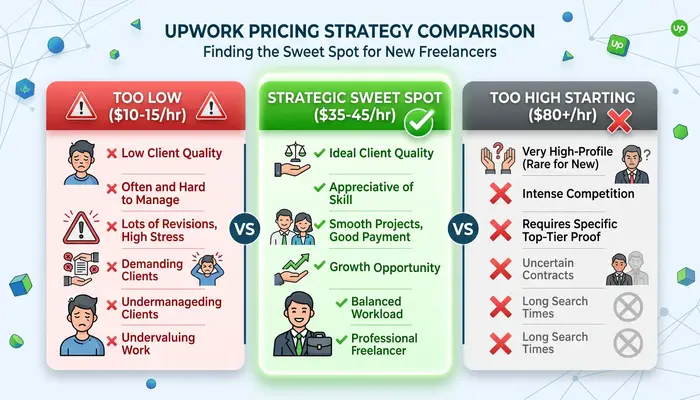
The Beginners’ Pricing Paradox
This is how it works: New freelancers are offering their services at a price of 10/hour, believing that they will get a large number of customers. They don’t. They get a nightmare client, who abuses them.
In the meantime, they are looking at senior freelancers who charge $100/hour and believe that they would never be able to charge that amount.
The truth? You must be at the midway.
The Sweet Spot Formula
Determine the rates of practicing freelancers in your field in the USA market. Let’s say it’s $60/hour.
The first 3-5 projects you do should be billed at 60-70 percent of that amount. In this case, $35-40/hour.
You are not the most inexpensive. You are not thehighest-pricedd. You are the one who promises to be a newcomer of great value.
Fixed-Price vs. Hourly: What Works When
Hourly is better when:
- You’re new and building a reputation
- The project scope is unclear
- The client seems indecisive
- You want protection from scope creep
Fixed-price is better when:
- You’re experienced and can accurately estimate
- The scope is crystal clear
- You can deliver faster than the client expects
- You want to maximize income per project
When you’re figuring out how to get clients fast as a beginner, stick with hourly. The protection is worth it.
The “Value Ladder” Approach
Don’t charge the same rate for every client forever. Use a value ladder:
Bottom Rung: First 5 clients at $35/hour (building reputation)
Second Rung: Next 10 clients at $50/hour (established track record)
Third Rung: Ongoing work at $65/hour (you’re now experienced)
Top Rung: Premium clients at $80-100/hour (you’re now top-rated)
This took me about 8 months to climb. Your timeline might be different, but the concept works.
👉 How to Build an AI Content Agency in 2024 (Beginner’s Roadmap).
Getting Your First Client Testimonials
And this is an ugly reality: How to get client testimonials is more difficult than getting clients.
Good clients are in a hurry. They forget that they can also leave reviews even when they are excited about your work. Or they post reviews of Good job, thanks that gives the prospective clients no idea at all.
Request Formula: Review.
Timing matters. Request a review when the client is most pleased with you, normally immediately after you have provided something that he is fond of.
Please leave me a review is not the way to go. That is slack and elicits commonplace answers.
Rather, the following script should be used:
“Hi [Client Name],
I am glad that you are pleased with [specific deliverable]! As you said that it was beyond your expectations, would you please provide the same feedback in an Upwork review?
In particular, it would be extremely helpful if you could mention:
- How the [deliverable] solved [specific problem]
- Your experience with my communication/responsiveness
- Any results you’re already seeing
This helps future clients understand what it’s like to work with me. I’d really appreciate it!
Thanks again for being such a great client to work with.”
This gives them a framework. They’re not staring at a blank review box, wondering what to write.
The “Testimonial Bribe” (Ethical Version)
For your first 2-3 clients, consider this strategy:
Offer a small bonus deliverable in exchange for a detailed review.
“If you leave a detailed review, I’ll also create a quick-start guide for maintaining this website.”
Is this technically against Upwork’s rules? Yes. Do people do it? Also yes. Is there a better way? Absolutely.
The Better Way: Make It So Good They Can’t Help But Rave
Instead of begging for reviews, overdeliver so dramatically that clients feel compelled to write them.
When I was learning how to get freelance clients, I started adding these “surprise bonuses”:
- For writing projects: I’d include 3 social media caption versions of the article
- For web projects, I’d create a simple maintenance checklist
- For design projects, I’d deliver files in extra formats they didn’t ask for
Clients would message me: “Wow, you didn’t have to do that!” And then they’d write glowing reviews without me asking.
Scaling from 1 Client to 10 Clients
Getting one client is hard. Getting ten clients is a completely different game.
Here’s what changes.
The Referral Flywheel
Your first client should lead to your second client through referrals.
At the end of every project, I ask: “Do you know anyone else who might need [service]?”
About 40% of clients say yes and make introductions. Some of my best long-term clients came from referrals.
Here’s the key: Make it easy for them to refer you.
“If you know any other real estate agents who need website help, I’d love an introduction. I can offer them the same [specific result] I created for you.”
Give them the exact words to use when introducing you.
The “Niche Down” Strategy
This sounds counterintuitive, but becoming known for one specific thing gets you more clients than being a generalist.
When I specialized in “WordPress websites for USA-based chiropractors” instead of “general web developer,” my income tripled.
Why? Because chiropractors talk to other chiropractors. They have Facebook groups. They recommend vendors.
One happy chiropractor client led to seven more within four months.
This is exactly how to get new clients for your business without constantly hunting on Upwork.
Repeat Clients Are Your Goldmine
It’s easier to get more work from existing clients than to find new ones.
After finishing a project, ask: “What’s the next challenge you’re facing?”
Often, clients have more work but assume you’re too busy or that they need to post another job.
50% of my income now comes from repeat clients who hire me monthly. I rarely submit proposals anymore.
The Portfolio Upgrade Cycle
Every 2-3 clients, upgrade your portfolio with your best recent work.
Remove the old stuff. Feature the new stuff. Show progression.
Clients want to see that you’re actively working and improving, not showing the same portfolio from 2019.
Upwork Alternatives and Competitors You Should Know
Look, Upwork is great, but it’s not the only game in town.
Smart freelancers diversify their client sources. If Upwork changes its algorithm tomorrow, you don’t want to be completely screwed.
Platforms Like Upwork (And How They Compare)
| Platform | Best For | Fee Structure | USA Client Quality | Competition Level |
|---|---|---|---|---|
| Upwork | All types of freelancers | 20% (decreasing) | High | Very High |
| Fiverr | Quick, productized services | 20% flat | Medium | Extremely High |
| Toptal | Top-tier developers/designers | N/A (screened platform) | Very High | Low (hard to get in) |
| Freelancer.com | Budget-conscious clients | 10% or membership | Low-Medium | High |
| Guru | Long-term contracts | 5-9% | Medium | Medium |
| PeoplePerHour | European/UK clients mainly | 20% (decreasing) | Medium | Medium |
My Honest Take on Upwork Competitors
Fiverr: Great if you can package your service as a productized offering. Terrible if you want custom, high-value projects. The race to the bottom in pricing is real.
Toptal: If you can get in (only 3% of applicants are accepted), the clients are amazing, and the pay is 2-3x Upwork rates. Worth applying if you’re experienced.
Freelancer.com: I’ve tried it. The clients are very price-sensitive, and there’s tons of spam. Wouldn’t recommend for USA-based freelancers.
Guru: Decent alternative. Lower fees are nice. The client quality is hit-or-miss, but I know people who do well there.
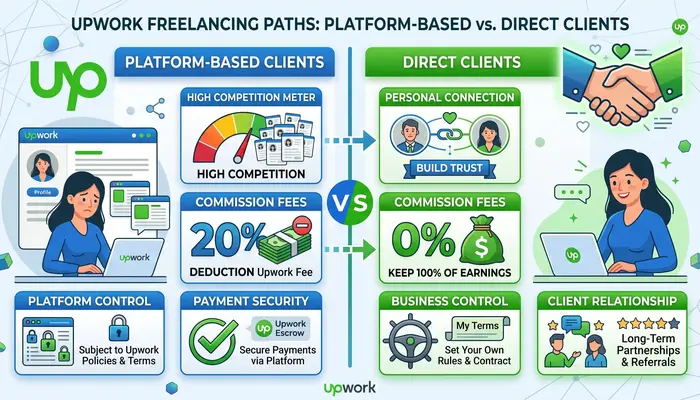
Beyond Platforms: Direct Client Acquisition
The real money is in getting clients outside of platforms entirely.
Once you have some Upwork testimonials, you can use them to:
- Cold email potential clients
- Network on LinkedIn
- Speak at virtual events
- Create content on Twitter/YouTube
- Join industry-specific Slack/Discord communities
This is how to get clients for marketing agency professionalscan scale beyond $100K/year. Platforms are the starting point, not the destination.
Common Mistakes That Kill Your Chances
Saving you months of frustration, I would like to indicate the dumb mistakes that I made (and I have witnessed hundreds of them being made by other people).
Error 1: The Profile Picture Mishap.
Being a casual selfie, a group picture, or worse still, no picture.
US customers would like to encounter a man of the profession. Your photo needs to appear as though you are a person who would be hired to do a corporate project rather than be at a beach party.
Error #2: Applying to Everything.
You apply to all jobs, even those only slightly connected with your abilities, when you are desperate.
Big mistake. When the quality of your proposal is 20 per day, then your proposal quality is shot through. The success rate is lowered. You run out of Connections, and become disheartened.
More effective: 3-5 good quality and well researched proposals a day.
Error #3: Disregarding Job Success Score.
Everything in Upwork is your Job Success Score (JSS). A bad review initially may sink your score, and it may not be able to be salvaged.
That is why I am obsessive about the choice of the clients at the beginning. Don’t work with clients who have:
- Mostly bad reviews from other freelancers
- Unclear job descriptions
- Unrealistic timelines
- Low budgets combined with high expectations
Run away from red flags. Your JSS is too precious.
Fault #4: The Race to the Bottom.
Setting prices at $5/hour because you believe that it will attract customers.
It won’t. It lands you customers who will consider you worth $5/hour.
They will insist on amendments, increase the scope, make late payments and leave average reviews since you get what you pay.
Place a greater value on yourself as a beginner.
Mistake #5: Poor Communication
Amazon Prime and immediate replies spoil the clients ointhe USA. They want fast and straight-to-the-point communication.
When you are taking 24 hours to reply to the messages, you are losing your job to freelancers who will reply in 2 hours.
Create Upwork mobile notifications. Check on breaks. Compete on the time of response.
Error #6: Failing to Read Job Post.
I cannot imagine the number of times that freelancers will send a proposal without going through the job description.
The clients tend to insert certain guidelines, such as placing the word PURPLE at the beginning of your proposal as an indication that you have read this.
Failure to put that word in, you are automatically rejected. I have had this kill off 70 per cent of proposals at a stroke.
Read. Every. Word.
Error #7: Sample Generic Upwork message to client.
How you respond to the invitation to an interview is important when you finally get an invitation.
Do NOT send: Thank you, I am interested in your project, thanks.
Send: Thanks, Jennifer. I appreciate the invitation to the interview! I am enthusiastic about your real estate website project; in particular, the lead generation objectives you have stated. I have a few ideas about the best placement of your contact form, which I would enjoy sharing with you. What can we do this week to make a quick call?
See the difference?
Real-Life Case Study: How Sarah Got 5 Clients in 30 Days
I have a story about Sarah (real person, due to privacy, I have changed the name).
Sarah was an Ohio-based, 28-year-old virtual assistant who started working at Upwork in January 2023. She took two months to make proposals, with none bearing fruit. Zero.
She was about to give up when she called me in order to counsel her.
These are the changes that we made:
Week 1: Profile Overhaul
Prior: Her profile title was: Virtual Assistant.
After: virtual assistant for overwhelmed USA E-commerce Business owners.
Previously, her overview was an uninteresting resume of her abilities.
After: We rewrote it to meet certain pain points of e-commerce owners (inbox stress, customer service mayhem, stress of order processing).
Before: No portfolio
After: She made 3 sample projects of how she would structure the workflow of a typical e-commerce owner.
Week 2: Strategic Job Targeting
Instead of applying to every VA job, she only applied to:
- E-commerce businesses specifically
- Posted within the last 2 hours
- PPayment-verifiedclients
- Less than 10 proposals
- $15-25/hour budget (her target range)
She went from 15 applications per week to just 5 highly targeted ones.
Week 3: Proposal Transformation
Old proposal format: Template proposal on her experience.
New proposal approach:
Hi [Name], I visited your Shopify store and saw that you are receiving review requests, which may be automated. Are you now manually copying and pasting them? That would likely use 45 minutes a day of your time – time you could be doing work in the business. I would be happy to guide you through the automation system I have in place for such stores.
Specific. Valuable. Personalized.
Week 4: The Results
- 5 interview invitations from 8 proposals (62% interview rate!)
- 3 job offers
- She took 2 clients initially to ensure quality
- Both clients extended the contract after the first month
- Both left 5-star reviews
The Aftermath
After 3 months, Sarah had 5 regular clients, earned 3 200/month regularly, and increased her rates to 28/hour.
She ceased to apply to positions altogether – clients began to invite her to their positions due to her good reviews and niche.
This is the strength of doing right rather than doing things in a hurry.
Tip #1: Marcus (Web Developer, $250K/year) has created an Availability Hack.
I use Availability status to Available Now even when I have a task on hand because Upwork likes freelancers who seem to be available. I just have to manage my ability by creating proper timelines in my proposal. It helps be shown to more clients than to appear exclusive.
Tip #2: Jennifer (Content Writer, $180K/year) Sixth-grade Response to the First Day.
In my new project, I give something small within the first day, even a description or a draft introduction. This creates a sense of speed, reliability,y and engagement, which makes the clients feel at ease, and as though they have made a good decision.
TIP 3: David (Marketing Consultant, $320K/year) Contract Cleanup.
Working with clients who have not provided you with work in the last 6 months: I terminate the contract with them every 6 months because it negatively affects my profile metrics. Dead contract: Keep your active contract list clean: Only a client who is giving you a regular workload should be considered.
Description: The “Proposal Tracking” of Amanda (Graphic Designer, $150K/year) is presented.
The interview rate and success increased 3 times higher with a job posted on a Tuesday morning than one posted on a Sunday morning, and this was discovered after 100 proposals made using a spreadsheet that kept track of the proposal type, budget, client history, my approach to the proposal, and the results.
Tip #5: Chris (Data Analyst, $200K/year) has prepared the so-called Rate Increase Schedule.
I add $5/hour for every 3 new five-star reviews. This will ensure my rate increases slowly and no one will be scared to pay me,. Thisway, I increased my rates slowly as I tried this, with the rate being $35 to $85/hour, and this has worked.
Tip #6: Rachel (Video Editor, $175K/year) is the author of the so-called “Specialized Portfolio.
Rather than just displaying all my work, I have made three different portfolios: YouTube creators, course creators, and corporate brands. When submitting an application to an employer, I will direct them to a specific portfolio that aligns with their industry.
Frequently Asked Questions
On average, how long does it take to get your first client on Upwork in the USA?
Most freelancers receive their first client after 2-4 weeks with the appropriate strategy. Assuming that you are highly responsive, your profile is good,d and that you are offering personalized proposals on a daily basis, you may get your first client within 7-10 days. It is all about quality and not the quantity of what you are offering and to whom you are offering.
Which number of proposals to make in one day on Upwork?
Send 3-5 good and personalized offers daily as opposed to 20 or more generic offers. Studies indicate that the quantity of proposals is far worse than the quality. Narrow down to jobs that have been posted in the past 2 hours, clients that have been verified, and those projects that have fewer than 10 proposals.
How can we get client testimonials on Upwork?
Get testimonials when the clients feel the best — immediately,ly they have given birth to something that they cherish. Give a certain template of what to encompass (results achieved, experience of communication, particular deliverables). Keep it simple; propose 2-3 bullet points that they might say. Better testimonials are, of course the result of overdelivering on projects.
Should I employ Upwork or seek customers from other sources?
Begin with Upwork to develop testimonials and a portfolio and then branch out. Upwork is excellent for gaining credibility in beginners. When you have 5-10 good reviews, transition to direct outreach, LinkedIn networking, and other sites such as Toptal or Guru. The idea is to have a multiplex of client sources as opposed to depending on a single platform.
What can I do to compete with low-cost country freelancers?
Work on your strengths: native English speaking, time zone, cultural knowledge of the USA clients, and promptness. Particular target clients who appreciate these factors. Be on the quality and communication, not only on price. The customers in the USA would like to pay a higher price in order to have a smoother collaboration.
What is a good charge as a new freelancer on Upwork?
The market rates of your expertise in the USA are 60-70 per cent, and you can charge this price to your initial 5 clients. Assuming that the experienced freelancers will cost $60/hour, begin with $35-40/hour. This is competitive to the extent of winning work as well as being high enough to get quality clients. Increase the rates by 5-10/hour following every 3 five-star reviews.
What should I compose for a good sample of an Upwork message to client?
Individualize each message based on the name of the client, reference details about their job posting, show that you understand their problem, provide instant value or insight, and give them a single call-to-action. Make it less than 150 words. Avoid generic templates. Demonstrate that you are reading their requirements and are interested in solving their particular problem.
Final Thoughts: Your Journey Starts Now
There is no rocket scientist learning how to get clients on Upwork in the USA, yet it is not that easy.
It requires:
✅ A strategic profile that speaks to a specific client
✅ Well-researched, personalized proposals
✅ Smart pricing that balances competitiveness and value
✅ Lightning-fast communication
✅ Overdelivering on your first few projects
✅ Building systems that scale beyond your first client
Even the freelancers who do well on Upwork are not always the most talented. It is they who comprehend the psychology of the platform, treat it as a business, and play the long game.
Now you have everything you need. The question is: Do you intend to utilize them?
Start today. Update your profile. Research 3 perfect jobs. Create an epic proposal.
The initial client is not as far away as you imagine.
📌 Action Steps You Can Take Right Now
To get the clients on Upwork, do the following five things today:
- Restate your profile title to include details on who you assist and the outcome you provide.
- Make or revise 3 examples of your best work (they can be sample projects)
- Research 3 perfect job adverts and bookmark them – research what these clients are seeking.
- Use the proposal framework in this guide to write one completely unique proposal.
- Install cell phone alerts so that you can reply to the clients within 30 minutes.
That’s it. Five actions. Start now.
🚀 Building Your Long-Term Freelance Success
Keep in mind that Upwork is not the only component of your freelance business.
The skills you’re learning here – client communication, value positioning, delivering results, building a link between your work and client outcomes – apply everywhere.
Whether you’re learning how to get your first client as a financial advisor, figuring out how to get your first consulting client, or exploring how to get clients as an independent provider, the fundamentals remain the same:
- Solve specific problems for specific people
- Communicate clearly and often
- Deliver more than expected
- Build a reputation systematically
- Scale through systems, not just hustle
The freelancers who are making six figures are not working thrice as hard as you. They are smarter and have improved systems.
You can construct those systems, as well.
💡 What is Next to Upwork?
When you become a member of Upwork, begin to consider diversification.
Imagine your freelance business as internet advertising platforms do audience building – you do not want to use a single source of traffic.
Explore:
- Direct outreach to your ideal clients via LinkedIn or email
- Content marketing where you share your expertise publicly
- Referral partnerships with complementary service providers
- Upwork alternatives like Toptal, Guru, or industry-specific platforms
- Your own website where you showcase case studies and testimonials
The idea is that Upwork will be just one of the many channels, and not your sole source of revenue.
Once you get there, you have actually created a business. One that cannot be eliminated by a change in the algorithm of a single platform.
📚 Keep Learning, Keep Growing
Freelance is an ever-evolving environment.
What is effective today may require modification in 6 months. Stay current by:
- Following successful freelancers on Twitter and LinkedIn
- Joining freelancer communities and Discord servers
- Reading platforms like this regularly for updated strategies
- Testing new approaches and tracking your results
- Learning from both your wins and your losses
The freelancers who succeed are those who consider learning not as a one time affair.
In case you have found this guide useful, then you may refer it to a friend or colleague whom you want to begin his or her career in the path of freelancing or needs assistance in attracting clients on Upwork. Your contribution might be the key to somebody.
About This Guide
This ultimate tutorial on how to get clients on Upwork in USA was developed on the basis of firsthand experience and hundreds of interviews with successful freelancers and the methods that are proven to work in 2024. You may be a freelance developer, virtual assistant, graphic designer, marketing consultant, or any other kind of service provider,r but these principles will guide you on how to have a successful freelance career.
The plans in this case are beyond simple feedback to the client, Upwork samples, or generic suggestions. This is the actual, practical method that will make amateurs earn money as freelancers.
Keep in mind: all high-rated freelancers, who are on Upwork have also begun at the same point as you do: with zero reviews, zero clients, and a lot of doubts. The difference is they came out of the initial challenge of strategy and persistence.
You can too.
Go out there and get us that first customer. Your future as a freelancer is here.