
Introduction: Remote Work Struggle Is Real.
Did you ever leave the workplace at the end of the day feeling like a busy but not a productive worker?
You’re not alone. I have been working at home for over six years, and the first two years were quite a nightmare. I would switch tabs, would fail to meet deadlines, and would feel like I was being overwhelmed with work.
The fact here is that when working remotely, you are at liberty, but still, a lot of discipline and necessary equipment are required.
This is where the best AI productivity tools for remote workers are. These are not mere fanciful applications, but are game-changers that can assist you in time management, automation of tedious activities, and, in fact, completing what you initiate.
This guide will also take you on a tour of the best AI productivity tools of the future, how they work, and which ones are worth your time and money. You may be a student with a job that you do in your dorm, a freelancer with clients, or a full-time remote worker: you will find something that suits you.
Let’s dive in.

Quick Answer: What Are the Best AI Productivity Tools for Remote Workers?
The best AI productivity tools for remote workers: time management software, such as Motion and Clockify; task automation software, such as Zapier and Make; AI assistants, such as ChatGPT and Notion AI; and collaborative work management software, such as Monday.com and ClickUp, are the most effective AI productivity tools that can be used by remote workers. These tools assist remote employees to be organised, automate tasks, and increasing concentration.
1. The Need for AI Productivity Tools by Remote Workers.
Speak plainly to me.
Working remotely is great until you realize that no one is looking over your shoulder or controlling you, that there is no hierarchy, no office, and that there are too many distractions at home.
I recall the first week of my work at home. I believed that I would be really productive. Rather, I wasted three hours cleaning up my workspace and being on YouTube and watching productivity videos. Ironic, right?
The thing is, in this case, remote work is out of order without the appropriate systems.
The Challenges Remote Workers Face:
- Time management disasters – Without a clear schedule, hours disappear
- Communication overload – Endless Slack messages and Zoom calls
- Task switching madness – Jumping between projects kills focus
- Feeling isolated – Working alone can drain motivation
- Burnout – No clear work-life boundaries
AI productivity tools shine in this. They do the tedious stuff, keep you in check of what is important, and remind you of it.
Pro Tip: The most effective productivity tool should be used. Begin with one or two tools, learn to use them,m and build up.
👉 Best AI Writing Tools for Bloggers 2026: The Ultimate Guide.
2. Conceptualizing AI Productivity Tools: What is Special about them?
What then constitutes an AI productivity tool to be AI-powered?
Great question.
The conventional productivity apps are calculators in that you tell them what to do, and they do it. Artificial intelligence devices seem more like an intelligent assistant, which learns your behavior and proposes how to work more efficiently.
Key Features of AI Productivity Tools:
- Smart automation – They handle repetitive tasks without your input
- Predictive suggestions – They learn your patterns and make recommendations
- Natural language processing – You can talk to them like a human
- Adaptive learning – They get better as you use them
As an example, a typical calendar app will only save your schedules. The Motion AI-based calendar analyzes your activities, makes predictions of their length, and automatically fits the tasks into your free time.
Mind-blowing, right?
Novice Notice: Do not be confused by the term AI. The majority of these are extremely easy to utilize; assuming one knows how to use Instagram, one can utilize these.
3. Time management: Best AI Productivity Tools.
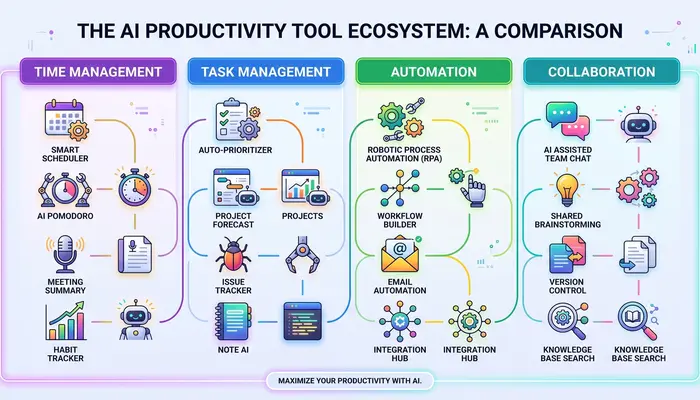
The most valuable thing to you as a remote worker is time.
You cannot purchase an additional one, but you can surely squander it. This is the reason why time management tools are necessary.
Top Time Management Tools for 2025:
Motion – The Smart Calendar
Motion is like having a personal assistant who plans your entire day. You dump in your tasks, set deadlines, and Motion automatically schedules everything.
What I love:
- Auto-scheduling based on priorities
- Reschedules tasks when meetings pop up
- Integrates with Google Calendar
Pricing: Starts at $19/month
Clockify – Free Time Tracking
If you’re a freelancer or need to track billable hours, Clockify is your best friend. It’s completely free and tracks time across projects.
Best for:
- Time entry for client projects
- Understanding where your time actually goes
- Teams that need transparent time tracking
Pricing: Free (with paid upgrades)
RescueTime – The Reality Check
Ever wonder where your day went? RescueTime runs in the background and shows you exactly how you spend your time online.
Reality check moment: When I first used RescueTime, I discovered I was spending 2.5 hours daily on email. Ouch.
What it does:
- Tracks app and website usage
- Shows productivity scores
- Blocks distracting sites during focus time
Pricing: Free version available; Premium at $12/month
👉 How to Build an AI Content Agency in 2024 (Beginner’s Roadmap).
4. Top Task and Project Management Software Built for Teams
Managing tasks solo is one thing. Coordinating with a team? That’s a whole different ball game.
Best Collaborative Work Management Tools:
ClickUp – The All-in-One Workspace
ClickUp is like the Swiss Army knife of project management. Tasks, docs, goals, wikis, time tracking—it does everything.
Why teams love it:
- Customizable workflows for any team
- Multiple views (list, board, calendar, Gantt)
- Built-in time tracking and docs
- Free forever plan for small teams
Perfect for: Teams who want everything in one place
Pricing: Free plan available; Paid plans from $7/user/month
Monday.com – Visual Project Tracking
If you’re a visual person, Monday.com will feel like home. Everything is color-coded, visual, and easy to understand at a glance.
Features:
- Drag-and-drop interface
- Automation for repetitive workflows
- 200+ templates for different industries
- Great for marketing agency project management software needs
Pricing: Starts at $8/user/month
Notion – The Flexible Workspace
Notion is hard to describe because it’s whatever you want it to be. Database? Check. Wiki? Check. Project tracker? Check.
What makes it special:
- Infinitely customizable
- Notion AI helps you write, summarize, and brainstorm
- Great for personal knowledge management
- Templates for everything
Pricing: Free for individuals; Team plans from $8/user/month
Common Mistake: Don’t try to use every feature at once. Start simple—maybe just a task list and a few notes. Add complexity as you go.
5. AI-Powered Document Process Automation Tools
Paperwork is the worst part of any job, right?
Good news: AI can handle most of it.
Top Document Process Automation Tools:
Zapier – Connect Your Apps
Zapier is like a digital assembly line. It connects different apps and automates workflows between them.
Example workflow:
- New email attachment → Save to Google Drive → Notify team in Slack
Why it’s awesome:
- 5,000+ app integrations
- No coding required
- Templates for common workflows
Pricing: Free for basic automation; Paid plans from $19.99/month
Make (formerly Integromat) – Advanced Automation
Make is like Zapier’s more powerful cousin. It handles complex, multi-step automations with visual workflows.
Best for:
- Complex automation scenarios
- Teams with technical knowledge
- Document process automation at scale
Pricing: Free tier available; Paid from $9/month
Magical – Text Expansion on Steroids
Ever type the same thing over and over? Magical fixes that. Type a shortcut, and it expands into full paragraphs.
Real-world use:
- Customer support responses
- Email templates
- Meeting notes formatting
Pricing: Free
6. Virtual Personal Assistant Tools That Actually Help
Imagine having an assistant who never sleeps, never complains, and costs less than your daily coffee.
That’s what AI assistants offer.
Best Virtual Personal Assistant Tools:
ChatGPT – The Conversational Genius
You’ve probably heard of ChatGPT. It’s not just for writing essays—it’s a full productivity powerhouse.
How I use it daily:
- Drafting emails
- Brainstorming ideas
- Summarizing long articles
- Creating outlines
- My math assistant for quick calculations
Pricing: Free version available; ChatGPT Plus at $20/month
YouMind – Your AI Memory
YouMind acts like a second brain, helping you capture thoughts, organize ideas, and retrieve information when you need it.
Features:
- Voice note capture
- Smart tagging and organization
- Quick search and retrieval
Perfect for: People who have great ideas but forget them instantly
Bot II – Task-Specific AI
Bot II specializes in specific workflows—from scheduling to data entry to report generation.
Best for: Repetitive business tasks that follow patterns
7. Marketing Agency Project Management Software Worth Trying
If you run a marketing agency or work in one, you know projects can spiral out of control fast.
Top Picks for Marketing Teams:
Asana – Campaign Management Made Easy
Asana excels at managing marketing campaigns with clear timelines, task dependencies, and team collaboration.
Features:
- Campaign calendar view
- Creative review and approval workflows
- Timeline view for project planning
- Integrations with design and marketing tools
Pricing: Free for teams up to 15; Premium from $10.99/user/month
CoSchedule – Content Marketing Calendar
CoSchedule is built specifically for content marketers. It’s your editorial calendar, social scheduler, and project manager in one.
What makes it special:
- ReQueue automatically fills your social calendar
- Marketing campaign templates
- Asset organization for creative files
Pricing: Starts at $29/month
8. Emerging AI Products You Should Know About
The AI space moves fast. Here are some newer tools making waves in 2025.
FutureTools – AI Discovery Platform
FutureTools is like Product Hunt but exclusively for AI tools. It’s where I discover new productivity tools before they blow up.
Why bookmark it:
- Daily updates on new AI tools
- Category filtering (productivity, writing, design)
- Community reviews and ratings
Website: FutureTools.io (free to browse)
BestOfAI – Curated AI Tool Lists
Similar to FutureTools but with expert curation and detailed comparisons.
Great for: Finding the best tool in specific categories
Roam Around – AI Travel Planning
Okay, this isn’t strictly productivity, but hear me out. If you’re a digital nomad or travel for work, Roam Around plans entire trips in seconds.
Why it matters: Time you save planning = time you can work or actually enjoy your trip
How Was Your Day App – Daily Reflection
This simple app uses AI to analyze your daily reflections and spot patterns in your mood, productivity, and energy levels.
The insight: Understanding your natural rhythms helps you schedule work during peak hours
👉 Print on Demand with AI Step by Step: Your Complete Beginner’s Guide to Making Money Online in 2024.
9. How to Choose the Right AI Tool for Your Workflow
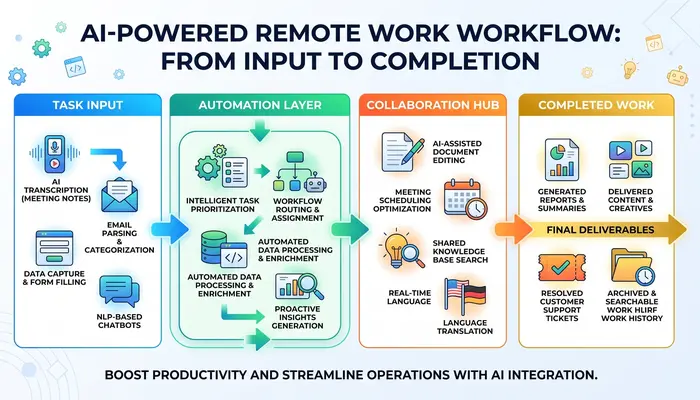
Here’s where people get stuck.
There are hundreds of AI productivity tools out there. How do you pick?
My 5-Step Selection Process:
Step 1: Identify Your Biggest Pain Point
Don’t try to fix everything at once. What’s your #1 struggle?
- Forgetting tasks? → Try task management software
- Wasting time? → Try time management tools
- Communication chaos? → Try team collaboration tools
Step 2: Start With Free Trials
Almost every tool offers a free trial. Use it. Actually, test the tool for at least a week before buying.
Step 3: Check Integration Capabilities
Does it play nice with tools you already use? Integration is key for smooth workflows.
Step 4: Consider the Learning Curve
Some tools are simple (like Magical). Others take weeks to master (like Notion). Be honest about how much time you’ll invest in learning.
Step 5: Calculate ROI
If a tool costs $20/month but saves you 5 hours of work monthly, and your time is worth $25/hour, that’s a $105 profit. Math matters.
Pro Tip: Don’t fall into the “shiny object syndrome” trap. Master one tool before adding another.
10. Real-Life Case Study: How Sarah Doubled Her Output
Here is a story of Sarah, who is a freelance content writer whom I encountered in a remote work community.
The Problem:
Sarah was gifted and sank. She had five regular clients, and it was mayhem taking care of their various needs, deadlines, and revisions. She had to work a 60-hour workweek and made less than she desired.
The Solution:
We sat down and built a simple AI productivity stack for her:
- Notion – Central hub for all client information and content calendars
- Motion – Automated daily schedule based on deadlines
- ChatGPT – First draft assistance and outline creation
- Grammarly – Editing and proofreading
- Clockify – Time tracking per client
The Results:
Within two months:
- Work hours dropped from 60 to 40 per week
- She took on 3 more clients (same workload, better systems)
- Income increased by 85%
- Stress levels? Way down
The key wasn’t working harder—it was working smarter with the right tools.
Sarah’s Top Tip:
“I used to think AI tools were for lazy people. Now I realize they free me up to do the creative work I actually love. The AI handles the boring stuff.”
11. Expert Tips for Getting Started with AI Productivity Tools
After years of testing these tools, here’s what actually works.
Tip #1: Start Small, Scale Gradually
Don’t download 10 tools at once. Pick ONE, use it for two weeks, then add another.
Tip #2: Set Up During Low-Pressure Times
Don’t try learning new software when you’re under a deadline. Set up tools during quiet weeks.
Tip #3: Use Templates and Communities
Most tools have template libraries and user communities. Don’t reinvent the wheel—use what others have built.
Tip #4: Schedule Weekly Reviews
Every Friday, spend 15 minutes reviewing what worked and what didn’t. Adjust your systems weekly.
Tip #5: Automate Decisions, Not Creativity
Use AI for scheduling, data entry, and organization. Reserve your brain power for creative and strategic thinking.
Tip #6: Build Your Personal “Tech Stack”
Document which tools you use and why. This becomes your productivity blueprint.
Example simple stack:
- Task management: ClickUp
- Time tracking: Clockify
- Writing assistance: ChatGPT
- Communication: Slack
- File storage: Google Drive
12 most popular mistakes when using AI tools.
What not to do.
Mistake #1: Tool Hopping
Changing tools each month implies that you do not master anything. Allow at least 30 days to make a decision.
Mistake #2: Over-Automation
Not all things have to be automated. There are certain processes that are quicker to do by hand.
Error #3: Overlooking the Human Factor.
The AI tools are useful for working together and do not substitute for human communication. Check-ins 1-on-1.
Mistake #4: Not Customizing Tools
The generic arrangements are seldom ideal. Take time and personalize tools to YOUR workflow.
Error #5: Forgetting Data Security.
Before signing any privacy policies, always read them. Do not put sensitive client information in unvetted AI applications.
Mistake #6: Skipping Training
The majority of tools have free webinars and training videos. Watch them. You will find out some features that you were not aware of.
Novice: It is in the learning process that mistakes are made. I have squandered money on tools that I did not utilize. Learn and move on.
Comparison Table: Best AI Productivity Tools at a Glance
| Tool | Best For | Pricing | Key Feature | Ease of Use |
|---|---|---|---|---|
| Motion | Auto-scheduling | $19/month | AI calendar management | Medium |
| ClickUp | Team collaboration | Free-$7/user | All-in-one workspace | Medium |
| Notion | Flexible workspace | Free-$8/user | Infinite customization | Medium |
| ChatGPT | Writing & brainstorming | Free-$20/month | Conversational AI | Easy |
| Clockify | Time tracking | Free | Unlimited tracking | Easy |
| Zapier | Workflow automation | Free-$19.99/month | 5,000+ integrations | Medium |
| Monday.com | Visual project management | $8/user/month | Color-coded boards | Easy |
| RescueTime | Time awareness | Free-$12/month | Automatic tracking | Easy |
Comparison: Free vs. Paid AI Productivity Tools
| Feature | Free Tools | Paid Tools |
|---|---|---|
| Cost | $0 (obviously) | $10-$50/month average |
| Features | Basic functionality | Advanced automation |
| Support | Community forums | Priority customer support |
| Limitations | User limits, feature caps | Usually unlimited |
| Integrations | Limited | Extensive |
| Best For | Solo users, students | Teams, professionals |
Pro Tip: Start with free versions, then upgrade only when you hit limitations.
Step-by-Step Guide: Setting Up Your First AI Productivity System

Let’s get practical. Here’s how to build your system from scratch.
Step 1: Audit Your Current Workflow (30 minutes)
Grab a notebook. For three days, write down:
- What tasks do you do daily
- What frustrates you most
- Where time disappears
Step 2: Identify Your Top 3 Challenges
From your audit, pick the three biggest time-wasters or stress points.
Example:
- Forgetting tasks and deadlines
- Spending too much time on email
- Losing track of project files
Step 3: Match Tools to Challenges
Based on your top 3:
- Task tracking → ClickUp or Notion
- Email management → AI email assistants like Superhuman
- File organization → Google Drive with folder templates
Step 4: Sign Up for Free Trials
Create accounts for your chosen tools. Use a work email to keep everything organized.
Step 5: Set Up One Tool Completely
Don’t touch the others yet. Spend 2-3 hours setting up your task manager:
- Create project folders
- Add your current tasks
- Set up recurring tasks
- Customize views
Step 6: Use Daily for One Week
Force yourself to use only this tool for task management for seven days. Build the habit.
Step 7: Review and Adjust
After one week, ask:
- What’s working?
- What’s confusing?
- What features am I not using?
Step 8: Add Second Tool
Now add your time tracker or automation tool. Repeat the process.
Step 9: Integrate Tools
Once both are working, connect them (e.g., time tracking within your task manager).
Step 10: Document Your System
Write down your process. Future you will thank present you.
Time investment: About 5-7 hours total over two weeks. Worth every minute.
Advanced Tips for Power Users
Once you’ve mastered the basics, here’s how to level up.
Create Automation Chains
Connect multiple tools to create workflows:
- Client fills form → Creates task in ClickUp → Schedules in Motion → Sends confirmation email
Use AI for Decision-Making
Tools like Notion AI can analyze your task list and suggest what to prioritize based on deadlines and importance.
Build Custom Dashboards
Most tools allow custom views. Create a dashboard that shows only what matters to you right now.
Set Up “Context Switching” Workspaces
Create different workspaces for different roles:
- “Deep Work Mode” – Only task list and writing tools
- “Communication Mode” – Email and messaging apps
- “Planning Mode” – Calendar and project views
Implement the “Two-Minute Rule” with AI
Use task killer features on Mac or automation to immediately complete or delegate tasks in under two minutes.
What is the Future of AI Productivity Tools?
Whither is this driving?
Judging by the present trends and discussions with developers, the following is what is in store:
Prediction 1: AI Which Predicts Burnout.
The tools you will have in the future will keep track of your work habits and alert you when you are on the verge of being burned out – before you even notice it.
Prediction 2: Voice-First Productivity
You will not have to type anything into it, but rather speak to your AI assistant normally: Hey, I need to complete the Johnson report by Friday, and I have three meetings tomorrow. When should I work on it?
Prediction 3: Hyper-Personalization
AI will come to know your specific working style and automatically make interfaces, suggestions, and workflows adapt to it.
Prediction 4: Ambient Collaboration
The AI will silently run in the background, automatically updating the team members, developing summaries, and keeping them on track without meetings.
Prediction 5: AI Workspaces of Ethics.
With an increase in AI ethics, the tools will provide insight into their use of your data and the decisions made by their AI.
Special Resource Section: Bookmark These
Here are resources every remote worker should have bookmarked:
Discovery Platforms:
- FutureTools – Daily AI tool discoveries
- BestOfAI – Curated AI tool lists
- Product Hunt – New tech products daily
- AI Products – Database of AI tools by category
Learning Resources:
- YouTube channels reviewing productivity tools
- Reddit communities: r/productivity, r/RemoteWork
- Tool-specific Discord communities
- Free courses on platforms like Coursera
Templates and Resources:
- Notion template gallery
- ClickUp template center
- Zapier workflow templates
- Free productivity worksheets
The commonly asked questions (FAQs)
The question is, what are the best AI productivity tools that remote workers can use in 2025?
The top AI productivity tools to support remote employees are: ClickUp to organize tasks, Motion to schedule with AI, ChatGPT to write, and Clockify to track time and Zapier to automate. The most suitable combination would be based on your workflow and team size.
Will free AI productivity tools be useful?
Yes, a lot of free AI productivity tools, such as Clockify, the free version of Notion, or the free version of ChatGPT, have great functionality when used by individuals and small teams. Use free versions and upgrade to advanced features when necessary or when you reach user limits.
What are the benefits of AI productivity tools in terms of time management?
AI time management systems consider your tasks, approximate the time to complete them, plan tasks to work automatically within your free time, and replan when there is a conflict. Applications such as Motion and RescueTime can give a comparison between your real-time usage and your perceived time usage.
What’s the difference between task management software and project management software?
Task management applications are for individual to-DO and personal productivity (such as Todoist). Team-based project management software manages intricate projects with multiple individuals, dependencies, schedules, and resources (such as Monday.com or Asana).
Is it possible to substitute human assistants with AI productivity tools?
Artificial intelligence devices are able to complete specific tasks such as scheduling, entering data, and processing documents well, but not human judgment, creativity, and relationship management. Consider them to enhance human ability as opposed to substituting it.
What is the time interval to achieve the outcomes of using AI productivity tools?
The majority of the users can realize the improvement in 1-2 weeks of regular usage. But it really takes 4-6 weeks to develop systems that are effective as you get acquainted with the tools, personalize the workflows, and form new habits around the tools.
Do AI productivity tools have a safe side for sensitive business data?
More reliable AI productivity tools are encrypted and adhere to data protection laws such as GDPR. It is always recommended to read the privacy policies, utilize two-factor authentication, and not enter extremely sensitive data into free or unverified tools.
What’s the best productivity tool for marketing agencies?
Marketing agencies usually require work management tools with visual workflows. Monday.com, ClickUp, and CoSchedule are good options as they manage content, creative approvals, communication with clients, and tracking campaigns all within the same platform.
Conclusion: It is High Time to Start Your Productivity Journey.
Look, I get it.
One thing is to read about productivity tools. Another thing is to actually implement them.
You may be experiencing some sort of overwhelm. That’s totally normal.
This is what I would like you to do: Do not attempt to put everything into action.
This week’s plan of action:
Day 1: Pick ONE pain point in your workflow
Day 2: Choose ONE tool that addresses it
Day 3: Sign up and spend 30 minutes exploring
Day 4-7: Use it daily, even if it feels awkward
That’s it. Small steps.
Thriving remote workers are not the most well-equipped. They are the ones who utilize a few tools in an excellent manner.
AI productivity solutions are not magic. They will not necessarily make you a success. But they will eliminate some friction and time spent, and allow you to concentrate on work that is important.
And honestly? By 2025, remote employees who will not be utilizing AI devices will be similar to writers who do not use spell check. Theoretically, it is possible, but why complicate life?
You’ve got this. Begin small, keep up, and see your productivity change.
And in case you liked this guide, please tell a friend or a colleague of yours that he or she would like to enhance their productivity when working remotely. The most appropriate tool can only be helpful when you apply it in practice, and when you share some knowledge and help people develop.