
📌 INTRODUCTION
Have you ever combined your freelance salary with your own grocery salary?
I’ve been there. It is cluttered, disorganized, and at the time of tax filing, you will spend hours trying to untangle that financial spaghetti.
The fact is as follows: it is not only prudent to keep your freelance cash apart, but it is a necessity. And honestly? It is simpler than you think.
You may be a freelance SEO professional, graphic designer, or virtual assistant, but you will need a business bank account for Freelancers USA. However, which one do you have to pick? Do you require an LLC initially? And what about such undercover charges that gouge your well-earned money?
This guide will guide you through all the information you need to know about business bank accounts as a freelancer. We will discuss what is free, what the best banks are, and I will show you what papers you need now to open an account.
We can streamline your finances in order to get you more focused on what you are best at— building your own business as a freelancer. Business Bank Accounts for Freelancers USA
📌 QUICK ANSWER BOX
The freelancing business bank account for freelancers in the USA will assist in separating personal finances and business finances, will ease taxes, and will guard your personal assets. The majority of freelancers will be able to establish a business account as a sole proprietor with only an EIN and valid ID. The best alternatives are Novo, Bluevine, and Lili, which have free business banking with no monthly charges. Business Bank Accounts for Freelancers USA
Why Freelancers Need a Separate Business Bank Account
Mind my words.
I believed that it was easier to have it all in one account when I began freelancing. You know, why make it complicated, right?
Wrong.
This is what has occurred: Tax time cam,e and I spent three days in all sorts of sorting out. Which charge was for business software? What was my Netflix? I nearly missed deductible costs in the value of hundreds of dollars. Business Bank Accounts for Freelancers USA
The Real Benefits You Can’t Ignore
Legal Protection
When you operate an LLC, mixing personal and business finances may undermine your legal protections. This is what courts refer to as piercing the corporate veil and that is, your personal assets may be liable in case someone sues you in your business.
Scary stuff.
Tax Time is Easy.
Having a business banking account that does not have any personal transactions, your accountant (or tax software) will be able to easily distinguish business expenses. This implies reduced tax payments and deductions.
Professional Image
The clientele is more likely to be convinced that you are legitimate with the appearance of checks or payments made to Sarah’s Design LLC rather than Sarah Martinez. Believe me, it is important in acquiring larger clients.
Better Financial Tracking
You will actually be able to determine whether or not your freelance business is profitable. There will be no more guessingwhethert it is the rent money or client payments in your account that are 2,000 dollars.
Pro Tip: Even if you’re just starting out and making $500/month freelancing, open a separate account now. Building good habits early saves headaches later.
Business Account vs Personal Account Bank: What’s the Difference?
So what actually changes when you switch from personal to business banking?
Let’s break it down in plain English.
Personal Bank Accounts
These are designed for individual use. You get:
- Simple features
- Maybe a 6-10 transactions per month limit
- Basic debit cards
- Limited cash deposit allowances
Business Bank Accounts
These are built for people making money. You get:
- Unlimited transactions (usually)
- Ability to accept business name checks
- Integration with accounting software like QuickBooks
- Multiple user access
- Merchant services
- Higher FDIC insurance limits for business funds
The Key Differences That Matter
| Feature | Personal Account | Business Account |
|---|---|---|
| Account Name | Your personal name | Business name or DBA |
| Transaction Limits | Limited (6-10/month) | Usually unlimited |
| Check Deposits | Must match your name | Can be business name |
| Monthly Fees | Often $0 | Varies ($0-$30) |
| Tax Reporting | Personal taxes only | Business expense tracking |
| Legal Protection | None | Protects LLC/Corp status |
| Professional Features | Basic | Invoicing, payroll, integrations |
Here’s the thing: using a personal account for business can actually violate your bank’s terms of service. I’ve heard of banks closing accounts when they discover business activity. Business Bank Accounts for Freelancers USA
Not worth the risk.
Beginner’s Note: If you’re a sole proprietor without an LLC, you CAN use a personal account legally. But I still recommend getting a business bank account for sole proprietor to keep things organized.
What Do I Need to Open a Business Bank Account?
Alright, let’s get practical.
You’ve decided you need a business account. What documents should you gather before applying?
For Sole Proprietors (No LLC)
This is the simplest setup. You’ll need:
- Government-issued photo ID (driver’s license or passport)
- Social Security Number (SSN) OR Employer Identification Number (EIN)
- Proof of business address (utility bill or lease agreement)
- Doing Business As (DBA) certificate (if using a business name different from your personal name)
Getting an EIN is free and takes 10 minutes online at the IRS website. Even as a sole proprietor, I recommend getting one instead of using your SSN for business purposes. It protects your identity.
For an LLC Business Bank Account
If you’ve formed an LLC (smart move for liability protection), you’ll need:
- EIN from the IRS (required for LLCs)
- LLC formation documents (Articles of Organization)
- Operating Agreement (some banks require this)
- Government-issued photo ID for all LLC members
- Business address proof
Additional Documents Some Banks Request
- Business license (if your city/state requires one)
- Professional licenses (for lawyers, accountants, etc.)
- Initial deposit (ranges from $0 to $100)
Pro Tip: Before heading to the bank, call ahead or check their website for their specific requirements. Some banks have different requirements, and you don’t want to waste a trip.
The EIN Question Everyone Asks
“Do I REALLY need an EIN?”
For sole proprietors: No, but I highly recommend it.
For LLCs: Yes, absolutely required.
Getting an EIN is free at IRS.gov (External link suggestion) and protects your Social Security number from exposure.
👉 How to Pay Freelance Taxes in the USA: The Ultimate Beginner Guide That’ll Save You Thousands.
Best Business Bank Accounts for LLC with No Fees
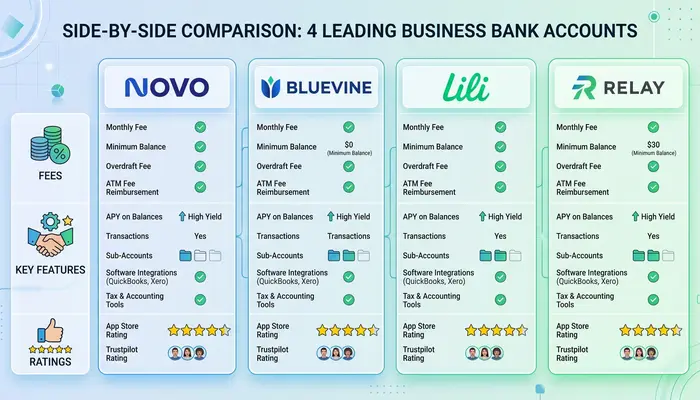
Let’s talk money. Or rather, let’s talk about NOT paying unnecessary fees.
Traditional banks love charging business accounts $15-30 per month. That’s $180-360 per year just for the privilege of keeping YOUR money with them.
No thanks.
Luckily, the banking world has changed. Several banks now offer business accounts with free banking that’s perfect for freelancers and small LLCs. Business Bank Accounts for Freelancers USA
My Top Picks for No-Fee Business Banking
1. Novo Business Checking
This is my personal favorite for freelance SEO freelancers and digital service providers.
What I Love:
- $0 monthly fees (seriously, zero)
- No minimum balance requirements
- Free ACH transfers and wire transfers
- Integrates with QuickBooks, Xero, and other accounting tools
- Mobile app is super clean and easy to use
- Physical debit card included
The Catch:
- No cash deposits (not great if you receive cash payments)
- No physical branches (online-only)
Best for: Digital freelancers, consultants, online service providers
2. Bluevine Business Checking
If you need higher transaction volumes, Bluevine is fantastic.
What I Love:
- $0 monthly fees
- Earn 2.0% interest on balances up to $250,000 (this is HUGE)
- Free incoming wire transfers
- 500 free monthly transactions
- Integrates with accounting software
The Catch:
- $100 minimum opening deposit
- Limited cash deposit options
Best for: Freelancers with higher income and consistent balances
3. Lili Banking
Designed specifically for freelancers and gig workers.
What I Love:
- $0 monthly fees on the basic plan
- Built-in expense categorization for taxes
- Automatic tax savings features
- Free instant virtual cards
- Mobile-first experience
The Catch:
- Premium plan ($14.99/month) needed for some advanced features
- No physical branches
Best for: Beginner freelancers who want tax help built-in
4. Relay Financial
Perfect if you need multiple accounts for different purposes.
What I Love:
- Up to 20 free checking accounts
- $0 monthly fees
- Free ACH and wire transfers (up to 10/month)
- Great for organizing money (one account for taxes, one for expenses, etc.)
The Catch:
- No interest earned
- Online-only
Best for: Freelancers who want to separate funds (taxes, operating expenses, savings)
Comparison Table: Best Bank for LLC Business Account
| Bank | Monthly Fee | Minimum Balance | Interest Rate | Cash Deposits | Best Feature |
|---|---|---|---|---|---|
| Novo | $0 | $0 | No | No | Best integrations |
| Bluevine | $0 | $100 to open | 2.0% APY | Limited | Earn interest |
| Lili | $0 | $0 | No | No | Tax features |
| Relay | $0 | $0 | No | No | Multiple accounts |
| Wise | $0 | $0 | No | No | International payments |
Beginner’s Note: Start with Novo or Lili. Both are beginner-friendly and completely free. You can always switch later if your needs change.
Business Bank Account for Sole Proprietor: Your Options
Now, if you haven’t formed an LLC yet, you’re probably operating as a sole proprietor.
That’s totally fine. Most freelancers start this way.
Here’s the question: Can you still get a business bank account for sole proprietor status?
Absolutely yes.
How It Works as a Sole Proprietor
As a sole proprietor, you and your business are legally the same entity. This means:
- You can use your SSN instead of an EIN (though I recommend getting an EIN anyway)
- The account can be in your personal name or your DBA name
- You have slightly more flexibility in bank choices
Best Banks for Sole Proprietors
All the banks I mentioned above (Novo, Bluevine, Lili, Relay) work perfectly for sole proprietors.
But you also have traditional bank options:
Chase Business Complete Checking
Pros:
- Physical branches nationwide
- Easy cash deposits
- Name-brand recognition
- Good mobile app
Cons:
- $15/month fee (waivable with $2,000 daily balance or $15,000 in deposits)
- More paperwork than online banks
Best for: Freelancers who need physical branch access and cash deposits
Bank of America Business Advantage
Pros:
- Physical branches everywhere
- 200 free transactions per month
- Cash management tools
Cons:
- $16/month fee (waivable with requirements)
- Less freelancer-friendly features
Best for: Freelancers with existing BofA relationships
Sole Proprietor vs LLC: Which Should You Choose?
This is a common question, so let me address it quickly.
Stick with Sole Proprietor if:
- You’re just starting out
- Your income is under $50,000/year
- You’re testing your freelance business
- You’re in a low-risk industry (like writing or graphic design)
Consider forming an LLC if:
- Your income exceeds $50,000/year
- You have significant business assets
- You’re in a higher-risk field (consulting that could lead to lawsuits)
- You want more credibility with bigger clients
Either way, you can (and should) still open a business banking account free of personal transactions.
👉 Best Niches for Freelancing in 2026: Top 14 Money-Making Opportunities.
Best Banks to Use for Business Accounts in 2024
Let’s zoom out and look at the bigger picture.
What are the overall best banks to use for business accounts this year, considering all factors?
I’ve tested dozens of banks over the years. Here’s my honest ranking:
Tier 1: Best Overall for Freelancers
1. Novo – Best all-around for digital freelancers
2. Bluevine – Best if you maintain higher balances
3. Lili – Best for tax-anxious beginners
Tier 2: Great Traditional Options
4. Chase Business Complete – Best physical bank option
5. Bank of America Business Advantage – Best for existing customers
Tier 3: Specialized Needs
6. Wise Business – Best for international freelancers
7. Mercury – Best for tech startups/software freelancers
8. Relay Financial – Best for complex money organization
What Makes a Bank “Best”?
I judge banks on these criteria:
✅ Low/No Fees – Your money should stay YOUR money
✅ Easy Account Opening – No 47-page applications
✅ Great Mobile App – You’ll manage everything from your phone
✅ Integration with Tools – Connects to QuickBooks, Stripe, etc.
✅ Customer Service – Real humans who actually help
✅ Transaction Limits – Unlimited is best for active freelancers
✅ Extra Features – Invoicing, expense tracking, etc.
How I’d Choose If I Were Starting Today
If I were launching my freelance business today, here’s exactly what I’d do:
Scenario 1: Digital Freelancer (Writer, Designer, SEO Specialist)
I’d open Novo as my primary account. Zero fees, great integrations, perfect for receiving electronic payments.
Scenario 2: Local Service Provider (Photographer, Tutor)
I’d go with Chase Business Complete because I’d need to deposit cash checks frequently and want physical branch access.
Scenario 3: International Freelancer Working with Global Clients
I’d choose Wise Business for its multi-currency features and low international transfer fees.
Scenario 4: High-Income Consultant
I’d pick Bluevine to earn 2% interest on my higher balance while still paying zero fees.
Pro Tip: You can have multiple business accounts. I actually use Novo for day-to-day operations and Bluevine as a high-yield savings account for tax money. There’s no rule saying you must stick to one bank.
Business Account Free Banking: Top Picks
Let’s get laser-focused on business account free banking options.
Because why pay fees if you don’t have to?
The True Cost of “Free”
Wait, are these accounts actually free, or is there a catch?
Let me break down what “free” really means:
Truly Free (No Hidden Costs):
- Novo
- Lili (basic plan)
- Relay Financial
- Mercury
Free With Conditions:
- Chase (free if you maintain a $2,000 balance)
- Bank of America (free with certain deposit requirements)
Mostly Free (Small Costs for Certain Features):
- Bluevine (free except $3 ATM fees)
- Wise (free except currency conversion fees)
Fee Comparison Table
| Bank | Monthly Fee | Wire Fee (Outgoing) | ATM Fee | Cash Deposit Fee |
|---|---|---|---|---|
| Novo | $0 | $0 (3 free/month) | $0 at 38,000+ Allpoint ATMs | Not available |
| Bluevine | $0 | $10 domestic | $3 | Not available |
| Lili | $0 | $10 | $2.50 | Not available |
| Relay | $0 | $0 (10 free/month) | $0 at network ATMs | Not available |
| Chase | $15 (waivable) | $25 | $3 out-of-network | Free |
| BofA | $16 (waivable) | $30 | $2.50 | Free |
How Much Can You Actually Save?
Let’s do some quick math.
Traditional Bank Scenario:
- Monthly fee: $15
- 2 wire transfers/month: $50
- 4 ATM fees: $12
- Total monthly cost: $77
- Annual cost: $924
Free Online Bank Scenario:
- Monthly fee: $0
- Wire transfers: $0
- ATM fees: $0
- Total monthly cost: $0
- Annual cost: $0
That’s nearly $1,000 per year saved just by choosing the right bank.
As a freelancer, that’s money you can invest in:
- New equipment
- Professional development courses
- Marketing
- Or just, you know, groceries
Common Mistake: Don’t choose a bank just because it’s free. Make sure it has the features you need. Free but inconvenient costs you in time and frustration.
Best International Business Bank Account for Freelancers
Are you working with clients outside the USA?
Then standard US banks might be costing you a fortune in international transfer fees and terrible exchange rates.
Let me introduce you to the world othe f best international business bank account options.
Why International Accounts Matter
Here’s what happens with a regular US bank when you receive payment from a UK client:
- Client sends £1,000
- Their bank charges a fee ($25)
- The intermediary bank takes a cut ($15)
- Your bank charges a receiving fee ($15)
- Your bank uses a bad exchange rate (you lose ~3% = $38)
Total cost: About $93
You just lost nearly 10% of your payment to fees.
That’s painful.
Best International Banking Options
Wise Business (Formerly TransferWise)
This is the gold standard for international freelancers.
What Makes It Amazing:
- Hold money in 50+ currencies
- Real exchange rates (not marked-up bank rates)
- Receive payments like a local in USD, EUR, GBP, AUD, and more
- Extremely low transfer fees (usually 0.5-1%)
- Virtual debit card works everywhere
Example:
That same £1,000 payment:
- Client sends £1,000
- Wise fee: ~$6
- Exchange rate: Real mid-market rate
- You receive: ~$1,220
Total cost: $6 instead of $93
Best for: Freelance SEO specialists, developers, writers working with international clients
Mercury (With International Features)
What I Like:
- Modern interface
- Good for tech freelancers
- International wire transfers available
- Integrates well with startup tools
The Catch:
- International features not as robust as Wise
- Better as a primary US account with Wise as secondary
Payoneer
Popular among freelancers on platforms like Upwork and Fiverr.
Pros:
- Easy platform integration
- Multiple currency accounts
- Virtual cards
Cons:
- Higher fees than Wise
- Customer service can be slow
My Recommended Setup for International Freelancers
Here’s what I’d do:
Primary Account: Novo (for US-based operations)
International Account: Wise Business (for receiving international payments)
Strategy: Receive international payments in Wise, then transfer to Novo when you need USD
This setup gives you:
- Low fees on international transactions
- Professional US business account
- Flexibility to hold multiple currencies
Pro Tip: If more than 30% of your income is international, open a Wise Business account immediately. The money you save in fees will be significant.
👉 AI Tools to Automate Social Media Content: The Complete 2025 Guide.
How to Choose the Right Business Bank Account
Okay, I’ve thrown a LOT of information at you.
How do you actually decide which bank is right for YOUR specific situation?
Let me give you a simple decision framework.
The 5-Question Method
Ask yourself these five questions, and you’ll know exactly which bank to choose.
Question 1: Do you receive cash payments?
YES → Choose a traditional bank with physical branches (Chase, Bank of America)
NO → Online banks are perfect (Novo, Bluevine, Lili)
Question 2: Do you work with international clients?
YES (>30% income is international) → Get Wise Business
SOMETIMES → Get Wise as a secondary account
NO → Standard US business account is fine
Question 3: What’s your average monthly balance?
Under $1,000 → Novo or Lili (zero fees, no minimums)
$1,000-$10,000 → Bluevine (earn 2% interest)
Over $10,000 → Bluevine or Novo witan h additional savings account
Question 4: What tools do you use?
If you use QuickBooks, Xero, or other accounting software → Novo or Bluevine
If you want built-in tax help → Lili
If you use Stripe or payment processors → Mercury or Novo
Question 5: How important is customer support?
Very important (I want human help) → Traditional banks or Bluevine
Not critical (I’m tech-savvy) → Any online bank works
Quick Decision Tree
Let me make this even simpler:
textSTART HERE
    ↓
Are you a digital freelancer? (writer, designer, developer, SEO freelancer)
    → YES → Do you earn over $5k/month?
        → YES → Bluevine (earn interest)
        → NO → Novo or Lili
    → NO → Do you need cash deposits?
        → YES → Chase Business Complete
        → NO → Novo

Do you have international clients?
    → YES → Add Wise Business as secondary account
    → NO → You're all set!
Red Flags to Avoid
Watch out for these warning signs:
❌ Monthly fees over $15 (unless you genuinely need the features)
❌ Minimum balance requirements over $500 (ties up your cash)
❌ Transaction limits (some banks limit you to 100-200 transactions/month)
❌ High wire transfer fees (over $25 per wire)
❌ Poor mobile app reviews (you’ll use the app constantly)
❌ Hidden fees in the fine print
Beginner’s Note: When in doubt, start with Novo. It’s free, easy to set up, and works great for 90% of freelancers. You can always add or switch banks later as your needs evolve.
Step-by-Step: Opening Your First Business Account
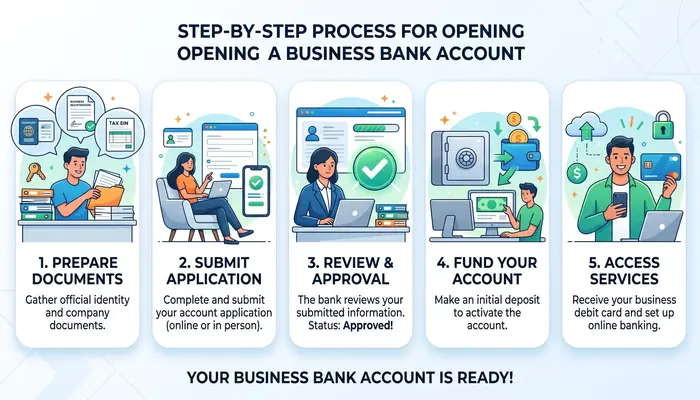
Alright, let’s do this.
I’m going to walk you through opening a business bank account from start to finish.
I’ll use Novo as the example since it’s the most popular choice for freelancers, but the process is similar for most online banks.
Before You Start: Preparation (15 minutes)
Step 1: Gather Your Documents
Open a folder on your computer and collect:
- Photo of your driver’s license or passport (front and back)
- Your Social Security Number or EIN
- Your business address
- Your DBA certificate (if you have one)
Step 2: Decide on Your Business Name
You’ll need to choose:
- Your legal name (Sarah Martinez), OR
- Your DBA name (Sarah Martinez Design)
If you’re using a DBA, make sure you’ve registered it with your county/state first.
The Application Process (10-15 minutes)
Step 3: Visit the Bank Website
Go to Novo.co (or your chosen bank)
Click “Open Account” or “Get Started”
Step 4: Enter Basic Information
You’ll provide:
- Your name
- Email address
- Phone number
- Business type (Sole Proprietor or LLC)
Step 5: Business Details
Answer questions about:
- Industry/business type
- Estimated monthly deposits
- Nature of your business (be honest—”freelance digital marketing” works perfectly)
Step 6: Upload Documents
Take photos or upload:
- Your ID
- EIN confirmation letter (if you have one)
- Any required business documents
Most banks let you take photos with your phone right in the app.
Step 7: Verify Your Identity
The bank will:
- Ask security questions based on your credit report, OR
- Send a verification code to your phone, OR
- Request a small deposit verification
This is standard security stuff.
Step 8: Fund Your Account
Link your personal bank account or:
- Make an ACH transfer
- Mobile check deposit
- Transfer from another bank
Some banks require a minimum opening deposit ($25-100), but many are $0.
Step 9: Wait for Approval (1-3 days)
Most online banks approve you within:
- 24 hours (Novo, Lili)
- 2-3 days (Bluevine, Relay)
- Up to 5 days (traditional banks)
You’ll get an email confirmation.
Step 10: Activate Your Debit Card
Your physical debit card arrives in 7-10 days.
Meanwhile, most banks give you a virtual card immediately for online purchases.
Post-Opening Setup (30 minutes)
Step 11: Connect Your Accounting Software
Link your bank to:
- QuickBooks
- Xero
- Wave
- FreshBooks
This automatically imports transactions.
Step 12: Set Up Your Business Profile
Add:
- Your business logo
- Business category
- Tax settings
Step 13: Start Using It!
- Update your invoice payment instructions to your new bank account
- Update payment processors (Stripe, PayPal) to deposit here
- Set up any automatic transfers
Pro Tip: Don’t close your personal account yet. Run both accounts in parallel for 30 days to ensure all your business payments are flowing to the new account before fully switching over.
Troubleshooting Common Issues
“My Application Was Denied”
This occasionally happens due to:
- ChexSystems issues (past banking problems)
- Identity verification failures
- Incomplete documentation
Solution: Try another bank. Different banks have different requirements. If Novo denies you, try Lili or Bluevine.
“They’re Asking for Additional Documents”
Sometimes banks request:
- Business licenses
- Proof of business activity (recent invoices)
- Explanation of your business model
Solution: Provide what they ask for. Be patient—it’s normal for some businesses.
👉 CRM Software for Freelancers in the USA 2026: Your Complete Guide.
Common Mistakes Freelancers Make (And How to Avoid Them)
Allow me to spare you the errors I have made (and of hundreds of other freelancers).
Error #1: Waiting to Open a Business Account.
The Mistake:
I will just work with my own account till I earn more.
Why It’s Bad:
You will spend months of transfers to sort out before switching. Overlooked tax deductions. And, if you havean LLC, you have already lost your legal protection.
The Fix:
Get a business account within the first month of freelancing. You only have to make $20,0 but you need to start the habit.
Error #2: Selecting a Bank on the basis of Brand Name.
The Mistake:
I will simply use Chase since I am familiar with them.
Why It’s Bad:
The charge levied by brand-name banks is a bite on your freelance earnings. They are targeted at larger companies and not the individual freelancers.
The Fix:
Compare characteristics and charges. It costs you 15/month at Chase, which is 180/ye —r- money you cannot afford to squander as you are starting your business.
Error #3: Failure to obtain EIN.
The Mistake:
Doing it all with your Social Security Number.
Why It’s Bad:
- Every client you work with sees your SSN
- Higher identity theft risk
- Looks less professional
- Harder to separate business and personal finances
The Fix:
Free EIN: Obtaining an EIN is free and takes 10 minutes at IRS.gov. Applies to all businesses.
Error #4: Personal and Business Expenses.
The Mistake:I
i am just going to go with my business card on this one grocery run….
Why It’s Bad:
- Makes accounting a nightmare
- Can trigger IRS audits
- Loses tax deductions
- For LLCs, destroys legal protection
The Fix:
Strict rule: Business account = business only. Personal account = personal only. No exceptions.
Mistake #5: Forgetting Accounting Software Integration.
The Mistake:
Handwriting all the transactions to a spreadsheet.
Why It’s Bad:
- Time-consuming
- Error-prone
- Makes you hate bookkeeping
- Easy to miss tax deductions
The Fix:
Choose a bank that integrates with QuickBooks, Wave, or Xero. Transactions import automatically. Saves hours every month.
Mistake #6: Not Reading the Fee Schedule
The Mistake:
Signing up without understanding the fees.
Why It’s Bad:
Hidden fees add up:
- $3 ATM fees
- $25 wire transfer fees
- $15 overdraft fees
- $10 paper statement fees
The Fix:
Read the fee schedule PDF before opening an account. Know exactly what actions cost money.
Mistake #7: Keeping All Money in Checking
The Mistake:
Leaving $20,000 sitting in a checking account earning 0% interest.
Why It’s Bad:
You’re losing money to inflation. At 3% inflation, your $20,000 loses $600 in purchasing power annually.
The Fix:
Keep 1-2 months of expenses in checking. Move the rest to:
- High-yield savings (like Bluevine at 2%)
- Tax savings account
- Investment accounts for long-term savings
Mistake #8: Not Separating Tax Money
The Mistake:
Spending all the money that hits your account.
Why It’s Bad:
Tax time arrives, and you owe $8,000… but you only have $1,200 in your account.
Panic.
The Fix:
Immediately transfer 25-30% of each payment to a separate savings account marked “TAXES.” Don’t touch it until quarterly taxes or tax season.
Common Mistake Warning: The biggest mistake? Not opening a business account at all. If you’re reading this and still using a personal account for freelance income, stop. Open an account today. Your future self will thank you.
Real-Life Case Study: How Sarah Saved $3,200 in Taxes
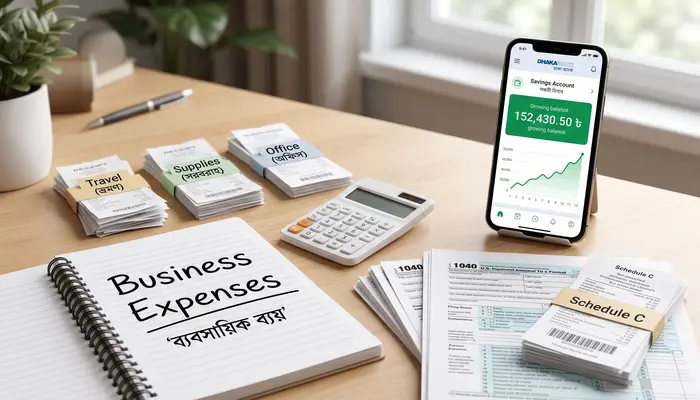
I want to share with you a story of Sarah (not her real name, but a real story).
Sarah is a freelance SEO specialist who presented herself to me in March 2023, frustrated.
The Problem
She has been working as a freelancer for 18 months, making approximately 6,500/month. She kept all her personal Chase checking accountforn everything personal, business, software payments to clients, groceries, you name it.
She was overwhelmed when the time to pay taxes came.
I know I purchased software and was at a conference, she explained to me. But I lost the receipts, and all it i, is jumbled up in my bank statement.
The accountant of hers had estimated that she had even missed out on at least 4,000 in deductible expenses simply because she could not document them in an appropriate manner.
That is approximately 1,200 in additional tax (30% effective tax rate).
The Solution
Here’s what we did:
Step 1: Opened Two Business Accounts
- Novo for regular business operations
- Bluevine for tax savings (earning 2% interest)
Step 2: Set Up Automatic Rules
Every time a client payment hits Novo:
- 30% automatically transferred to Bluevine (tax savings)
- Transaction auto-categorized in QuickBooks
Step 3: Committed to Separation
Business card ONLY for business. Personal card ONLY for personal. No mixing.
The Results (12 Months Later)
By the next tax season, Sarah’s accountant found:
Documented Business Expenses:
- Software subscriptions: $2,400
- Home office deduction: $3,600
- Conference and training: $1,800
- Meals with clients: $1,200
- Professional services: $1,500
- Total deductions: $10,500
Tax Savings:
At her 30% effective tax rate, these deductions saved her $3,150 in taxes.
Plus:
- She earned $280 in interest on her tax savings account (2% oan n average $14,000 balance)
- Saved $180 in bank fees by switching from Chase
- Saved 10+ hours during tax preparation
Total Financial Benefit: $3,610
But here’s what really mattered to Sarah:
“I feel like a real business owner now. I know exactly how much I’m making, what I’m spending, and what I owe in taxes. I sleep better at night.”
That peace of mind? Priceless.
Key Takeaway: A proper business bank account isn’t just about organization—it’s about keeping more of your hard-earned money through proper tax deductions and smart financial management.
Expert Tips for Managing Your Business Account
You’ve got your business account. Now let’s make sure you’re using it like a pro.
These are the tips I wish someone had told me when I started.
Tip #1: The 30% Rule for Taxes
Here’s a simple system that prevents tax-time panic:
Every time money hits your business account, immediately transfer 30% to a separate savings account.
Example:
- Client pays you $3,000
- Immediately move $900 to tax savings
- Keep $2,100 for expenses and income
By tax time, you’ll have enough money set aside for:
- Federal income tax
- Self-employment tax
- State income tax (if applicable)
Some freelancers use Relay Financial because you can create multiple accounts:
- Account 1: Operating (daily business)
- Account 2: Tax savings
- Account 3: Equipment/investment fund
Tip #2: Reconcile Weekly, Not Monthly
Most people reconcile their accounts once a month.
That’s a mistake.
Better approach: Spend 10 minutes every Friday reviewing your transactions.
- Mark personal expenses that accidentally hit the business account
- Categorize transactions while you remember what they were
- Catch errors early
- Stay on top of your finances
I use QuickBooks, and it takes me literally 10 minutes each Friday morning.
Tip #3: Use Virtual Cards for Subscriptions
Many business account free banking options (like Novo and Lili) offer instant virtual cards.
Smart strategy:
Create a virtual card specifically for recurring subscriptions:
- Adobe Creative Cloud
- Canva Pro
- Email marketing software
- Project management tools
Benefits:
- Easy to track subscription spending
- Can cancel the virtual card if you get fraudulent charges
- Know exactly how much you spend on tools monthly
Tip #4: Name Your Transactions
Most banking apps let you add notes to transactions.
Use this feature!
Instead of seeing “AMZN MKTP US $47.99” and wondering what you bought three months later, add a note:
“AMZN MKTP US $47.99 – Office chair for home office”
Your future self (and accountant) will love you.
Tip #5: Set Up Low Balance Alerts
Configure your bank to alert you when your balance drops below a certain amount.
I set mine at $1,000.
This prevents:
- Overdraft fees
- Declined client refunds
- Embarrassing payment failures
- Cash flow surprises
Tip #6: Use Separate Accounts for Different Income Streams
If you have multiple income sources, consider separate accounts:
Example for a freelance designer:
- Account 1: Retainer clients (predictable monthly income)
- Account 2: Project-based work (variable income)
- Account 3: Passive income (template sales, affiliate commissions)
Why? Because you can manage each income stream differently:
- Retainer income pays your bills
- Project income funds growth
- Passive income goes to investments
Tip #7: Review Annually, Switch if Needed
Don’t be afraid to switch banks if your needs change.
Every January, ask yourself:
- Is this bank still serving my needs?
- Have they added fees?
- Is there a better option now?
Banking loyalty doesn’t pay. Always choose what’s best for your current situation.
Pro Tip: Set up two-factor authentication on your business account. As a freelancer, your bank account IS your business. Protect it like Fort Knox.
👉 For more tax tips for freelancers, visit IRS.gov Small Business Tax Center.
Frequently Asked Questions About Business Bank Accounts for Freelancers
Will I require an LLC to open a bank account for my business?
Nope, to open up a bank accounasng a sole propriet, you do not need an LLC. It might be possible to open a business account with the use of a Social Security Number or an EIN only, as a sole proprietor. Nevertheless, possessing LLC will give you extra legal security and may present you as more competent to customers.
Which is the best free business bank account for freelancers?
Novo, Bluevine, and Lili are the most suitable free banking services with the best business accounts that freelancers can have in 2024. Most digital freelancers would benefit from Novo; 2% interest on the balance would be better with Bluevine, and Lili is a perfect fit since it provides built-in tax assistance to beginners.
May I use my bank account with personal income to use as a freelance income?
Yes, indeed—but it is a bad idea, legally, as a sole proprietor. Preferring personal and business finances complicates taxes, risks the LLC’s legal protection, and is against the terms of service of most banks. It only takes 15 minutes to open a separate business banking account without any personal transactions, and will save you the headaches all through the year.
What will be the opening cost of opening a business bank account?
A number of the newest online banks provide business bank accounts to freelancers in the USA with no initial deposit and no charges per month. Conventional banks such as Chase or Bank of America normally charge a fee of 15-30/month but the charges can be waived with minimum balances.
To what documents am I required to open a business bank account?
In the case of sole proprietors, you will be required to: (1) Government-issued photo ID, (2) Social Security Number or EIN, (3) Proof of business addres,s and (4) DBA certificate when using a business name. To open a business bank account (LLC), you will also require your Articles of Organization and EIN.
Is it a good idea to obtain an EIN for my freelance business?
Yes, I highly suggest the acquisition of EIN in spite of being a sole proprietor. It is free, doesn’t require more than 10 minutes to do on IRS.gov, and secures your Social Security number as well as makes you appear more professional. In the case of LLCs,s an EIN is needed.
Is it possible to open a business bank account online?
Absolutely. Novo, Bluevine, Lil,i and Relay are banks that enable you to create a business bank account as a sole proprietor or LLC entirely online within 10-15 minutes. You will receive an immediate virtual card, and real cards within 7-10 days.
What is the difference between a business aa nd personal bank account?
The difference between a business account and personal account of a bank includes: business accounts permit deposits in your business naLLC legalited transactions, compatibility (with accounting software), LLC-legal protection, invoicing and multi-user access (not in personal accounts).
What is the most appropriate bank for an international freelancer?
To get the most international business bank account, select Wise Business. It also provides 50+ currency accounts, real exchange rates (no markup) and fees are 90% less than other banks. It is ideal with SEO freelancers and other online specialists who deal with international clients.
Which taxes do I divide my freelance taxes?
Open two accounts: one for operating expenses and one for tax savings. Have 25-30% of all payments automatically transferred to your tax savings account. Interest rates of 2% are offered by banks such as Bluevine,e which means that your tax money in fact increases even as you save it.
Final Thoughts: Your Next Steps
Look, I get it.
Banking isn’t exciting. It is not as much fun as getting your first 5,000 client or coming up with a fantastic logo.
But here’s the truth: business bank accounts for freelancers in the USA are the foundation of a sustainable freelance business.
They help you:
- Pay less in taxes by tracking deductions
- Look professional to bigger clients
- Sleep better knowing your finances are organized
- Protect your personal assets if you have an LLC
- Actually understand if your business is profitable
You’ve read this far, which means you’re serious about doing this right.
So here’s what I want you to do today:
Action Step 1: Decide which bank fits your situation (use my decision tree above)
Action Step 2: Gather your documents (ID, SSN or EIN, business address)
Action Step 3: Open your account (takes 15 minutes online)
Action Step 4: Update one client invoice with your new account details
That’s it. Four simple steps.
By this time tomorrow, you could have a professional business bank account for LLC or sole proprietor set up and ready to go.
Your future self—the one who isn’t scrambling during tax season—will thank you.
And remember: you don’t need to be perfect. You just need to start.
Choose a business banking account free of monthly fees, keep it simple, and adjust as you grow.
You’ve got this.
Share This Guide
Assuming you like this guide, please recommend it to a friend or colleague who would like to begin his/her path in the field of AI-powered freelancing or online income.
It would be less difficult to develop a successful freelance business when we support one another.
Got questions? Leave them in the comments below. I read each and every one of them and enjoy assisting freelancers in developing better businesses.
Open this business now. Your future is waiting with your organized, professional tax-efficientt future.