
📌 INTRODUCTION
Have you ever sent out an invoice and then waited weeks (or even months) to receive payment?
Frankly speaking, one of the most irritating aspects of being a freelancer. I recall that the first freelancing job I undertook in 2019 was to do a writing project for $500 and wait 45 days to be mailed a check. My bank cleared it, and before I could pay it, I had paid late fees on two bills.
Sound familiar?
The following is the reality: selecting the appropriate payment methods to pay freelancers within the USA may translate into either receiving payment within 24 hours, or it may take one month to receive payment. It influences your cash flow, the level of your stress, and, frankly, your capability to pay rent without delays.
I will take you through all the payment optionsforf freelancers in 2026 in this guide. We will discuss the charges, the speed, security, and the most appropriate methods to use in various forms of freelance work. You are a graphic designer, writer, developer,er or consult,ant and you will find a payment solution that suits you best here. Best Payment Methods for Freelancers in the USA
I can demonstrate how you can get paid quicker, more che,aply and with much less of a hassle.
📌 QUICK ANSWER BOX
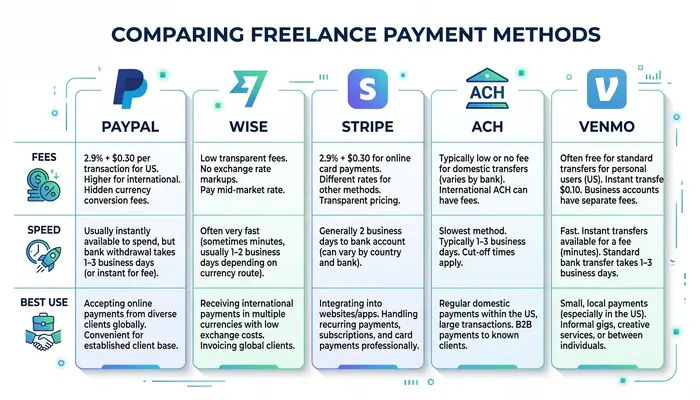
What are the best payment methods for freelancers in the USA? The best alternatives are PayPal (quick, very common), Wise (low overseas charges), Stripe (business invoicing), direct bank transfer via ACH (free, slower), and apps like Venmo or Cash App to send smaller sums of money. Select depending on the location of the clients, the speed of payments required, and tolerance of fees.
Why Your Payment Method Matters More Than You Think
Look, I get it. When you are a beginner freelancer, you are contemplating how to get clients, create a portfolio, o ando d the work itself.
Payment methods? That is kind of an afterthought.
However, this is what I discovered to my cost: the inappropriate payment system may cost you hundreds (or thousands) of money annually.
Why this is important: let me break it down:
The Hidden Cost of Payment Fees
Some freelancer payment platforms charge 3-5% per transaction. If you’re making $50,000 a year as a freelancer, that’s $1,500-$2,500 going straight to fees.
That’s not pocket change. That’s a new laptop, a vacation, or three months of groceries.
Speed Equals Cash Flow
However, in a one-person business, where you have to wait 5-7 days to get paid after a purchase, it can be fatal to your cash flow. I have months when I had 3000 pending payments but only 47 in my checking account.
Not fun.
Client Preferences Matter
There are certain ways that some clients will only pay. Methods of payment in foreign trade, international clients could want to use such ways of payment as Wise or Payoneer. Corporate clients tend to desire to make direct bank transfers.
In case you are not able to tolerate the way they want things to be, you may even end up losing the gig.
Tax Implications
Various payment methods have varied paper trails. Some simplify tax time, and others make it a nightmare of following and recording.
Believe me, you will be glad that you made the correct choice when you are in the future.
Top 10 Best Payment Methods for Freelancers in the USA
So what are your options? Let’s look at the complete landscape of freelance payment methods available in 2026.
Here’s my ranked list based on popularity, reliability, and overall value:
- PayPal – The most recognized name in online payments
- Wise (formerly TransferWise) – Best for international clients
- Stripe – Professional and developer-friendly
- Direct Bank Transfer (ACH) – Zero fees, trusted by corporations
- Venmo/Cash App – Perfect for quick, small payments
- Square – Great for in-person payments with a card reader
- Payoneer – Another solid international option
- Zelle – Bank-to-bank transfers, increasingly popular
- Check/Money Order – Old school but still used
- Cryptocurrency – Bitcoin, Ethereum for tech-savvy clients
Now let’s dive deep into each one.
PayPal: The Industry Standard for Freelancer Payments
Let’s start with the big one. PayPal has been around since 1998, and honestly, it’s still the most widely used freelancer payment option in the USA.
Why Freelancers Love PayPal
It’s everywhere. Nearly every client you work with will have a PayPal account. You can send an invoice in 2 minutes, and they can pay with a few clicks.
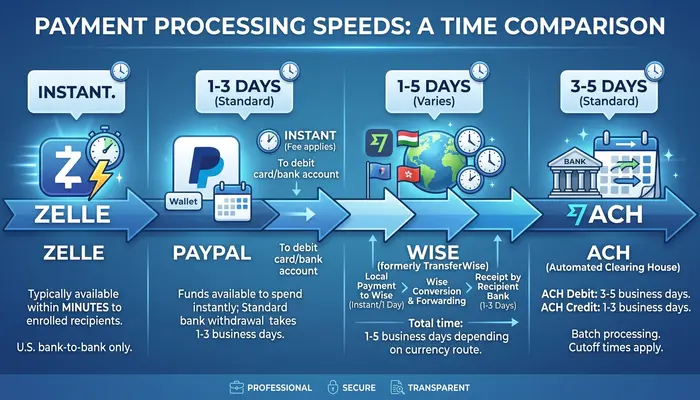
It’s fast. Payments typically show up instantly in your PayPal balance. You can transfer to your bank account within 1-3 business days (or instantly for a 1.5% fee).
It offers buyer and seller protection. If there’s a dispute, PayPal has systems in place to protect both parties.
PayPal Fees for Freelancers
Here’s where it gets less fun:
- Domestic payments: 2.9% + $0.30 per transaction
- International payments: 4.4% + fixed fee based on currency
- PayPal Goods & Services: Same as domestic
- Friends & Family: Free (but no protection, and against ToS for business)
So if a client pays you $1,000, you’ll receive $970.70 after fees.
Pro Tips for Using PayPal
✅ Send invoices through PayPal – They look professional and track automatically
✅ Link your bank account – Avoid keeping large balances in PayPal (they can freeze accounts)
✅ Use PayPal Business – Get access to better reporting and tax features
✅ Watch out for chargebacks – Deliver work through documented channels
When to Use PayPal
- One-time projects with new clients
- Clients who aren’t tech-savvy
- When you need payment NOW
- Small to medium-sized payments ($100-$5,000)
👉 Best Invoicing Software for Freelancers in the USA: Your 2024 Guide.
Wise (TransferWise): Best for International Freelance Work
Having clients with different backgrounds and working internationally, I would like to introduce you to your new best friend: Wise.
I only wish I had heard about this service in the beginning when I was starting to accept European and Australian clients. I lost thousands of dollars to bad exchange rates and excessively high international wire charges.
Why Wise Beats Traditional Banks for Freelancers
Real exchange rates. Banks and PayPal charge 3-5% hidden charges oforcurrency conversion. Wise uses the real mid-market exchange rate, as you can find on Google.
Low, transparent fees. The fee will be 0.5-2% based on the currency pair. That’s it. No hidden charges.
Multi-currency accounts. You are able to save money in 50 or more currencies and change between them when it is profitable to do so.
Wise Fees Breakdown
- USD to USD: Around 0.5-1%
- International transfers: 0.5-2% depending on currency
- Receiving payments: Often free or very low cost
- No monthly fees for personal accounts
For a $1,000 international payment from the UK, you might pay just $6-10 in fees versus $40-50 with a traditional bank or PayPal.
That’s a huge difference.
How Wise Works for Freelancers
- Create a free Wise Business account
- Get local bank details for USD, EUR, GBP, and more
- Give these details to your international clients
- They pay you like a local (no international wire fees on their end)
- You receive money in that currency or auto-convert to USD
Best Use Cases for Wise
- European, UK, Australian, or Canadian clients
- Regular international payments
- When you want to save on exchange rates
- Clients who prefer bank transfers over PayPal
👉 Wise’s official fee comparison page (https://wise.com) as an authoritative source.
Stripe: Professional Invoicing and Payment Processing
Stripe isn’t as household-famous as PayPal, but among professional freelancers and agencies? It’sthe gold standard.
Why Stripe Feels More Professional
When you send a Stripe invoice, it just looks more legitimate. The payment page is clean, modern, and trustworthy.
Plus, you can:
- Accept all major credit cards and debit cards
- Set up recurring payments for retainer clients
- Automate invoices and payment reminders
- Integrate with accounting software like QuickBooks or FreshBooks
Stripe Fees for Freelancers
- Online payments: 2.9% + $0.30 per transaction
- In-person payments: 2.7% + $0.05 (with Stripe Terminal)
- International cards: Additional 1.5%
Pretty similar to PayPal, but you get more professional features.
Stripe vs PayPal: Which Should You Choose?
Use Stripe if:
- You want to look more professional
- You need custom payment flows
- You’re building a website with payment integration
- You have retainer or subscription clients
Use PayPal if:
- You need the payment RIGHT NOW
- Client already has PayPal
- You’re doing small, one-off projects
Setting Up Stripe as a Freelancer
- Sign up at Stripe.com (takes 10 minutes)
- Verify your business info and bank account
- Create your first invoice or payment link
- Send to client
- Get paid directly to your bank account in 2-7 days
Beginner’s Note: Stripe might seem technical at first, but their Invoice feature is super simple. You don’t need to be a developer to use it.
Direct Bank Transfer (ACH): Free but Slower Option
Here’s the thing nobody tells you when you’re starting out: the cheapest payment method is often the old-fashioned bank transfer.
What is ACH Transfer?
ACH (Automated Clearing House) is how banks transfer money between accounts in the USA. It’s the same system used for direct deposit of paychecks.
Why Corporate Clients Love ACH
Big companies hate paying PayPal fees. When they’re paying you $5,000, they don’t want to spend an extra $150 on transaction fees.
So they’ll ask for your bank account details and initiate an ACH transfer.
Pros of Direct Bank Transfer
✅ Zero fees – Nobody takes a cut
✅ Professional – This is how “real” businesses pay each other
✅ Simple – Just provide routing and account number
✅ Trackable – Banks keep perfect records for taxes
Cons of Direct Bank Transfer
❌ Slow – Takes 3-5 business days usually
❌ Less convenient – Requires sharing bank details
❌ No dispute system – Unlike PayPal/Stripe protections
❌ Requires trust – Best for established client relationships
When to Use ACH Bank Transfers
- Large payments over $2,000 (fees really add up)
- Corporate or government clients
- Ongoing client relationships
- When you can wait a few days for payment
How to Request ACH Payment
Simply provide your client with:
- Bank name
- Routing number (9 digits)
- Account number
- Account type (checking/savings)
- Your business name exactly as it appears on the account
Common Mistake Warning: Never share your online banking login credentials. Only share routing and account numbers.
Venmo and Cash App: Quick Payments for Small Gigs
Let’s talk about the payment apps your friends use to split dinner bills. Can you use them for freelancing?
Yes. But with some caveats.
Venmo for Freelancers
Venmo is owned by PayPal and is wildly popular among younger Americans. It’s instant, social, and super easy to use.
Venmo Fees:
- Personal payments: Free
- Business payments: 1.9% + $0.10
- Instant transfer to bank: 1.75% (free standard transfer takes 1-3 days)
The Catch: Venmo is technically for personal payments between friends. Using it for business violates their terms of service, and they can freeze your account.
Cash App for Freelancers
Cash App (owned by Block, formerly Square) is similar to Venmo but slightly more business-friendly.
Cash App Fees:
- Personal payments: Free
- Business payments: 2.75%
- Instant transfer: 1.5% (free standard transfer)
Cash App offers a Business account option, which is more legitimate for freelancing.
When These Apps Make Sense
- Small gigs under $200 (quick logo design, short writing piece)
- Local clients you know personally
- Emergency quick payments when you need cash today
- Creative services for friends (but still get paid!)
When to AVOID Them
- Large payments over $500
- International clients
- Corporate clients (they’ll think you’re unprofessional)
- When you need detailed payment records for taxes
Pro Tip: If you’re going to use these apps, use the business version and keep excellent records. Take screenshots of every transaction.
Credit Card Payment Processing: Square and PayPal Card Readers
What if you’re a freelancer who meets clients in person? Maybe you’re a photographer doing event coverage, a hairstylist, or a personal trainer.
You need a way to accept credit card swiper payments on the spot.
Square Reader: The Freelancer’s Best Friend
I bought my first Square card reader in 2020 for $49. It’s paid for itself a thousand times over.
How Square Works:
- Order a card reader (free or $49 for a chip reader)
- Download the Square app
- Connect the reader to your phone via Bluetooth
- Swipe, dip, or tap the client’s card
- Money hits your account in 1-2 business days
Square Fees:
- Swiped/inserted/tapped: 2.6% + $0.10
- Keyed in manually: 3.5% + $0.15
- Invoices: 2.9% + $0.30
PayPal Zettle Card Reader
PayPal also offers a credit card swiper called Zettle (they bought it from iZettle).
Same concept as Square, similar fees (2.6% + $0.10 for card present).
When You Need a Card Reader
- In-person consultations
- Events and trade shows
- Client meetings
- On-site services (photography, training, repairs)
- Retail at craft fairs or markets
Square vs PayPal Zettle
Honestly? They’re nearly identical. Choose based on which ecosystem you already use.
If you’re already using PayPal for invoicing, get Zettle. If you’re starting fresh, Square has better reporting and point-of-sale features.
External Link Suggestion: Link to Square’s official site (https://squareup.com) for readers to explore hardware options
Cryptocurrency Payments: The Future of Freelancing?
Okay, I know what you’re thinking. “Crypto? Really? That’s for tech nerds and gamblers.”
But hear me out.
Why Some Freelancers Swear by Crypto
Near-zero international fees. Sending $10,000 from Australia to the USA costs maybe $2-5 in crypto. Traditional wire? $50-75.
Fast. Bitcoin can settle in 10 minutes. Ethereum in 2 minutes. Stablecoins even faster.
No middleman. Nobody can freeze your account or reverse the payment.
Privacy. Some clients prefer to pay this way for legitimate privacy reasons.
The Downsides (They’re Real)
❌ Volatility – Bitcoin can drop 5% while the transaction processes
❌ Complexity – You need a wallet and an understanding of security
❌ Tax nightmare – Crypto is taxed as property, creating complicated reporting
❌ Limited adoption – Most clients won’t even consider it
Best Crypto Options for Freelancers
- USDC or USDT (Stablecoins) – Pegged to the dollar, minimal volatility
- Bitcoin – Most widely accepted cryptocurrency
- Ethereum – Fast and well-established
How to Accept Crypto Payments
- Create a wallet (I recommend Coinbase for beginners)
- Get your wallet address for the cryptocurrency
- Share the address with the client
- They send payment
- You convert to USD immediately (to avoid volatility)
My Honest Take
Should you accept crypto? Only if:
- Your client specifically requests it
- You’re comfortable with the technology
- You’re willing to convert to USD immediately
- You work with international tech clients
For most freelancers? Stick with PayPal and Stripe for now.
Beginner’s Note: Don’t feel pressured to accept crypto just because it sounds cool. Focus on payment methods that work reliably for your specific situation.
Comparison Table: Fees, Speed, and Best Use Cases
Alright, let’s put all this information into an easy-to-scan format.
| Payment Method | Fees | Speed to Bank | Best For | International? |
|---|---|---|---|---|
| PayPal | 2.9% + $0.30 | 1-3 days (instant for 1.5%) | Quick payments, most clients | Yes (expensive) |
| Wise | 0.5-2% | 1-2 days | International clients | Yes (excellent) |
| Stripe | 2.9% + $0.30 | 2-7 days | Professional invoicing | Yes (fees apply) |
| ACH Bank Transfer | $0 | 3-5 days | Large payments, corporate | No |
| Venmo | 1.9% + $0.10 | 1-3 days (instant 1.75%) | Small gigs, friends | No |
| Cash App | 2.75% | 1-3 days (instant 1.5%) | Quick small payments | No |
| Square Reader | 2.6% + $0.10 | 1-2 days | In-person payments | No |
| Crypto (USDC) | ~1% | Immediate | Tech clients, international | Yes (excellent) |
| Zelle | $0 | Immediate | Trusted clients | No |
| Check | $0 | 5-10 days | Old-school clients | No |
Fee Comparison: $1,000 Payment
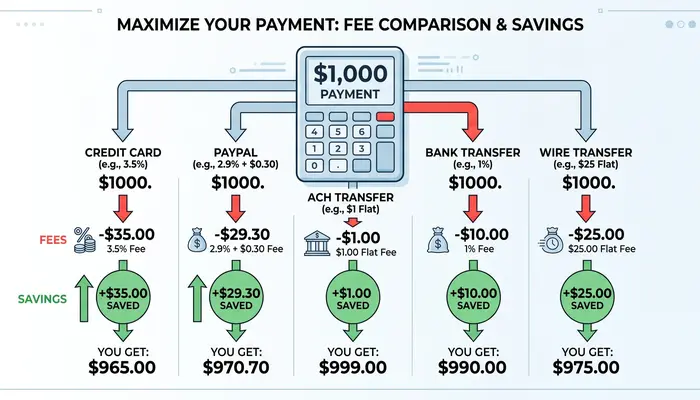
Let’s say you’re getting paid $1,000. Here’s what you actually receive:
- PayPal: $970.70
- Wise (international): $985-$995
- Stripe: $970.70
- ACH Transfer: $1,000.00
- Venmo Business: $980.90
- Cash App: $972.50
- Square (in-person): $973.90
- Crypto (USDC): $995-$998
- Zelle: $1,000.00
See the difference? On a $1,000 payment, choosing the right method can save you $25-30.
Do that 50 times a year, and you’ve saved $1,250-$1,500.
How to Choose the Right Payment Method for Your Business
So with all these options, how do you actually decide?
Let me walk you through my decision-making framework.
Step 1: Consider Your Client Location
US-based clients:
- First choice: ACH bank transfer (for large amounts)
- Second choice: PayPal or Stripe
- Third choice: Zelle or Venmo (small amounts)
International clients:
- First choice: Wise
- Second choice: Payoneer
- Third choice: PayPal (if they insist)
Step 2: Consider Payment Size
Under $100:
- Venmo, Cash App, or Zelle are fine
- Fees are minimal in dollar terms
$100-$2,000:
- PayPal or Stripe for convenience
- ACH if client offers it
Over $2,000:
- ALWAYS try for ACH first (save those fees!)
- Wise for international
- Stripe if you need a credit card option
Step 3: Consider Payment Speed
Need it today:
- PayPal with instant transfer
- Venmo/Cash App
- Zelle
Can wait 1-3 days:
- Standard PayPal
- Stripe
- Square
Can wait 5+ days:
- ACH bank transfer
- Checks
Step 4: Consider Your Industry
Creative services (design, writing, marketing):
- PayPal and Stripe work great
- Professional appearance matters
Tech/development:
- Stripe (integrates with GitHub, etc.)
- Crypto is more accepted here
Physical services (photography, training, events):
- Square reader for in-person
- PayPal for invoicing
Consulting:
- ACH for retainers
- Stripe for one-time projects
My Personal Payment Stack
Want to know what I actually use? Here’s my setup:
- Stripe for all invoicing (professional look, great records)
- Wise for my European clients
- ACH for my three biggest retainer clients (saves me $200/month in fees)
- PayPal as backup when clients insist
- Square reader in my bag for rare in-person situations
This combination gives me flexibility while minimizing fees.
Pro Tip: Don’t try to offer every payment method. Pick 2-3 that work for your client base and master them. Too many options create confusion.
Step-by-Step: Setting Up Your First Payment System
Let’s get practical. Here’s how to actually set this stuff up.
Setting Up PayPal (10 minutes)
Step 1: Go to PayPal.com and click “Sign Up”
Step 2: Choose “Business Account”
Step 3: Enter your business information:
- Business name (can be your personal name if sole proprietor)
- Business type
- Email address
- Phone number
Step 4: Connect your bank account:
- Click “Wallet”
- “Link a bank”
- Enter routing and account numbers
- Verify with micro-deposits (2-3 days)
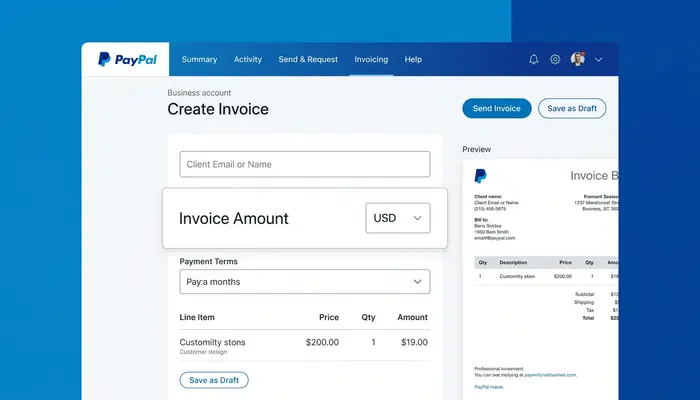
Step 5: Create your first invoice:
- Click “Send & Request”
- Choose “Create Invoice”
- Fill in client details, item description, and amount
- Send!
Done. You can now accept payments.
Setting Up Stripe (15 minutes)
Step 1: Go to Stripe.com and click “Start now”
Step 2: Enter your email and create a password
Step 3: Activate your account:
- Provide business details
- Tax ID (SSN for sole proprietors)
- Bank account information
- Confirm your phone number
Step 4: Create an invoice template:
- Go to “Invoices” in the dashboard
- Click “Create invoice”
- Add your logo (looks professional!)
- Set payment terms (due on receipt, net 15, net 30, etc.)
Step 5: Send your first invoice:
- Enter client email
- Add line items
- Set due date
- Send!
Stripe will email you when the client pays, and the money hits your bank automatically.
Setting Up Wise (20 minutes)
Step 1: Go to Wise.com and click “Register”
Step 2: Choose account type (Personal or Business)
Step 3: Verify your identity:
- Upload driver’s license or passport
- Take a selfie (for security)
Step 4: Get your multi-currency account details:
- Click “Open a balance”
- Choose currencies you need (USD, EUR, GBP, etc.)
- You’ll get local bank details for each
Step 5: Share these details with clients:
- They pay you as if you’re a local business
- No international wire fees on their end
- You receive money in that currency or convert to USD
Common Mistake Warning: Don’t skip the identity verification. Wise is a regulated financial institution and legally must verify all users. The process is safe and typically takes 1-2 business days.
Real-Life Case Study: How Sarah Tripled Her Income
There is a friend of mine whom I shall tell you. She is a free-lance graphic designer in Austin, Texas.
The Problem
As of 2023, Sarah made approximately 3,500/month working as a freelancer. Mediocre, not enough to comfortably pay rent, student loans, and savings.
Her biggest issues:
- Clients took 30-45 days to pay on average
- She was losing 3% to PayPal fees on every transaction
- International clients thought her rates were “too high”
She was doing great work but struggling financially.
The Breakthrough
Sarah came to a meet-up of freelancers and another designer mentioned Wise and ACH transfers. Either she had never heard of.
During the subsequent month, she had three changes:
Change 1: She began to give a 5 percent discount to the clients who would use ACH bank transfer payments rather than PayPal.
Outcome: Her three largest clients at once defected. She was able to save on PayPal charges (175/month), and clients were happy to feel that they were saving money.
Change 2: She installed Wise to make international payments and reduced her effective rate to Europeans by 15%.
Outcome: European customers believed that she offered them a discount (she only ceased to lose money to foreign currency exchange). In two months she had 4 new international clients.
Change 3: She began to use Stripe to do all the invoicing and to set automatic payment reminders.
Outcome: Her mean payment period was reduced to 12 days as compared to 35 days. Her financial difficulties were eliminated.
The Results (6 Months Later)
- Monthly income: $9,200 (up from $3,500)
- Average payment time: 10-14 days (down from 35)
- Payment fees: 1.2% of revenue (down from 3%)
- International clients: 40% of business (up from 0%)
Sarah didn’t change her design skills at all. She just optimized how freelancers get paid.
That’s the power of choosing the right freelance payment systems.
Key Takeaway: The payment method you choose directly impacts your income, not just your expenses.
Common Payment Mistakes Freelancers Make (And How to Avoid Them)
I would like to tell you about some of my painful lessons (as well as some of the errors that I observe among freelancers all the time).
Error #1: Only one method of payment.
Why it is bad: You lose customers who would like to use other approaches, in particular, international ones.
Solution: Have no less than 2-3 choices. I will accept PayPal, Stripe, or bank deposit.
Error #2: Failure to include Fees in your Rates.
Why it is bad: When you charge a project at $500 and PayPal, you actually earn 485.50. You cut your pay by 3 per cent.
Resolution: You can either include the fees in your charge or charge your clients an extra 3 percent when they are making payments using PayPal/credit card. There are numerous freelancers who give $500 via bank, or 515 via PayPal.
Error #3: Having Large Balances in PayPal.
Why it is bad: PayPal has the ability to lock up your account without much notice. I have witnessed freelancers without access to $10,000+ weeks.
Solution: At least once a week transfer to your bank account. Do NOT use PayPal as a savings account.
Error #4: Failing to Read Payment terms.
Why it is harmful: There are certain platforms (such as Venmo) that are literally forbidding business. Their use may have your account banned forever.
Discussion: It is advisable to always use the business version of payment apps, although the cost may be a little higher.
Error #5: Sharing Banking Password.
Why it is bad: When a client requests you to provide her with your online banking password so that she can establish payment, that is a gigantic red flag. It is either a scam or they are not knowledgeableaboutf what they are doing.
Solution: Use ONLY share routing number and account number. No passwords, security questions, or ATM PIN.
Mistake #:6 Not to Document Payments.
Why it is bad: Tax time is a nightmare. Without records,ds you can not prove income.
Solution: Pay with automated solutions (PayPal, Stripe, and others) OR create a basic spreadsheet with all of the payments recorded: date, client, amount, method.
Error # 7: Good Enough is Accepting “Payment Pending.
Why it is bad: There are clients that claim that they sent the payment, but they are in limbo. You perform, and then the payment defaults.
Remedy: Do not deliver final files until you find that payment has indeed cleared your account. “Pending” doesn’t count.
Error #8: Not paying attention to Currency Conversion Rates.
Why it is bad: PayPal charges an extra 3- 4% for currency conversion on all foreign transactions. On a $2,000 payment, that’s $60-80 down the drain.
Resolution: Pay with Wise when doing international payments or pay directly in USD.
Expert Tips to Get Paid Faster (Real Freelancer Secrets)
Wish to find out how experienced freelancers receive their payments fast and with confidence? The following are insider strategies.
Tip #1: Offer Multiple Payment Options, But Guide Toward Your Favorite
On your invoice, you should have such options:
“Payment options:
- ✅ Bank Transfer (Preferred) – Account details below
- PayPal – email@example.com
- Stripe – Pay invoice link”
The “preferred” label nudges clients toward your zero-fee option without forcing it.
Tip #2: Use Payment Milestones for Large Projects
For projects over $2,000, split into milestones:
- 50% upfront before starting
- 25% at midpoint
- 25% upon completion
This protects both you and the client AND improves your cash flow dramatically.
Tip #3: Set Up Automatic Late Payment Reminders
Both Stripe and PayPal have automatic reminders for 3 days overdue, 7 days overdu,e etc.
An automatic timer. You need not play the bad guy by hand.
Tip #4: Add Payment Terms to Every Contract
Add such a clause as:
“The payment should be made within 7 days of the invoice date. Late payments (after 14 days) will be subject to a 5 percent late fee.
The late fee will hardly be enforced on a regular basis, but it is an indication of professionalism.
Tip #5: Create a “Fast Pay” Discount
Pay within 24 hours and get 3% off your invoice.
This is faster and more cost-effective to use and can save you money (you are not paying 3% to PayPal).
Tip #6: Use Instant Transfer for Emergencies Only
PayPal or any other service will cost 1.5% for an immediate transfer to your bank. That’s expensive.
It should only be used when you require cash urgently. Otherwise, allow 1-3 days.
Tip #7: Keep a “Payment Received” Email Template
Develop a prototype such as:
“Hi [Client Name],
Payment received! Thank you. I have begun to work on [project], and you will receive [deliverable] by [date].
I am looking forward to collaborating with you!
[Your name”
This confirms acceptance of payment AND establishes terms of delivery. Professional and efficient.
Tip #8: Build Relationships with Reliable-Paying Clients
The following is the truth: 20 percent of your customers will give 80 percent of your earnings. Concentrate on acquiring and retaining fast and reliable clients.
I would also prefer to have three clients, who pay me at a rate of 2,000/month through ACH on the first day of every month than twenty clients who pay me at a rate of 300 every now and then.
Pro Tip: Once you have worked successfully 3-4 times with a client, inquire whether they would want to have a retainer agreement or not. The holy grail of income stability among freelancers is retainers.
Frequently Asked Questions (FAQ)
What is the best payment method for freelancers in the USA?
What is the most appropriate payment plan is determined by what is going on with you, and for the majority oe freelancers in the US, Stripe or PayPal provides the most convenient, fast, and acceptable payment for clients. Wise is the most likely to provide the lowest fees when working internationally. In the case of big corporate clients, fees are completely removed by using ACH bank transfer.
How do freelancers get paid quickly?
To receive payment immediately as a freelancer: (1) Use instant payment systems such as PayPal or Zelle, (2) send out invoices immediately after work completion, (3) offer small discounts to receive prompt payment, (4) set up automatic payment notification, (5) have contracts specifying the terms of payment, and (6) request partial upfront payment before undertaking large projects.
What are the cheapest payment methods for freelancers?
ACH bank transfer and Zelle (both free), and then Wise (international payment 0.5-2 percent fees) are the cheapest methods of payment. The credit card processing companies such as PayPal and Stripe have charges of 2.9% + 0.30, which is understandable concerning the convenience but becomes expensive when making big payments.
Can I use Venmo for freelance work?
Technically, the Terms of Service of Venmo imply that it is not designed to transact business transactions, but they do provide a Venmo Business profile that can transact business transactions at the cost ofa 1.9% fee. To be professional and to keep tax records, it is preferable to use PayPal Business or Stripe and other websites that are specialized in paying freelancers.
How much do payment processors charge freelancers?
Standard payment processing fees for freelancers are: PayPal (2.9% + $0.30), Stripe (2.9% + $0.30), Square (2.6% + $0.10 for in-person), Wise (0.5-2% for international), Venmo Business (1.9% + $0.10), and ACH/Zelle (free). These charges should be included in your prices.
What payment method do international clients prefer?
The commonly used services among international clients are Wise (TransferWise) or Payoneer since both services provide local bank accounts in various countries, which saves them costly international wire transfer charges. PayPal is also well-established on an international scale but with higher fees (4.4%+) of cross-border payments.
Should freelancers accept cryptocurrency payments?
To accept cryptocurrency, freelancers must only accept it when: (1) The client asks them to, (2) You are comfortable with the technology and taxation, (3) You use stablecoins such as USDC to avoid volatility, and (4) You convert it to USD upon receipt. In the case of the majority of freelancers, the conventional payment method is more feasible.
How can I avoid PayPal fees as a freelancer?
To reduce or eliminate PayPal charges: (1) Ask clients to send money via ACH transfer (free), (2) ask clients to send money via PayPal Friends and Family (high risk, against ToS to use with business), (3) ask clients to pay the fee, (4) charge the fee to customers, or (5) use other services with lower charges such as Wise to transfer money internationally.
Do freelancers need a business bank account to accept payments?
No, freelancers do not necessarily have to legally open a business bank account in order to receive payments, particularly when they are a sole proprietor. A personal checking account is fine with PayPal, Stripe, ACH transfers, and most payment options. But a business account is more organized, has different funds to pay taxes, and it will look more professional.
What’s the fastest way to receive freelance payments?
Zelle (instant), PayPal with instant transfer (immediate with a 1.5% fee), Venmo instant transfer (immediate with a 1.75% fee) and Cash App instant deposit (immediate with a 1.5% fee) are the fastest ways to send and receive money. In the case of free options, ACH transfers require 3-5 days, and PayPal typically takesl 1-3 days.
Final Thoughts: Choose Wisely, Get Paid Well
Here, here is what I want you to remember from this guide:
Your payment method matters. It affects your income, your cash flow, your professional image, and your stress levels.
You do not have to employ all the methods that I have mentioned here. In fact, please don’t. Select 2-3 which are good with your particular client base and learn them.
For most freelancers starting out, I recommend:
- Stripe or PayPal for general invoicing
- Wise if you have any international clients
- ACH bank transfer as an option for your biggest clients
That simple combination will cover 95% of situations.
You can incorporate additional options as you develop. Perhaps a Square reader when out and about. Perhaps Bitcoin with technology customers. Perhaps Payoneer in case of a particular marketplace abroad.
But start simple. Get those initial systems installed. Instead, concentrate on what is important: doing great work and finding great clients.
The most appropriate way of payment in the world will not assist you unless you have customers to pay. Especially when you have the work, it becomes just that much easier to be paid cheaply and cheaply.
Looking to talk about what payment is best in your particular case? Write a comment in the comments box. I read and answer each and every one.
We now have to establish those payment accounts and begin to earn what you deserve!
📌 SHARE THIS GUIDE
In case you have found this guide useful, you can refer a friend or a colleague who would like to begin his/her path in freelancing or online income.
The appropriate payment system can transform the financial life of a person literally. I only wish that someone would have explained all this to me when I was beginning. It would have saved me thousands of dollars, as well as countless headaches.
Post it on your social, send it via a text to a freelancing acquaintance, or save it as a bookmark when you will require to keep a record of certain charges and establishment guidelines.
With your support, we will be able to empower more individuals to have sustainable and profitable freelance professions.
About This Guide
This comprehensive guide covers the best payment methods for freelancers in USA for 2026, including detailed fee comparisons, setup instructions, and real-world case studies. Whether you’re looking for freelancer payment options, trying to understand how freelancers get paid, or comparing freelance payment systems, this guide provides actionable advice for maximizing your income and minimizing fees.
Subjects included: PayPal as a freelancer, Wise as a global payment, Stripe as an invoicing payment, ACH bank transfers, credit card payments with Square, Venmo and Cash App as small payments, cryptocurrency, and tips from experts on how to receive faster payments.