
Introduction: Your Journey to Creating Smart Digital Products Starts Here
Have you ever browsed Etsy or Shopify and asked yourself, “Why do people make money selling things that they made in their laptops?
The fact is the following: we are in the era of the golden age of the digital products. And now with AI? It is as though somebody bestowed upon you a superpower.
I recall a case when my friend Sarah (a high school teacher who is zero tech) earned her first 1000 dollars selling coloring books that were created by AI. With her eyes full of tears she said to me, I made this in THREE HOURS.
This is what becoming knowledgeable about how to develop AI-powered digital products can do to you.
You may be a college student and need a source of side income, a stay-at-home parent looking to create something to do at home, or simply sick and tired of the 9-to-5 grind, this guide will reveal to you how, in fact, you can make AI-powered digital products that people actually want to purchase.
No coding required. No university diploma required. Only you, a bit of creativity and the AI tools that I am about to demonstrate.
Quick Answer: What Are AI-Powered Digital Products?
Ai-based digital products can be downloaded and are products that are developed or optimized with the help of artificial intelligence technologies. These are ebooks, templates, graphics, courses, planners, etc which you can sell at such places as Shopify, Etsy or Gumroad. The AI will do the heavy lifting (design, writing, coding), whereas you can be creative and market. Average creators get to earn between $500 and 5,000 a month in the sale of such digital downloads.
Why AI-Powered Digital Products Are the Future (And Why You Should Start NOW)
Being straightforward with you.
The online market of products is booming. Statista says that by 2025 the industry will be a $331 billion industry. It is interesting here though.
AI has entirely drawn the line at the same level.
There is no need to be a graphic designer in order to make beautiful templates. You do not necessarily have to be a writer in order to publish an ebook. and you certainly do not have to have a business degree to be able to set up an ecommerce business selling ready-to-sell products.
The Three Big Advantages
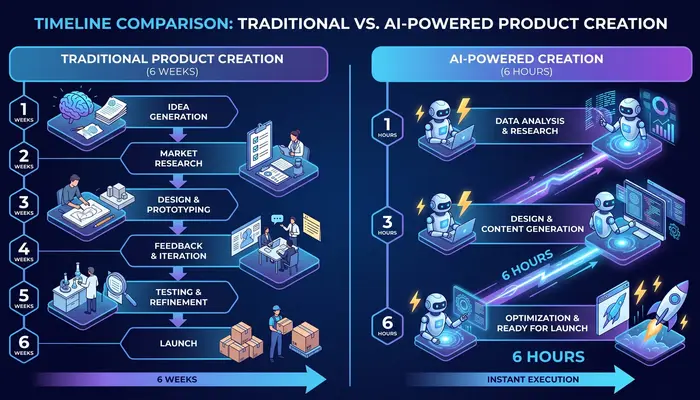
Saving Time: What once took weeks to do, is done in hours. I have witnessed individuals to develop complete lines of products within a weekend.
Minimal Starting costs: Forget about inventory, warehouses or manufacturing. Your startup cost? Perhaps $50 on the software subscriptions.
Passive Income Potential: Once it is created sell it forever. And, as you are sleeping, your digital downloads are earning you money.
Best Digital Product Ideas You Can Create with AI (Even This Weekend)
The super simple list of the best digital product ideas you can develop with AI (Even This Weekend)
Well, what can you make?
Well, there are limitless possibilities. However, here are the hot ideas of digital products that are selling hotcakes at the moment.
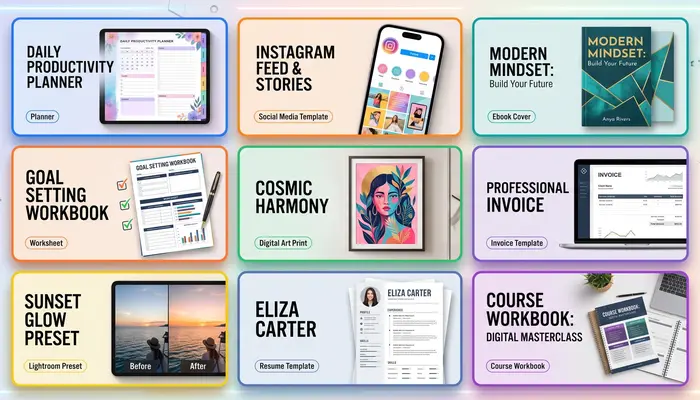
Top 10 AI-Powered Digital Product Ideas
These can be used to print off the planners and journals.
AI is able to come up with beautiful designs in minutes. Wed-planners, exercise magazines, budget books – these are popular.
- Social Media Templates
Each company will require Instagram posts, Facebook cover, and Pinterest pins. Canva who? AI is able to make complete template packs.
- Ebooks and Guides
Write ChatGPT or Claude, use Midjourney to write covers. One of my friends sells gardening manuals at a price of $17 each.
- Educational Worksheets
Homeschool parents and teachers are on the hunt to find good resources. Math workbook, reading comprehension, science projects.
- Digital Art and Wallpapers.
Cell phone wallpapers, desktop pictures, printable art. No effort, maximum demand.
- Business Templates
Invoice templates, propositions, email templates. Professional-appearing templates will fetch good money to business owners.
- preset and filters in photography.
Being able to develop Lightroom presets that photographers and influencers require is possible with the help of AI.
- resume and CV templates.
Job seekers will never be out of need of assistance in order to stand out. ATS friendly resumes templates are popular to sell.
- Web Themes and Web components
With some knowledge of a code, AI can assist you to make WordPress themes or elements of a site.
- Online Course Materials
Presentation slides, workbooks, cheats. There is no slowdown of online learning boom.
Essential AI Tools for Product Design and Development
Here the magic is wrought.
They are your new best friends. I have personally tried dozens of sites and these are those sites that will provide.
The Ultimate AI Toolkit for Digital Product Creators
| Tool Category | Best AI Tools | Price Range | Best For |
|---|---|---|---|
| Text Generation | ChatGPT, Claude, Jasper | $0-$20/mo | Ebooks, guides, course content |
| Graphic Design | Midjourney, DALL-E, Canva AI | $10-$30/mo | Templates, art, social media |
| Product Design | Figma AI, Adobe Firefly | $12-$55/mo | Professional design work |
| Video Creation | Synthesia, Pictory | $30-$60/mo | Video courses, tutorials |
| Audio/Voice | ElevenLabs, Descript | $5-$30/mo | Audiobooks, podcasts |
| Code Generation | GitHub Copilot, Replit | $10-$20/mo | Website themes, apps |
My Top 3 Must-Have Tools
ChatGPT Plus (20/month): This cannot be compromised. I apply it to brainstorming, writing an ebook, or, even, creating questions to be put on the quiz.
Midjourney (10/month): To make beautiful images. Covers of books, designs of planners, social media graphics, and so on, it does everything.
Canva Pro ($13/month): The artificially intelligent capabilities are astounding. Background eraser, artificial intelligence-generated images, resizing of templates. The secret weapon of product designer.
Note: These tools have free versions to begin with. After earning your initial 100, then invest in paid subscriptions. Put not the cart before the horse.
👉 Shopify’s official guide on selling digital products (high authority, relevant)
Step-by-Step: How to Create AI-Powered Digital Products (The Complete Blueprint)
This is enough, now we may get down to nitty-gritty.
This is the very process that I teach my students and it is effective regardless of whether it is your first product or the 50 th.
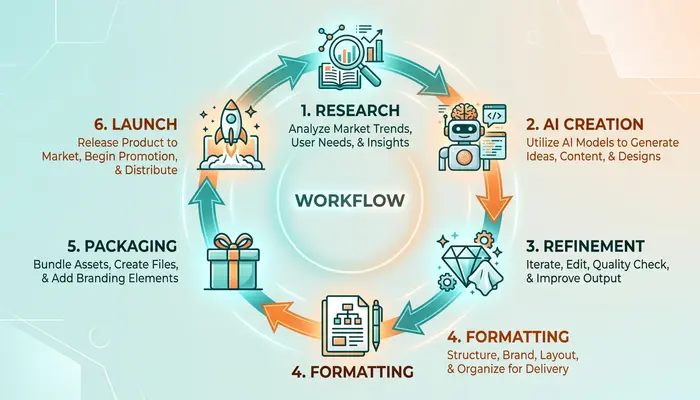
Phase 1: Research and Planning (Days 1-2)
Step 1: Niche to Find.
Don’t attempt to please everybody. Choose a particular audience.
Rather than planners, consider it as wedding planning workbooks to budget conscious brides. See the difference?
Apply these methods of research:
- Browse best-sellers on Etsy in the digital downloads category
- Check Amazon’s bestselling ebook categories
- Search Pinterest for trending topics
- Look at what’s popular on Creative Market
Step 2: Validate Your Idea
Before creating anything, make sure people want it.
Here’s a quick validation checklist:
- Are people searching for it? (Check Google Trends)
- Are competitors selling similar products? (Good sign!)
- Are there reviews and ratings? (Shows demand)
- Can you add something unique? (Your AI advantage)
Step 3: Analyze Your Competition
Look at the top 5 products similar to yours. Note:
- Their pricing
- What customers love (read reviews)
- What customers complain about (your opportunity)
- Design style and quality
- Number of pages/components
Beginner’s Note: Don’t let perfect competitors scare you. Competition means there’s a market. No competition might mean there’s no demand.
Phase 2: Creation (Days 3-5)
Step 4: Create Your Content with AI
Let’s say you’re creating a “Budget Planner for College Students.”
Here’s how I’d use AI:
For Written Content:
textPrompt to ChatGPT: "Create a comprehensive budget planner for college
students. Include monthly expense categories, savings goal trackers,
and financial tips. Make it friendly and non-preachy."
For Design Elements:
textPrompt to Midjourney: "Modern minimalist budget planner page layout,
pastel colors, clean lines, college-friendly aesthetic, organized
sections, professional but fun --ar 3:4"
Step 5: Refine and Customize
This is where you add YOUR touch.
AI gives you 80% of the way there. The final 20% is what makes it special:
- Adjust colors to match current trends
- Add personal tips or examples
- Check for errors (AI isn’t perfect)
- Ensure consistency across all pages
- Make it user-friendly
Step 6: Format for Delivery
Different products need different formats:
- Printables: High-res PDF (300 DPI minimum)
- Ebooks: PDF or ePub format
- Templates: Native format (Canva template, Google Sheets, etc.)
- Graphics: PNG with transparent background or JPG
- Courses: Video files (MP4) plus PDF workbooks
Common Mistake: Forgetting to test your files! Download them, try to use them like a customer would. I once sold 50 copies of a planner before realizing one page wouldn’t print correctly. Embarrassing.
👉 Etsy’s seller handbook for credibility on best practices.
Phase 3: Packaging and Presentation (Day 6)
Step 7: Create Irresistible Product Mockups
People buy with their eyes first.
Use these tools for mockups:
- Placeit.net (easiest for beginners)
- Smartmockups.com (great variety)
- Canva templates (budget-friendly)
Step 8: Write Compelling Product Descriptions
Your description should answer:
- What exactly is included?
- How will it help the customer?
- What format is it in?
- What do they need to use it?
Here’s a template that works:
text[Emotional Hook]
Struggling with [problem]? This [product] makes [desired outcome]
ridiculously easy.

[What's Included - Bullet Points]
✓ Item 1
✓ Item 2
✓ Item 3

[How It Helps]
Perfect for [ideal customer] who wants to [goal] without [pain point].

[Technical Details]
Format: [file type]
Pages: [number]
Includes: [bonus items]

[Guarantee/Trust Element]
Instant download. No waiting. 30-day satisfaction guarantee.
Choosing the Best eCommerce Platform for Small Business Owners
Your product now you have. In which places do you sell it?
This is when majority of the beginners become overwhelmed. So many options!
Break it down, sir, depending on your circumstances.
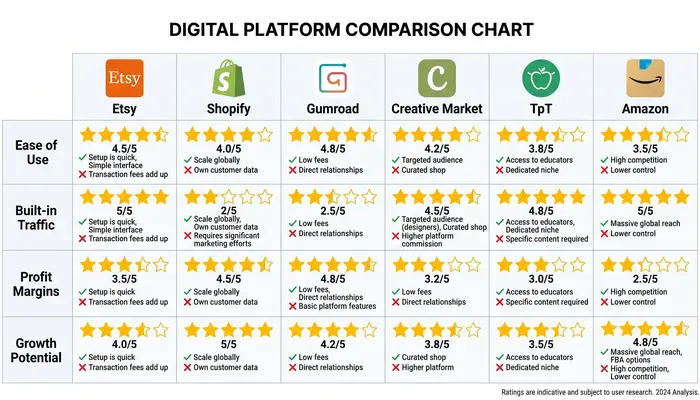
Platform Comparison: Where Should YOU Sell?
| Platform | Best For | Monthly Fees | Transaction Fees | Ease of Use | Traffic |
|---|---|---|---|---|---|
| Etsy | Beginners | $0 + $0.20/listing | 6.5% | Very Easy | Built-in HIGH |
| Shopify | Serious sellers | $29+ | 2.9% + $0.30 | Medium | You drive it |
| Gumroad | Simple setup | $0 (Free tier) | 10% (free) / 3.5% (paid) | Very Easy | You drive it |
| Creative Market | Designers | $0 | 30% commission | Easy | Built-in MEDIUM |
| Teachable | Courses only | $39+ | 5% (free tier) | Medium | You drive it |
| SendOwl | Digital only | $9+ | $0 | Medium | You drive it |
My Honest Recommendations
In case you are new: Use Etsy or Gumroad.
Etsy is the most suitable e-commerce site to start on as a small business due to its millions of customers already browsing through it seeking digital downloads. You do not have to begin at the beginning.
My initial sale in Etsy took place in 48 hours of posting. On Shopify? Three weeks and 200 in advertisements.
In case you desire to create a brand: Shopify prevails.
Yes, it costs more. However, you are the owner of your customer data, everything can be customized and you are creating something that can be sold (most business-for-sale listings in ecommerce are Shopify stores).
The Shopify Buy Button is brilliant – it allows adding to your blog or Instagram and sell without sending the customers away.
In case of selling courses: Teachable or Thinkific.
They deal with video hosting, management of students and certificates. Worth the investment.
Pro Tip: Get started on Etsy to test your product. When you are selling frequently, grow to your own Shopify store. This is the route of the most successful sellers.
👉 Statista’s digital market research to support market size claims.
Websites Like Etsy: Alternative Marketplaces for Digital Downloads
Don’t put all the eggs in the same basket.
The most intelligent designers of products that I know sell in many platforms. It is referred to as diversification and it cushions your income.
Top Websites Like Etsy for Digital Products
1. Creative Market
Ideal when it comes to design oriented products (fonts, graphics, templates). Better quality customers and those who are ready to pay high prices. Here I sell the templates of websites at 45-79 a piece.
2. Design Bundles
Best with craft oriented online products. SVG files, pattern. The marketplace appeals to Cricut users and crafters that have money to spend.
3. Teachers Pay Teachers
This is GOLD especially when you are developing some teaching materials. Educators are on the hunt to find worksheets, lesson plans, and classroom materials. Here, my friend sells science worksheets at the rate of 2,000/month.
4. Envato Elements
You post it once, and have royalties continuously. Not as profitable on a per sale basis but it is indeed passive. I had 50 items 2 years ago and continue to receive monthly payments.
5. Amazon KDP (for ebooks and planners)
Novels are not the only novels that Kindle Direct Publishing takes. Books of low content (journals, planners, notebooks) are selling so well. Amazon has a reach that is unparalleled, as well.
6. Payhip
Super beginner-friendly. Free listing, user-friendly interface, in-built email marketing. Superb in case you are selling to your current audience.
Multi-Platform Strategy That Works
Here’s what I do (and teach):
Tier 1 (Primary): Etsy (60% of effort)
Tier 2 (Secondary): Shopify store (30% of effort)
Tier 3 (Passive): Creative Market, Design Bundles, Envato (10% of effort)
This way, one algorithm change or policy update won’t kill your income.
👉 AI Side Hustles That Pay Weekly in USA: 17 Real Ways to Earn $500-$5000/Month.
Pricing Strategies That Actually Work (Without Underselling Yourself)
Let’s talk money.
This is the main point where the beginners fail. They charge insanely low or insanely high (racing to the bottom or no sales).
The Goldilocks Pricing Formula
Here’s how to price your digital products:
Step 1: Calculate Your “Should Be” Price
Add up:
- Time invested (hours × your desired hourly rate)
- Tool costs (AI subscriptions, software)
- Desired profit margin (at least 70%)
Divide by expected sales in first month.
Example:
- 5 hours of work × $30/hour = $150
- Tools cost: $20
- Total: $170
- Expected first-month sales: 20
- Base price: $8.50
But wait…
Step 2: Research Competitor Pricing
Look at your top 5 competitors. What’s their range?
If they’re selling similar planners for $12-$25, and you calculated $8.50, you can safely price at $15-$18.
Step 3: Add Perceived Value
Here’s the secret: bundle and tier.
Instead of selling one planner for $12:
- Basic: Single planner – $12
- Deluxe: Planner + tracker + bonus checklist – $24
- Ultimate: Everything + video tutorial + templates – $47
Suddenly your average order value jumps.
Psychological Pricing Tricks
Charm Pricing: $17 sells better than $20 (studies prove it)
Anchor Pricing: Show a “regular price” of $29, sale price $17
Bundle Discounts: “Buy 3, get 40% off” (increases cart value)
Common Mistake: Pricing too low to “be competitive.” You’re not Walmart. You’re selling a solution, not a commodity. I doubled my prices and sales went UP because people perceived higher value.
👉 How to Get Clients on Upwork in the USA: The Complete Beginner’s Guide That Actually Works.
Real-Life Case Study: From Zero to $3,000 Monthly (The Sarah Story)
Keep in mind Sarah at first?
I will recount to you her whole story as it is so inspirational.
Month 1: The Shaky Start
Sarah decided to create printable coloring books for adults (stress-relief themed). She used:
- ChatGPT to research trending themes
- Midjourney to generate the coloring page designs
- Canva to compile everything into a PDF
Total creation time: 6 hours spread over one weekend.
She listed on Etsy for $4.99 (too cheap, but she was scared).
Results:
- 13 sales
- $64.87 revenue
- Dozens of 5-star reviews
The reviews said: “This is amazing! Do you have more?”
Month 2: The Expansion
Sarah created 5 more themed coloring books. But this time:
- Raised price to $7.99
- Created bundles at $19.99
- Added mockup photos showing the pages
- Improved her SEO keywords
Results:
- 47 individual sales
- 12 bundle sales
- $615.12 revenue
Month 3-4: The Momentum
She started using her reviews as market research. People kept asking for journals, so she created:
- Gratitude journals with prompts
- Anxiety relief workbooks
- Mindfulness planners
All created using AI. She got faster – now creating a product in 3-4 hours.
She also expanded to Creative Market and her own Shopify store using the Shopify Buy Button on Instagram.
Results Month 4:
- $1,847 revenue
- 156 total sales
- Added to her email list: 89 subscribers
Month 6: The Breakthrough
By now Sarah had 23 products listed. The older ones kept selling (passive income!).
She reinvested profits into:
- Professional product photography ($150)
- Paid Etsy ads ($100/month)
- A VA to handle customer service ($200/month)
Results:
- $3,240 revenue
- 287 sales
- Started getting wholesale inquiries
What Sarah Did Right
- Started small – One product, validated the market
- Listened to customers – Let reviews guide product development
- Improved gradually – Each product was better than the last
- Diversified platforms – Not dependent on one income source
- Reinvested profits – Grew the business systematically
She still teaches full-time. This is her side income. And it all started with learning how to create AI-powered digital products.
Common Mistakes to Avoid (Learn From Others’ Pain)
I will spare you some of headaches.
These are the errors that I observe all the time (and not to mention that I have done the majority of them myself).
The Top 10 Digital Product Disasters
In the first step, you can develop products that no one desires.
Simply because you believe it to be cool, does not imply that customers do. Always validate first.
- Overcomplicating Things
Your initial product does not necessarily have to be 100 pages. Start simple. A 10-page planner which addresses a single issue is better than a 100-page mess.
- Ignoring SEO
Keywords are all everything on Etsy in particular. Make use of all the 13 tag spots. Investigate what people really query.
- Poor File Quality
Pixellated PDFs, improper page size, unprintable files, etc. – these will kill your reputation in no time.
- No Branding Consistency
When you want to be serious about this, ensure that the colors, fonts and style are similar across products. It builds trust.
- Without Remembering the Customer Experience.
Add straightforward instruction manual. Instruct them on the things to expect. Ask questions prior to them asking.
- Not Building an Email List.
This is leaving cash inexplicable. Although you may sell on Etsy, refer them to your site so they can get their email address to make purchases in the future.
- Quitting Prematurely.
The first month can be a sluggish month. That’s normal. The Etsy SEO will need 2-3 months to take effect. Shopify is even more time-consuming. Patience.
- Copying Competitors Exactly
Inspiration is fine. Any copying will result in banning and even being sued. Always make your spin.
- Not Reinvesting Profits
The initial $500 is to go back in the business. More efficient tools, sponsored advertising, photos of the products. Don’t purchase a new television.
Expert Tips from Successful Product Designers (The Insider Secrets)
I interviewed five individuals with incomes of $5,000 and above per month, based on digital products.
The following are their tips:
Hint 1: “Batches, Drip Release, Marcus, $7, 200/month.
I release a product every week, but I make 5-6 products every weekend to keep my shop active in terms of algorithm and to have a constant flow of launch hype.
Tips 2: “Spy on Reviews, Not Products” Jennifer, $5,800/month.
“I read 3-star reviews of the competitors. They give you just the answer of what is wrong or annoying. And then I make a product that addresses those issues. Instant benefit.
Hint number 3: Niche Down Ridiculously – Tom, $6,100/month.
Sell not a budget planner, sell a budget planner to nurses with student loan debt to pay, the more specific you get, the better. I only sell ONLY to truck drivers. weird niche, no competition, rabid customers.
Note: Aisha is a video mockup company that promises 3 times the better conversion, Aisha, $9,400/month.
I began to insert 10-second video previews of flipping pages or the product in action and sales skyrocketed. People are able to see what they are getting.
TIP 5: “Make Improvements to current consumers” David, 5200/month.
I make an expansion pack to my bestselling products every 3 months, which helps the previous customers to return and get another one as they already like the first one.
My Pro Tip: Become a part of Facebook groups of your target audience. Not to pester them, not to pester, but to listen. The questions they put are the same? Those are products that are awaiting to be developed.
Legal Stuff You Need to Know (Boring but Important)
Quick legal crash course.
I’m not a lawyer, so definitely consult one if you’re doing anything complex. But here are the basics:
Copyright and AI Content
The tricky part: AI-generated content exists in a legal gray area.
Current understanding (2024):
- You CAN sell AI-generated products
- You CAN’T claim full copyright on purely AI work in some jurisdictions
- You SHOULD add human editing/customization (which gives you stronger rights)
- You MUST check each AI tool’s commercial use terms
Best Practice: Always significantly edit and customize AI outputs. This protects you legally and makes better products anyway.
Commercial Use Licenses
Make sure your tools allow commercial use:
- ChatGPT: ✅ You own the output (per their terms)
- Midjourney: ✅ Commercial use with paid plan
- DALL-E: ✅ You own the images
- Canva: ⚠️ Some elements require licensing
Common Mistake: Using fonts or graphics that aren’t commercially licensed. Always check.
Business Registration
You’ll need to:
- Get a business license (requirements vary by state)
- Collect sales tax in states where applicable (Etsy helps with this)
- Report income on your taxes (keep records!)
- Consider an LLC for liability protection (optional but recommended once you’re making real money)
Beginner’s Note: Don’t let this paralyze you. Start selling, and handle legal stuff as you grow. Millions of Etsy sellers started without LLCs.
FAQ: Your Questions Answered
Q1: What is the amount of money that I will require to begin developing AI-powered digital products?
Honestly? The initial amount you can use is 0 with the help of free AI tools (ChatGPT free tier, Canva free). However, I suggest that you spend at least $30-50 during the first month to purchase more quality AI tools and post on sites. That’s it. No stock and no warehouse, no massive investment.
Q2: What is your duration to make your first digital product?
To make a full beginner according to this guide: 6-12 hours to make your first product. With time to become familiar with the AI tools and process, you will be making products in 3-4 hours. I have sellers who, within less than an hour, do simple template batches.
Q3: Do I have to be aware of how to code or design?
Absolutely not! The point of utilizing AI is that. I have taught old ladies in their 60s and high school dropouts. Provided that you are able to use Facebook, you will be able to develop AI-powered digital products. Technical stuff is dealt with by the AI.
Q4: What is the most excellent digital product concept to beginners?
Begin with printable planners, worksheets or templates. They are easy to make, are always needed and can be priced easily. Keep it simple, don’t develop complicated products such as full courses or software until you know the market better.
Q5: Would I be able to earn passive income in case of digital downloads?
Yes and no. It is passive in that you do it once and sell many times without having to replenish it. However, you will have to market and do listings optimization, customer questions, and develop new products periodically. It is more of low-Maintenance Revenue than passive.
Q6: Etsy or Shopify- Which one is better to start with?
Etsy, hands down. In-built traffic, cheaper, less complicated to set up. Begin with that, test your products and then when you are getting regular sales, go to Shopify. The most suitable ecommerce site to start with as a small business is the one that has existing customers.
Q7: What do I do with complaints or money back requests by customers?
Be an attentive and a loving person. The majority of problems are caused by misunderstanding product descriptions or the technical misunderstanding. My no questions asked policy is a 30-day money back guarantee – trust and I get less than 2percent money back requests. Customers who are good like it are thankful of the guarantee.
Q8: Am I able to sell AI-created products in a variety of platforms at the same time?
Absolutely! Indeed, I do recommend it. All you need to do is to ensure that you are not breaching any exclusivity agreements (some sites have them). The majority of sellers that sell successfully post on 3-5 sites at a time.
Final Thoughts: Your Digital Product Journey Starts Today
Look, I get it.
It is intimidating to begin something in the new. What you are likely to be thinking is: What in case nobody buys or What in case my products are not good enough?
These are the things I have learned as a result of years of doing so and having taught hundreds of students:
The initial product will not be perfect. And that’s okay.
The coloring book Sarah had as her first one had some lacy spacing. There were some typos in my first ebook. We each made sales anyway, as we solved a real problem of real people.
It is not about talent or luck that the difference between those who succeed in developing AI-powered digital products and those who fail is there.
It can be defined as just doing it.
Ok, this is my challenge to you, create your first product over the weekend. Just one. Adhere to the instructions on this guide. Make use of AI tools that I suggested. List it on Etsy.
Maybe you’ll make $5. Maybe $50. Perhaps not till the first week.
But you’ll have started. And that is far better than a month more of “research” and planning.
The product designing and developing capabilities that you are developing today will be a payoff years to come. There is nothing temporary about digital products, they are the future of online business.
The AI tools are continually improving. The online platforms are simplifying it. There is an increasing market.
The only issue is: Are you going to join in?
And, in case you liked this guide, you can share it via your friend or colleague who needs to get started on working on digital products or online revenue building. Learning together!