
INTRODUCTION
Ever thought of getting some money while you sleep?
I’m not referring to a get-rich-quick scheme. I mean, you can make money online with AI prompts – it’s legit, and people are making anywhere from $500 to $5000 a month.
The really bizarre thing is that you don’t need a degree in computer science. There is no need to spend thousands of dollars to get started. And honestly? You don’t even have to be a tech whiz.
Sarah is a college student from Ohio who began dabbling in side hustles last year by offering AI prompts for sale. In week two, she earned $100 for the first time. By month #3, she was making $800 per month. Today? Her AI prompt business brings her more money than she does from her part-time job as a barista.
But what is this selling AI prompts business, and how can YOU get in on it?
In this selling AI prompts online, I’ll guide you through it all. It’s about step-by-step instructions, real-life examples, pricing strategies, and the platforms you can use to make money.
Let’s go over some ways you can monetize your creativity. AI Prompts.
QUICK ANSWER BOX
You can sell an AI prompts online guide. Where customers will purchase a list of pre-written prompts for AI models such as ChatGPT, Midjourney, or DALL-E, and earn between $5 and $50 per prompt. Begin by researching trends, crafting valuable prompts, and promoting them to new niche starters in need of successful templates. AI Prompts.
What Are AI Prompts and Why Do People Buy Them?
Let me explain this in super simple terms.
In simple terms, an AI prompt is a set of instructions that you provide to an AI tool to obtain specific results. It’s sort of like a recipe, just that one recipe is used to create cookies, while the other recipes can be used to make a killer resume or to create stunning logo designs, for instance, using Midjourney.
These are actually worth paying for; here’s why:
Time is money. The majority of people do not intend to invest hours attempting to create the ideal prompt. They would prefer to spend $10-$20 on something that is effective right away.
They want results that have been achieved. A good prompt can propel low-quality AI responses to high-quality ones. As you’re selling AI prompts, you’re selling shortcuts to better results.
Beginners feel overwhelmed. Many new users of AI are often unsure of how to begin. The prompts serve as their training wheels. AI Prompts.
Here’s a thought: Do you want to spend 3 hours attempting various variations and tweaks to make ChatGPT deliver a professional email, or do you want a template that you can use at $7 per message and works flawlessly every time?
That’s what you’re selling, as you’re selling AI prompts.
How Much Money Can You Really Make Selling AI Prompts?
Let’s talk numbers. Real numbers.
I don’t know if you’re going to make $10,000 in your first month; I’m not going to tell you. This is BS, and you know it!
Here’s what’s actually realistic when you’re just starting with selling AI prompts online:
Month 1: $100-$300
You’re testing the waters, figuring out what sells, building your first collection.
Month 2-3: $300-$800
You’ve found your groove, got some reviews, and understand your audience better.
Month 4-6: $800-$2,000
You’ve built a solid catalog, have repeat customers, and refined your marketing.
Month 6+: $2,000-$5,000+
You’re scaling, possibly automating, maybe even building your own platform.
But here’s the thing – these numbers depend on three factors:
Quality of your prompts. Generic = low sales. Specific and tested = higher prices.
Number of prompts you sell. More variety = more potential customers.
Marketing effort. Create amazing prompts but tell nobody = $0. Promote consistently = steady income. AI Prompts.
Let me show you a real breakdown:
| Pricing Tier | Price Per Prompt | Sales Per Month | Monthly Income |
|---|---|---|---|
| Beginner Bundle | $5-$10 | 30-50 | $150-$500 |
| Intermediate Pack | $15-$25 | 20-40 | $300-$1,000 |
| Premium Collection | $30-$50 | 10-30 | $300-$1,500 |
| Custom Prompts | $50-$100 | 5-15 | $250-$1,500 |
Trust me, consistency beats brilliance here. Someone selling 50 decent prompts monthly at $10 each makes more than someone with 5 “perfect” prompts at $50. AI Prompts.
Who’s Buying AI Prompts? (Understanding Your Market)
This aspect took me aback when I began my research on the market for selling AI prompts.
If you’re thinking about buying prompts, you’d be right to assume that only tech nerds do, wouldn’t you? Wrong. AI Prompts.
Those who are truly shelling out their money are:
Small Business Owners
They require marketing copy, social media posts, email campaigns, etc., to prompt them. They are not interested in diving into AI – they want results. AI Prompts.
Content Creators and Bloggers
These folks are using prompts for article outlines, SEO optimization, and social media captions. If you’re someone looking into how to get into freelance writing, AI prompts can seriously speed up your process. AI Prompts.
Students and Academics
A need for research summaries, essay outlines, and study guides. (Note: They should write their own work; however, prompts can be used to help organize and brainstorm their work.)
Freelancers and Virtual Assistants
They’re buying prompt packs to serve their clients better and faster.
Marketing Agencies
They purchase prompts in bulk to maintain consistency across client projects.
Here’s what shocked me: Complete beginners are actually your best customers. They’re willing to pay more because they value the time saved and the learning experience.
Someone learning how to sell articles online might buy your “Perfect Article Hook Generator” prompt for $15 without blinking.
The person who’s already an expert? They’ll probably try to create their own. AI Prompts.
👉 Best AI Tools for Beginners in 2026 (Practical, Free & Easy to Use)
Best Platforms for Selling AI Prompts Online
Alright, so where do you actually sell AI prompts?
I’ve tested most of these platforms myself (and talked to sellers making real money), so here’s my honest take:
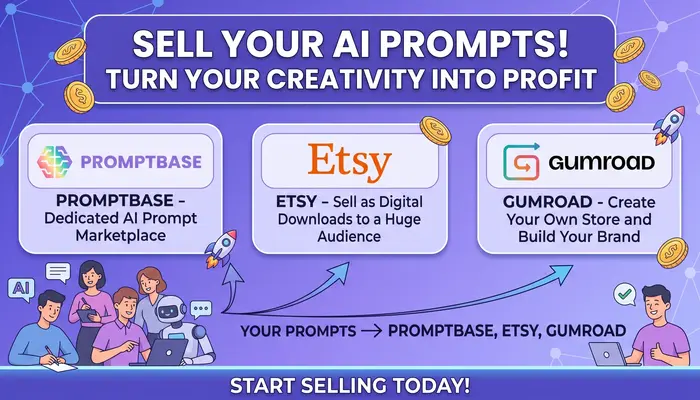
PromptBase (My Top Pick for Beginners)
Pros:
- Built specifically for selling AI prompts
- Takes care of payment processing
- Built-in audience already looking for prompts
- Clean, professional marketplace
Cons:
- They take a 20% commission
- Competitive (but that means there’s demand!)
- You’re building on someone else’s platform
Best for: Getting your first sales quickly while learning the ropes.
Etsy (Surprising But Effective)
Pros:
- MASSIVE existing traffic
- People already have buying intent
- You can sell prompt bundles as digital downloads
- Only $0.20 listing fee
Cons:
- 6.5% transaction fee plus payment processing
- You compete with everything (not just prompts)
- Requires good SEO knowledge
Best for: Selling prompt bundles and templates to creative professionals. AI Prompts.
Gumroad (Great for Building Your Brand)
Pros:
- Easy setup, creator-friendly
- You control pricing and messaging
- Can build an email list
- 10% fee (or 0% on paid plan)
Cons:
- You need to bring your own traffic
- No built-in marketplace discovery
Best for: Creators who already have an audience or want to build one.
Your Own Website (Advanced Move)
Pros:
- Keep 100% of profits (minus payment processing)
- Complete control over branding
- Build long-term business asset
- Can use tools like Zotero for reference management if you’re creating academic prompts
Cons:
- Requires technical setup
- You handle all marketing
- Need to drive traffic yourself
Best for: Once you’re making $1,000+ monthly on other platforms and want to scale. AI Prompts.
| Platform | Commission | Difficulty | Time to First Sale | Best For |
|---|---|---|---|---|
| PromptBase | 20% | Easy | 1-2 weeks | Beginners |
| Etsy | 6.5% + fees | Medium | 2-4 weeks | Bundle sellers |
| Gumroad | 10% | Easy | Varies | Brand builders |
| Own Website | ~3% (payment) | Hard | 1-3 months | Established sellers |
Pro Tip: Start with PromptBase for quick validation, then expand to Etsy and Gumroad as you build momentum. Think of it like diversifying your income streams. AI Prompts.
Step-by-Step Guide: Creating Your First Profitable AI Prompt
Okay, enough theory. Let’s make something that you can sell right now.
Let’s take you step-by-step on how to build an actionable ChatGPT prompt people will purchase. The same applies to Midjourney, DALL-E, or any other AI tool. AI Prompts.
Step 1: Pick a Specific Problem to Solve
Don’t create “a prompt for writing.” That’s too vague.
Instead, choose something like:
- “Email subject lines that get 40%+ open rates”
- “Instagram captions for fitness coaches”
- “Product descriptions for Etsy sellers”
The more specific, the better. Someone searching for help with APA formatting website references doesn’t want general writing help – they want precise citation formatting.
Step 2: Research What’s Already Selling
Spend 30 minutes browsing PromptBase or Etsy.
Look for:
- Prompts with lots of reviews (proof of sales)
- Price points that seem popular
- Gaps you could fill better
I found that prompts related to APA style online formatting were selling well, but most were generic. That’s an opportunity. AI Prompts.
Step 3: Create and Test Your Prompt
Here’s my process:
First draft: Write what you think will work
Test it: Run it through the AI tool 5-10 times
Refine it: Adjust based on results
Test again: Make sure it’s consistently good
Let’s say you’re creating an “Email Newsletter Introduction” prompt:
Bad prompt: “Write an email newsletter intro”
Good prompt:
textWrite a compelling 3-paragraph email newsletter introduction for [TOPIC] that:
- Opens with a surprising statistic or question
- Addresses the reader's biggest pain point about [TOPIC]
- Promises one specific takeaway they'll learn
- Uses conversational tone like talking to a friend
- Keeps paragraphs to 2-3 sentences maximum
- Includes one rhetorical question
- Ends with a smooth transition to the main content

Target audience: [DESCRIBE AUDIENCE]
Newsletter topic: [SPECIFIC TOPIC]
Tone: [Professional/Casual/Friendly]
See the difference? The second one gives specific, actionable instructions that produce consistent results. AI Prompts.
Step 4: Package It Professionally
Your prompt needs:
Clear title: “Email Newsletter Introduction Generator for Coaches & Consultants”
Description that sells: Explain what it does, what results to expect,and who it’s for
Instructions: How to use it (even if it seems obvious)
Examples: Show 2-3 sample outputs
Customization tips: How buyers can adjust it for their needs
Step 5: Price It Right (For Now)
Start at $5-$10 for single prompts.
$15-$25 for prompt bundles (3-5 related prompts).
You can always raise prices later based on reviews and demand. AI Prompts.
Step 6: List It and Learn
Put it up on PromptBase or Etsy.
Then watch what happens:
- Are people clicking but not buying? (Maybe the price or description needs work)
- Are people buying but leaving mediocre reviews? (The prompt might need improvement)
- Are people buying and loving it? (Great! Make similar prompts)
Beginner’s Note: Your first few prompts probably won’t be bestsellers. That’s totally normal. Think of them as your learning phase. Each one teaches you something about what your market actually wants.
👉 Best AI Tools for Beginners in 2026 (Practical, Free & Easy to Use).
Pricing Your AI Prompts: The Sweet Spot Formula
Let’s talk money. Honestly, it’s the price that most beginners can get wrong when selling AI prompts online.
Price too low? You’re missing out on making money, and potential users may believe your prompts are substandard.
Price too high? Nobody bites,s and you don’t know what you did wrong?
This is the formula that I have seen time and time again:
The Value-Based Pricing Method
Consider: “What value to the buyer does this save? (Time/Money)”.
You’re giving them $100 in value if your prompt makes it possible for them to write a sales email that would otherwise take 2 hours –—and whose time is valued at $50 per hour.
They feel as though they are getting a bargain when you charge $15-20.
Pricing By Complexity
| Prompt Type | Suggested Price | Why This Works |
|---|---|---|
| Simple single-use prompts | $5-$10 | Low barrier to entry, impulse buy territory |
| Multi-step workflow prompts | $15-$25 | More value, requires testing and refinement |
| Industry-specific bundles | $25-$50 | Niche targeting, comprehensive solution |
| Custom prompt creation | $50-$150 | Personalized, high-touch service |
My Favorite Pricing Strategy: The Ladder
Use a $5-$7 “tripwire” prompt that is valuable but easy to use.
After you have someone that purchase the products and produces outcomes, they will certainly return for your $20 package.
After that? They are available for your $50 collection.
That’s the way people gain trust when they’re learning about how to sell articles online – you don’t begin by trying to offer them your most costly service.
Common Mistake: Underpricing because you’re new.
Look, I get it. You want those first sales. But pricing at $3 when everyone else charges $10 doesn’t make you look like a deal – it makes people suspicious.
Start at market rate. Let your quality speak for itself.
Marketing Your AI Prompts Without Paid Ads
The truth is, you can go ahead and make the best AI prompts, but no one is going to know about them if you make $0.
Hold on – don’t worry about having to spend a ton of money on marketing; I’ll just give you a big STOP.
In this post, I will be showing you some free (or very cheap) ways you can put your prompts in front of buyers.
Strategy #1: SEO for Your Prompt Listings
Whether you’re on PromptBase, Etsy, or your own site, SEO matters.
Title optimization:
- Include your main keyword naturally
- Be specific about what it does
- Add the target user (if relevant)
Good example: “ChatGPT Prompt Bundle for Real Estate Agents – Email & Social Media Templates”
Bad example: “Cool AI Prompts Pack”
Description optimization:
- Use your related keywords naturally (like selling AI, online guide, etc.)
- Answer common questions
- Include benefits, not just features
Think about what someone searching for your prompt would actually type into Google or the platform search bar.
Strategy #2: Social Proof on Steroids
Reviews are GOLD when selling AI prompts.
Here’s how to get them:
Give away 5-10 prompts to your first users in exchange for honest reviews. This builds credibility fast.
Follow up with buyers (if the platform allows) asking how the prompt worked for them. Many will voluntarily leave reviews.
Screenshot great feedback and share it on social media.
Strategy #3: Content Marketing (The Long Game)
Start a simple blog or Medium account where you:
- Share tips about using AI effectively
- Show examples of what your prompts create
- Teach people about the problems your prompts solve
Someone reading “How to Write Better Marketing Emails with ChatGPT” is a perfect customer for your email prompt collection.
If you’re creating prompts related to writing and publishing, articles about how to get into freelance writing or how to sell articles online attract your ideal buyers.
👉 Free AI Tools That Actually Help You Earn Money in 2026: Your Complete Beginner’s Guide.
Strategy #4: The Reddit/Forum Approach
Find communities where your target buyers hang out:
- r/ChatGPT
- r/Entrepreneur
- r/SideHustle
- Industry-specific subreddits
Don’t spam. Instead, genuinely help people with their questions. When relevant, mention “I created a prompt that solves exactly this – happy to share it.”
This builds trust and drives targeted traffic.
Strategy #5: YouTube Tutorials
You don’t need fancy equipment. Use your phone.
Create 3-5 minute videos showing:
- What your prompt does
- Live demo of results
- How to customize it
Title it something searchable like “Best ChatGPT Prompt for Instagram Captions (2025)”
Include your sales link in the description.

Common Mistakes That Kill AI Prompt Sales
I won’t cause you heartache.
I’ve witnessed these errors destroy what is probably fantastic prompt businesses. Turn a blind eye to them, and you’ve put yourself in a position that is ahead of 70% of all sellers.
Mistake #1: Making Prompts Too Generic
You don’t need to purchase a prompt that tells you to write a blog post.
“Write a 1,500-word SEO optimized, beginner-level, conversational blog post about [TOPIC] featuring H2 and H3 subheadings” – this is useful.
Specificity = Sales.
Mistake #2: Not Testing Enough
You have listed it, and it worked for us as soon as we made a request. Big mistake.
Try it out 10 to 20 times,s varying the conditions. Ensure that it continually gives good results.
One negative result a buyer suffers = bad review, fewer sales.
Mistake #3: Terrible Descriptions
Your product description shouldn’t read as a robot wrote it (ironically).
Bad: “This prompt generates content for marketing purposes using advanced AI technology.”
Good: “Tired of staring at a blank screen when you need to write marketing emails? This ChatGPT prompt creates compelling email copy in 30 seconds – complete with subject line, body, and call-to-action. Perfect for coaches, consultants, and small business owners who need to send regular newsletters but hate writing them.”
See how the second one speaks to a specific person with a specific problem?
Mistake #4: Ignoring Customer Feedback
Has anyone commented, “Great prompt, but would be better if it included X”?
Revise your prompt and thank them.
This demonstrates both your concern and that you make your product better. Win-win.
Mistake #5: Giving Up Too Soon
With the initial 2-3 prompts not becoming instant bestsellers, most sellers give up.
The truth is that you may need to make 10-15 prompts in order to find your winners.
Consider it like the way people discover how to sell articles online; your first couple of articles likely won’t go viral. However, each of them guides you towards what works.
Same concept here.
| Mistake | Why It Hurts | Quick Fix |
|---|---|---|
| Generic prompts | No clear value proposition | Add 3+ specific parameters |
| Minimal testing | Inconsistent results | Test 10+ times before listing |
| Robot descriptions | Doesn’t connect with buyers | Write like you’re explaining to a friend |
| Ignoring feedback | Missed improvement opportunities | Update prompts based on reviews |
| Quitting early | Never finding your winning formula | Commit to 20 prompts minimum |
How to Scale from $500 to $5,000 Monthly
So you’ve made your first few hundred dollars selling AI prompts online. That’s awesome!
Now what?
Here’s how to turn this side hustle into high income:
Scaling Strategy #1: Build Prompt Collections
Instead of selling individual prompts, create themed bundles:
- “Complete Social Media Marketing Prompt Pack” (10 prompts) – $49
- “Freelance Writer’s AI Toolkit” (15 prompts) – $67
- “E-commerce Product Description Bundle” (8 prompts) – $39
Bundles have higher perceived value and increase your average transaction size.
Scaling Strategy #2: Create Subscription Offerings
This is where the real money is.
Offer a monthly subscription where buyers get:
- 5 new prompts every month
- Access to your private community
- Priority support
- Prompt customization requests
Charge $20-50/month. Get 100 subscribers? That’s $2,000-5,000 in recurring revenue.
Scaling Strategy #3: Teach Others
Once you’re successful at selling AI, teach others how you did it.
Create a course on “How to Build an AI Prompt Business” for $97-297.
Your existing customers are perfect students – they already trust you.
Scaling Strategy #4: License to Businesses
Approach marketing agencies, content teams, and consultancies.
Offer exclusive licensing deals: “Get unlimited access to my entire prompt library for your agency – $500/month”
One corporate client can equal dozens of individual sales.
Scaling Strategy #5: Expand to Multiple AI Tools
Started with ChatGPT? Add Midjourney prompts. Then DALL-E. Then Stable Diffusion.
Each new category opens a new customer base.
Real Talk: Scaling takes time. Don’t expect to jump from $500 to $5,000 overnight.
But if you add one new revenue stream each month (new platform, new prompt type, subscription tier), you’ll get there faster than you think.
Legal Stuff You Need to Know
Okay, I know legal talk is boring. But trust me – 5 minutes reading this section can save you massive headaches later.
Can You Legally Sell AI Prompts?
Yes! Absolutely.
Prompts are your original creative work. You own them, and you can sell them.
But – make sure you’re not selling prompts that include:
- Copyrighted characters or content (no “Harry Potter fanfic generator”)
- Trademarked terms in misleading ways
- Other people’s intellectual property
Do You Need to Pay Taxes?
Short answer: Yes.
If you’re in the USA and earning money selling AI prompts, that’s taxable income.
Keep records of:
- All sales revenue
- Platform fees
- Business expenses
- Any software subscriptions
Talk to a tax professional (or use something like TurboTax Self-Employed) to file correctly.
Pro Tip: Set aside 25-30% of your earnings for taxes so you’re not caught off guard at tax time.
Terms of Service for AI Platforms
Read the TOS for ChatGPT, Midjourney, etc.
Most allow commercial use of outputs, but there are sometimes restrictions:
- Midjourney requires a paid plan for commercial use
- ChatGPT’s terms generally allow selling outputs
- Always verify current terms
Your Own Terms and Conditions
When selling prompts, include simple terms like:
- “All sales final – digital products”
- “For personal or commercial use”
- “No refunds after download”
- “No reselling the prompts themselves”
Most platforms (PromptBase, Gumroad) have standard terms you can use.
👉 IRS guidelines for self-employment income for credibility.
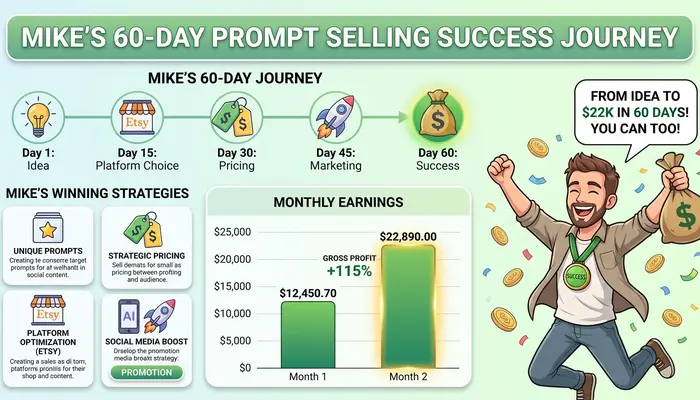
Real Success Story: How Mike Made $3,200 in 60 Days
I’ll give you a true story that will give you some idea of what is truly possible.
Austin, Texas native Mike is a 28-year-old graphic designer. He stumbled upon a YouTube video explaining how to sell prompts online using AI tools, and thought it was a good idea to try.
Month 1: The Learning Phase
Mike started by creating 8 Midjourney prompts for logo designs, since that’s what he knew best.
He priced them at $7 each on PromptBase.
First month results: $140 (20 sales)
Not life-changing, but proof of concept.
Month 2: The Pivot
Mike noticed something interesting in reviews: People loved his prompts but kept asking for variations.
So he created prompt bundles:
- “Complete Brand Identity Prompt Pack” (10 prompts) – $35
- “Social Media Graphics Generator” (6 prompts) – $25
- “Marketing Materials Bundle” (8 prompts) – $30
He also expanded to Etsy and started posting tutorial videos on YouTube.
Second month results: $850 (34 bundle sales + individual prompts)
Now we’re talking.
The Breakthrough
One of Mike’s YouTube videos (“How to Create Professional Logos Using Midjourney”) went semi-viral — 45,000 views.
In the description: Links to his prompt bundles.
Days 45-60 results: $2,210 in sales
Total 60-day earnings: $3,200
What Mike Did Right:
✅ Started in a niche he understood (design)
✅ Listened to customer feedback and adjusted
✅ Created bundles with higher price points
✅ Used free marketing (YouTube) effectively
✅ Diversified platforms (PromptBase + Etsy)
What Mike Says Now:
“I never thought selling AI prompts would replace my design income, but honestly? It’s getting close. And the best part is I create a prompt once, and it sells repeatedly. That’s way better than trading hours for dollars.”
Expert Tips from Top AI Prompt Sellers
So I contacted a number of successful prompt sellers who make a profit of $2000+ a month and asked them for their inside tips.
These are the things they said to me:
Tip #1: “Solve a Painful Problem” – Jessica, $4,200/month
“Generic prompts just don’t sell, but when I developed a prompt that is tailored just for real estate agents to write their property descriptions, with emotional triggers and local SEO words? It was my bestselling book for $22, “Find the Pain, Solve it Specifically.”
Tip #2: “Update Your Prompts Regularly” – David, $3,800/month
“AI tools evolve and update continuously – I release my bestselling prompts every 2-3 months to adapt to new features and then follow up with the people who have bought a copy of my original prompts with the updated version; some re-purchase the updated version.”
Tip #3: “Build an Email List ASAP” – Carmen, $5,600/month
“My biggest error was not collecting e-mails from day one; now I’ve got 2400 subscribers, and when I release a new prompt pack, I send an e-mail to them and make $1000+ within 24 hours. Your e-mail record is your enterprise insurance coverage.
Tip #4: “Create Prompts for Emerging Platforms” – Ryan, $2,900/month
“Everyone’s selling ChatGPT prompts – I tried to concentrate on newer tools like Claude and Bard, and specialized AI tools – less competition, hungry audience – if a new AI tool comes out, I’m one of the first to have prompts for it.”
Tip #5: “Show the Results, Not Just the Prompt” – Alicia, $3,100/month
I put in 3-4 sample outputs with each prompt I sell, and buyers can check before buying, and it helped boost my sales by ~40%.
Common Thread?
See that they all have elements of specificity and value. Not one of them is offering a generic ‘Write better prompt.
They identified target groups and target issues and then developed target solutions.
Right there’s the blueprint.
Frequently Asked Questions About Selling AI Prompts Online
Q1: Do I need to be a tech expert to start selling AI prompts?
Nope! Anyone who can utilize ChatGPT and Midjourney as a regular user can create prompts. What people want to know is what results they want, not a lot of technical information. There are tons of successful sellers out there; most of them are teachers, writers, marketers, etc., and have no coding knowledge whatsoever.
Q2: How long does it take to make your first sale?
It takes the majority of people 2-4 weeks to make their initial sale when they post on platforms such as PromptBase. The time frame will vary based on your product prices, niche, and description quality. Some sellers will sell within 48 hours of putting their product on the market.
Q3: Can I sell prompts for multiple AI tools?
Absolutely! Indeed, it’s a good idea to hedge your bets among ChatGPT, Midjourney, DALL-E, and the rest of the AI. If you’re only doing one, you’re not reaching the number of potential buyers that you can—different buyer audiences, different tools.
Q4: What if someone buys my prompt and then resells it?
While most platforms will have terms that ban this activity, it may occur. Make sure to specify in the product description that you don’t allow resale. Demonstrate, with examples, how a watermark can be used to achieve this. Work on establishing your brand and your reputation – copycats are unlikely to last very long as you’re not able to give your customer care and updates.
Q5: Do I need a business license to sell AI prompts online?
This will vary, depending on the area and income. In the United States, it’s typically not necessary to have a formal business license to sell as a sole proprietor, on a small scale, although you will eventually have to fireportncome on your taxes. Please consult the regulations in your area. Many people begin selling as a sole proprietor, and then incorporate an LLC when they are making $1,000+ per month.
Q6: How do I know if my prompt idea will actually sell?
Research first! To find out what people are looking for, check out PromptBase, Etsy, and Reddit. When searching for a prompt, be sure to find one that has numerous reviews (evidence of demand) in fields that you know. Make an MVP, set a reasonable price, and see if there is demand in the market.
Q7: Can I use AI to create prompts to sell?
Interesting question! While it’s okay to use AI to come up with a prompt or to edit one, ensure that they are tested and supplemented with your own knowledge. Usually, an AI-generated prompt, without any testing and tweaking, yields mediocre outcomes. It’s you: the testing, refining, and packaging.
Final Thoughts: Your Next Steps
Here’s what I want you to remember from this selling AI prompts online guide:
You don’t need to be a tech genius. You don’t need thousands of dollars. You just need to start.
Pick one AI tool you’re already comfortable with. Create three specific prompts that solve real problems. List them on PromptBase or Etsy.
That’s it. That’s your week one action plan.
Will you make $5,000 in your first month? Probably not.
But could you make your first $100? Absolutely.
And that first $100 proves the model works. Then it’s just about refinement and scaling.
The people making serious money selling AI prompts right now started exactly where you are – staring at a screen, wondering if this would actually work.
They took action. Now it’s your turn.
If this guide helped you, pass it on to a friend or colleague who wants to embark on a path to earn money online or via AI-powered freelancing. This becomes a good ecosystem for more people making good AI prompts.
Additional Resources for Your AI Prompt Journey:
If developing prompts for academic or research content, get to know reference management software such as Zotero Online and Zotero Web. Many buyers in education require prompts to help them format their online text and citations in the APA style, such as when to use et al. in a citation or how to format for APA 7th website standards. Awareness of these details provides you with the opportunity to develop extremely specific prompts for students and researchers.
For writers/content creators, knowledge of the standards of the AP Stylebook online and the guidelines of the APA formatting website can be valuable in your prompts. Many freelance writers picking up online selling tips should have tips and prompts to aid them in proper style consistency.
The beauty of selling AI prompts online is that each and every niche has its very own requirements. It’s your responsibility to determine what those needs are and what solutions you can provide.
But now put down that book and get to work! You’re ready to make your first sale!