
📌 INTRODUCTION
Have you ever wondered why you are in a sea of repetitive tasks, yet your competitors are on autopilot in running their business?
I get it. I also went there.
This is the reality: the game is different. When you are manually emailing and following up on leads at midnight, savvy businesspeople are creating AI automation funnels that not only work 24/7 but also do so without even sweating.
Nor do you need to be a technology genius or spend big money to develop an AI chatbot to get this to work.
This guide will demonstrate to you specifically how to create an AI funnel of automation that will transform your leads into customers in their sleep. We will discuss all the steps from selecting the appropriate tools to the first automated workflow configuration in plain and simple English.
At the conclusion of this paper, you will have an easy-to-follow roadmap of developing your own AI-powered sales machine. Sound good? Let’s jump in.
📌 QUICK ANSWER BOX
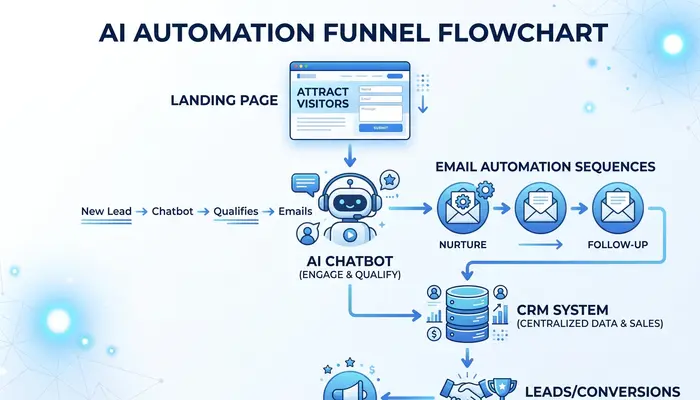
The process of constructing an AI automation funnel: An AI automation funnel is a combination of both artificial intelligence tools and marketing automation to generate leads, automatically nurture them, and transform leads into customers. A landing page, an AI chatbot, email automation, and CRM integration will be required, but they will be linked to each other and will not require a human to operate.
What Exactly Is an AI Automation Funnel?
And I will reduce this in the simplest manner.
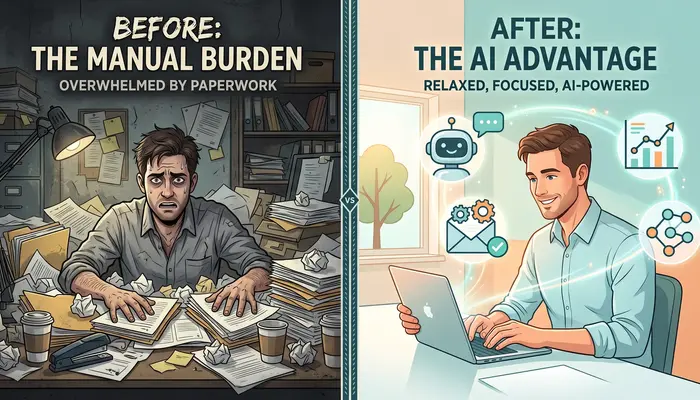
Imagine a classic sales funnel such as an assembly line of a factory. One goes to your website, perhaps downloads something, receives some email, and, hopefully, purchases.
Now suppose an assembly line like that, except that the robots are artificial intelligence-powered. Your funnel of AI automation.
The difference herein lies in the following:
Traditional Funnel:
- You manually respond to inquiries
- You personally send follow-up emails
- You qualify leads by talking to each one
- You schedule meetings one by one
AI Automation Funnel:
- AI chatbot answers questions instantly (even at 3 AM)
- Automated sequences send personalized emails based on behavior
- AI scores and qualifies leads automatically
- Smart scheduling tools book appointments without your input
A combination of artificial intelligence and problem-solving with automation tools creates the magic. The AI does not operate according to strict rules only but learns, evolves, and makes decisions depending on the actions of the users.
🎯 Beginner’s Note: You do not have to know the ins and outs of coding and machine learning. Modern platforms have enabled this to be extremely user-friendly.
Why Every Business Needs AI Automation in 2025
I will tell you the truth.
By the year 2025, if you are not automating with AI, then you are literally taking a knife to a gunfight.
Recent statistics indicate that companies that make use of AI automation experience a growth in qualified leads by 451%. That’s not a typo.
This is why the agencies of AI automation are flourishing at the moment:
The Time Factor
You can only have 24 hours in a day. Your automation funnel? It has a 168-hour workweek without complaint
One of my friends owns an agency of AI automation. He explained to me that his clients save an average of 23 hours a week on repetitive activities only. Nearly a day of your life to come back.
The Money Factor
AI business process automation cuts costs dramatically. Here’s the breakdown:
| Task | Human Cost (monthly) | AI Automation Cost | Savings |
|---|---|---|---|
| Lead qualification | $3,500 | $99 | $3,401 |
| Email marketing | $2,000 | $49 | $1,951 |
| Customer support | $4,500 | $150 | $4,350 |
| Appointment scheduling | $1,800 | $29 | $1,771 |
| TOTAL | $11,800 | $327 | $11,473 |
Look at those numbers. That’s $137,676 saved per year.
The Competition Factor
This is something that your competitors are already doing. The search volume of the term ” AI automation agency in 2025 is 340% larger than it was a year ago.
The number of companies that provide AI automation service is increasing more rapidly than ever before, since the demand is soaring.
💡 Pro Tip: The companies that have achieved success toda, are not the ones that have the most intelligent products—they are the ones that have the most intelligent automation.
Essential Components of an AI Automation Funnel
Ok, now on to the nuts and bolts.
Five components of AI automation funnels are present in every successful one. Imagine these to be the organs of a body–you must have all of them all operating.
1. Smart Landing Pages
This is where everything starts. But we’re not talking about boring static pages.
Your landing page needs to:
- Load in under 2 seconds (AI tools can optimize this)
- Adapt content based on where visitors came from
- Use AI-powered personalization to show different messages to different people
2. AI Chatbot (Your 24/7 Sales Rep)
This is your digital employee who never sleeps, never takes breaks, and never has a bad day.
A good AI chatbot does more than just answer “What are your hours?”
It should:
- Qualify leads by asking the right questions
- Schedule appointments directly
- Route serious buyers to your sales team
- Handle objections with pre-programmed responses
Many businesses hire an AI chatbot development company to build custom solutions, but there are also great ready-made options.
3. Email Automation Sequences
Once someone enters your funnel, they need nurturing.
Your AI-powered email system should:
- Send behavior-triggered emails (someone viewed pricing? Send a discount)
- Personalize subject lines and content based on user data
- Test different versions automatically to improve open rates
- Remove people who aren’t engaging
4. CRM with AI Lead Scoring
Not all leads are created equal.
AI analyzes hundreds of data points to score each lead:
- How many pages did they visit?
- Did they watch your video?
- What’s their company size?
- Have they downloaded resources?
The system automatically prioritizes hot leads so you focus on people ready to buy.
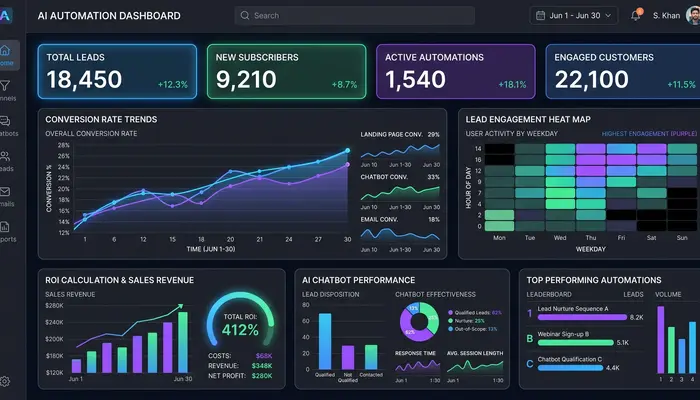
5. Analytics Dashboard
You can’t improve what you don’t measure.
Your dashboard should show:
- Conversion rates at each funnel stage
- AI performance metrics
- Revenue attribution
- Bottlenecks and drop-off points
🎯 Beginner’s Note: You don’t need all of this on day one. Start with components 1-3, then add the others as you grow.
Best Tools and Platforms to Build Your Funnel
Now you’re probably wondering: “Okay, but what tools do I actually use?”
Great question. Let me show you what’s working right now.
For Beginners (Easy to Use)
ClickFunnels + ManyChat Combo
- ClickFunnels for landing pages and basic automation
- ManyChat for AI chatbot functionality
- Cost: Around $150/month combined
- Setup time: 2-3 days
This is what I recommend if you’re just starting out. The learning curve isn’t steep, and there are tons of YouTube tutorials.
For Growing Businesses (More Power)
HubSpot + Intercom
- HubSpot handles CRM, email, and automation
- Intercom provides advanced AI chatbot features
- Cost: $500-$800/month
- Setup time: 1-2 weeks
This is the sweet spot for businesses doing $10K-$100K monthly.
For Advanced Users (Maximum Customization)
Custom-Built Solutions
Some companies need something unique. That’s where AI agent development services come in.
You might need custom development if:
- You have complex integration requirements
- Your industry has specific compliance needs
- You want proprietary AI functionality
Many businesses also use SaaS development services to build cloud-based automation platforms tailored to their exact needs.
Platform Comparison Table
| Platform | Best For | Price Range | AI Capabilities | Learning Curve |
|---|---|---|---|---|
| ClickFunnels | Beginners | $147-$297/mo | Basic | Easy |
| HubSpot | Mid-size business | $500-$3,200/mo | Advanced | Moderate |
| ActiveCampaign | Email-focused | $49-$259/mo | Moderate | Easy |
| Zapier + Make | Integration experts | $20-$600/mo | Via connections | Moderate |
| Custom CloudAI solution | Enterprises | $5,000+/mo | Fully custom | Complex |
💡 Pro Tip: Don’t get caught in “shiny object syndrome.” Pick one platform and master it before jumping to another.
👉 AI Tools to Automate Social Media Content: The Complete 2025 Guide.
Step-by-Step Guide: Building Your First AI Automation Funnel
Okay, enough theory. We shall create this thing.
I will take you step by step on how to develop an AI automation funnel starting at the point of absolute zero. Get a coffee—this is where it comes in handy.
Step 1: Define Your Funnel Goal
Time to consider: What is the ONE thing I want people to do with my software?
Is it:
- Booking a discovery call?
- Purchasing a product?
- Signing up for a free trial?
- Downloading a lead magnet?
Write this down. Everything else builds around this goal.
Example: “I want people to book a 30-minute strategy call with me.”
Step 2: Map Your Customer Journey
Grab a piece of paper (yes, actual paper) and sketch this out:
textAwareness → Interest → Consideration → Decision → Action
For each stage, write down:
- What content does the person need?
- What questions do they have?
- What might stop them from moving forward?
This becomes your automation blueprint.
Step 3: Build Your Lead Magnet
You need something valuable to offer in exchange for contact information.
Good lead magnets for AI automation:
- “7-Day AI Automation Challenge” (email course)
- “AI Tools Comparison Checklist” (PDF)
- “Free Funnel Audit” (personalized service)
- “ROI Calculator” (interactive tool)
Spend time on this. A great lead magnet can double your conversion rate.
Step 4: Create Your Landing Page
Use your chosen platform to build a simple page with:
- Compelling headline (include your main keyword)
- 3-5 bullet points of benefits
- Lead capture form (name + email minimum)
- Clear call-to-action button
- Optional: short video explanation
🎯 Beginner’s Note: Don’t obsess over perfection. A “good enough” page that’s live beats a perfect page that never launches.
Step 5: Set Up Your AI Chatbot
This is where artificial intelligence enters the game.
Configure your chatbot to:
Greeting Message:
“Hey! 👋 I’m here to help you learn about AI automation. What’s your biggest challenge right now?”
Qualification Questions:
- “What’s your business type?”
- “How many leads do you get monthly?”
- “Are you ready to implement within 30 days?”
Based on answers, route to:
- High-intent: “Schedule a call now”
- Medium-intent: “Download our guide”
- Low-intent: “Join our newsletter”
Most platforms have templates for this. Don’t build from scratch if you don’t have to.
Step 6: Build Your Email Automation Sequence
Create a 7-email welcome sequence that delivers value while moving people toward your goal.
Sample Sequence:
Email 1 (Immediate): Deliver the lead magnet + set expectations
Email 2 (Day 1): Quick win or actionable tip related to AI automation
Email 3 (Day 3): Case study or success story
Email 4 (Day 5): Address common objection
Email 5 (Day 7): Introduce your paid offer
Email 6 (Day 10): Social proof and testimonials
Email 7 (Day 14): Urgency-based call-to-action
Use AI tools within your email platform to:
- Optimize send times for each person
- Test subject lines automatically
- Personalize content based on behavior
Step 7: Integrate Your CRM
Connect everything to your customer relationship management system.
This creates a central hub where you can:
- See every lead’s journey
- Track all interactions
- Get notified about hot leads
- Analyze what’s working
Popular CRM options: HubSpot, Pipedrive, Salesforce, or even simple Google Sheets for basic tracking.
Step 8: Add AI Lead Scoring
Configure your system to automatically score leads based on:
Demographic Scoring:
- Company size (+10 points for 50+ employees)
- Job title (+15 points for decision-makers)
- Industry (+20 points for target industries)
Behavioral Scoring:
- Visited pricing page (+15 points)
- Watched demo video (+10 points)
- Opened 3+ emails (+8 points)
- Downloaded multiple resources (+12 points)
Leads over 50 points? They go to your sales team immediately.
Step 9: Set Up Retargeting
Not everyone converts the first time. That’s where AI-powered retargeting comes in.
Install tracking pixels for:
- Facebook/Instagram Ads
- Google Ads
- LinkedIn Ads
Create custom audiences of people who:
- Visited but didn’t opt in
- Opted in but didn’t book a call
- Attended a call but didn’t buy
Show them targeted ads with different messaging based on where they dropped off.
Step 10: Test and Launch
Before going live, test everything:
✅ Submit your own form—does the email arrive?
✅ Chat with your bot—does it respond correctly?
✅ Click every link—does everything work?
✅ Check mobile version—does it look good?
Then launch. Don’t wait for perfection.
💡 Pro Tip: Set a calendar reminder for 48 hours after launch. That’s when you’ll have enough data to spot obvious issues.
👉 Best AI Writing Tools for Bloggers 2026: The Ultimate Guide.
How AI Agent Development Services Can Help
Let’s talk about when you might need professional help.
I’m a big believer in DIY when you’re starting out. But there comes a point where custom AI agent development services make sense.
When to Consider Professional Services
You should think about hiring experts if:
1. You Need Industry-Specific Solutions
Healthcare, finance, and legal industries have compliance requirements that off-the-shelf tools can’t handle. AI agent development services can build HIPAA-compliant or SOC 2-certified systems.
2. You’re Scaling Fast
When you’re processing thousands of leads daily, generic tools start breaking. Custom solutions handle enterprise-level volume without hiccups.
3. You Want Competitive Advantage
If AI automation is core to your business model, proprietary technology gives you an edge competitors can’t copy.
What Professional Services Include
Most AI automation agencies offer:
Discovery and Strategy Phase:
- Audit your current processes
- Identify automation opportunities
- Create custom funnel architecture
- Define KPIs and success metrics
Development Phase:
- Custom AI agent creation
- Integration with existing systems
- CloudAI infrastructure setup
- Testing and quality assurance
Launch and Optimization:
- Deployment support
- Team training
- Ongoing optimization
- Performance monitoring
Cost Expectations
Here’s what you’re looking at:
| Service Level | Cost Range | Timeline | Best For |
|---|---|---|---|
| Basic Consultation | $2,000-$5,000 | 1-2 weeks | Small businesses needing guidance |
| Semi-Custom Setup | $10,000-$25,000 | 1-2 months | Growing companies |
| Fully Custom Development | $50,000-$200,000+ | 3-6 months | Enterprises |
| Monthly Management | $2,000-$10,000/mo | Ongoing | Companies wanting hands-off operation |
Common Mistake: Don’t hire an agency just because it sounds impressive. Start simple, prove ROI, then scale up.
[External linking suggestion: Link to a reputable source like Gartner’s report on AI automation trends]
Common Mistakes to Avoid When Building Your AI Automation Funnel
I have witnessed individuals make these errors numerous times. Get to know, by their loss.
Mistake #1: Automating a Broken Process
The thing is the following: automation makes things quicker. When you have a process that is a sucker, then automation will make it a sucker.
Fix it first, then automate it.
Prior to creating any funnel, physically go through your sales process 10-20 times. Identify what works. Then automate that.
Mistake #2: Over-Complicating Things
I observe this every day. Before they have made their first sale, people attempt to construct a 47-step funnel using 14 various tools.
Begin with the following flow:
textLanding Page → Lead Magnet → 3 Emails → Call to Action
That’s it. Make that work, then add complexity.
Mistake #3: Ignoring the Human Touch
AI is mighty, and people continue to shop with individuals.
Human connection should be boosted with your automation, not eliminated.
Balance Automation with Personal Touch:
| Automate This | Keep This Human |
|---|---|
| Initial response | High-value sales calls |
| Lead qualification | Customer onboarding |
| Appointment scheduling | Negotiation |
| Follow-up reminders | Complex problem-solving |
| FAQ answers | Relationship building |
Mistake #4: Not Testing Enough
Your artificial intelligence chatroom is wonderful to you. But have you tried it on real strangers?
Have 5-10 people, who have not seen your funnel go through it. OObservethem (through screen share). What puzzles them, you will be aghast to hear.
Mistake #5: Setting and Forgetting
AI automation isn’t a crockpot. You can’t just set it and walk away forever.
Check your metrics weekly:
- Conversion rates
- Email open rates
- Chatbot completion rates
- Lead quality scores
If something drops, investigate immediately.
🎯 Beginner’s Note: Mistakes are data. Every failure teaches you something valuable. I’ve probably made 50+ funnel mistakes, and each one made me better.
Real-Life Case Study: $50K in 90 Days with AI Automation
I have a real-life example that can attest to this stuff working.
The Background
Sarah has her own business coaching practice. Prior to the automation of AI, she used to do all of them manually:
- Responding to Instagram DMs at all hours
- Manually sending email follow-ups
- Qualifying leads on phone calls that went nowhere
- Forgetting to follow up with warm leads
She was working 60-hour weeks and making approximately 8,000 a month. It does not do it justice to say that it is burnt out.
The Problem
Sarah couldn’t scale. She was not able to create new content, her conversion rate was low (approximately 3 percent), and she was falling behind on leads all the time due to her inability to respond quickly enough.gh.
The AI Automation Funnel Solution
We built a simple funnel for her:
Step 1: Created a free “7-Day Business Clarity Challenge” as a lead magnet
Step 2: Set up a landing page with an AI chatbot that asked qualifying questions
Step 3: Built a 7-email automation sequence delivering daily challenge content
Step 4: Added AI lead scoring based on:
- Email open rates
- Challenge completion
- Link clicks
- Quiz answers
Step 5: Automatically booked qualified leads into her calendar
Step 6: Set up retargeting ads for people who didn’t complete the challenge
The Results
After 90 days, here’s what happened:
| Metric | Before | After | Change |
|---|---|---|---|
| Monthly leads | 45 | 312 | +593% |
| Conversion rate | 3% | 11% | +367% |
| Monthly revenue | $8,000 | $50,000+ | +525% |
| Work hours/week | 60 | 25 | -58% |
| Response time | 4-8 hours | 30 seconds | -99% |
But here’s what really matters: Sarah got her life back.
She now spends mornings with her kids, creates content only when inspired, and takes Fridays completely off.
The best part? The funnel runs 24/7. While she sleeps, it:
- Captures new leads from her content
- Qualifies them through conversations
- Nurtures them with value
- Books the good ones on her calendar
What Made It Work
Three things were critical to Sarah’s success:
1. She niched down: Instead of “business coaching for everyone,” she focused on “female entrepreneurs scaling from $50K to $200K.”
2. She used artificial intelligence and problem-solving together: The AI didn’t just automate—it solved specific problems (late responses, poor qualification, forgetting follow-ups).
3. She stayed involved where it mattered: Sarah still does the actual coaching calls. The AI just handles everything else.
💡 Pro Tip: You don’t need to transform everything overnight. Sarah started with just the chatbot and lead magnet. She added email automation in week 3 and lead scoring in week 6.
Advanced AI Automation Strategies for 2025
Willing to go the extra mile? These are strategies that will make the difference between good funnels and great funnels.
Strategy #1: Multi-Channel AI Orchestration
Don’t just automate email. Coordinate across:
Email + SMS + Messenger + WhatsApp
Your AI system should know:
- If someone opened your email but didn’t click → send a follow-up SMS
- If they engaged on Messenger → pause the email sequence
- If they haven’t responded anywhere in 3 days → try WhatsApp
This multi-touch approach can increase conversion by 40-60%.
Strategy #2: Predictive Lead Behavior
Advanced AI doesn’t just react—it predicts.
Using machine learning, your system can forecast:
- Which leads are likely to convert (and when)
- Which customers might churn
- What content will resonate with specific segments
- Optimal pricing for different customer types
Many AI automation agencies now offer predictive analytics as part of their AI automation service packages.
Strategy #3: Dynamic Content Personalization
Stop sending the same content to everyone.
Modern AI can personalize:
- Email subject lines based on past engagement
- Landing page copy based on referral source
- Product recommendations based on browsing behavior
- Video content based on viewer preferences
Example: If someone came from a Facebook ad about “time-saving tools,” show them content about efficiency. If they came from a LinkedIn post about “revenue growth,” show ROI-focused content.
Strategy #4: AI-Powered Upsell Sequences
The fortune is in the follow-up.
After someone becomes a customer, AI can:
- Identify which additional products they might need
- Time the offer based on usage patterns
- Create personalized bundles
- Adjust pricing based on lifetime value
One e-commerce client increased average order value by 73% using AI-powered upsell automation.
Strategy #5: Voice and Video AI Integration
Text is great, but voice and video create deeper connections.
Emerging tools now let you:
- Clone your voice for personalized audio messages
- Generate custom video messages with AI avatars
- Transcribe and analyze sales calls automatically
- Create AI-powered voice assistants for phone support
This is especially powerful for AI automation agencies working with high-ticket offers.
Strategy #6: Continuous A/B Testing
Let AI handle optimization while you sleep.
Set up tests for:
- Subject lines (AI generates and tests variations)
- CTA button colors and text
- Landing page layouts
- Chatbot conversation flows
- Offer timing and positioning
The AI automatically implements winning variations and keeps testing new ideas.
Tool Comparison for Advanced Strategies:
| Feature | HubSpot | ActiveCampaign | Custom AI Solution |
|---|---|---|---|
| Multi-channel orchestration | ✅ Limited | ✅ Good | ✅ Excellent |
| Predictive analytics | ✅ Basic | ❌ No | ✅ Advanced |
| Dynamic personalization | ✅ Good | ✅ Good | ✅ Excellent |
| Voice/Video AI | ❌ No | ❌ No | ✅ Yes (with integration) |
| Auto A/B testing | ✅ Yes | ✅ Limited | ✅ Advanced |
| Price | $$$ | $$ | $$$$ |
🎯 Beginner’s Note: Don’t implement all of these at once. Master basic automation first, then add one advanced strategy every 2-3 months.
👉 A Forrester report on AI marketing automation trends.
Measuring Success: KPIs That Matter for Your AI Automation Funnel
You can’t improve what you don’t measure. Here are the metrics that actually matter.
Primary KPIs (Check These Weekly)
1. Funnel Conversion Rate
Formula: (Number of conversions / Total visitors) × 100
This is your north star metric. If you have 1,000 visitors and 50 conversions, that’s a 5% conversion rate.
Industry Benchmarks:
- Weak: Below 2%
- Average: 2-5%
- Good: 5-10%
- Excellent: 10%+
2. Cost Per Lead (CPL)
Formula: Total marketing spend / Number of leads generated
If you spent $500 on ads and got 100 leads, your CPL is $5.
What’s good? Depends on your industry, but generally:
- B2C: $10-50
- B2B: $50-200
- High-ticket services: $200-500+
3. Lead Quality Score
Not all leads are equal. Track the average lead score generated by your AI system.
Watch for trends:
- Rising scores = your funnel is attracting better prospects
- Falling scores = you might need to adjust targeting
4. Time to Conversion
How long from first contact to sale?
AI automation should speed this up. If it’s taking longer after implementing automation, something’s wrong.
Target: Reduce time to conversion by at least 30% within 90 days.
5. Email Engagement Metrics
Open Rate: 20-25% is average, 30%+ is great
Click Rate: 2-3% is average, 5%+ is great
Unsubscribe Rate: Under 0.5% is good
AI tools should help improve all of these through personalization and send-time optimization.
Secondary KPIs (Check These Monthly)
6. Customer Lifetime Value (CLV)
Formula: Average purchase value × Number of repeat purchases × Average customer lifespan
If customers spend $100/month and stay for 12 months, CLV = $1,200.
Your AI upsell sequences should increase this over time.
7. Return on Investment (ROI)
Formula: (Revenue – Cost) / Cost × 100
If you spent $1,000 on automation tools and made $5,000, your ROI is 400%.
Minimum acceptable ROI for AI automation: 300% within the first year.
8. Chatbot Engagement Rate
Formula: (Number of conversations started / Number of visitors) × 100
A good AI chatbot should engage 20-40% of visitors.
Also track:
- Conversation completion rate
- Questions successfully answered
- Escalations to human support
9. Lead Response Time
One of the biggest benefits of AI automation is instant response.
Target: Under 60 seconds for initial response, 24/7.
If your AI chatbot is slower than this, investigate why.
10. Attribution Accuracy
Can you trace revenue back to specific funnel stages?
Use UTM parameters and proper tracking to know:
- Which traffic source performs best
- Which funnel steps convert highest
- Where people drop off most
Creating Your Success Dashboard
Don’t drown in data. Create one simple dashboard that shows:
Traffic Section:
- Visitors this week
- Traffic sources breakdown
- Bounce rate
Conversion Section:
- Leads generated
- Conversion rate
- Lead quality score
Revenue Section:
- Sales made
- Revenue generated
- ROI
AI Performance Section:
- Chatbot engagement rate
- Email open/click rates
- Automation success rate
Most AI automation service providers can help set this up for you.
Tracking Tool Recommendations:
| Tool | Best For | Price | Complexity |
|---|---|---|---|
| Google Analytics | Traffic & basic conversions | Free | Medium |
| Mixpanel | User behavior tracking | $0-$999+/mo | Medium |
| Amplitude | Product analytics | $0-$2,000+/mo | High |
| Databox | Dashboard aggregation | $47-$231/mo | Low |
| Tableau | Advanced visualization | $70-$140/mo | High |
💡 Pro Tip: Set up automated weekly reports emailed to you every Monday morning. Seeing progress (or problems) consistently keeps you accountable.

Frequently Asked Questions About Building AI Automation Funnels
1. How much does it cost to build an AI automation funnel?
It only takes a small investment of $50-200/month, and platforms such as ClickFunnels and ManyChat can be used. Mid-level setups run $500-$1,000/month. AI agent development services to develop custom solutions begin at about $10, 000-25,000 to set u, plus a monthly fee. Keep it small and build up as ROI is realized.
2. Do I need coding skills to build an AI automation funnel?
Nope! It is feasible to complete beginners on modern no-code platforms. With the ability to use email and refer to tutorials, you will be able to create a basic funnel. With that being said, collaborating with SaaS development agencies or AI automation agencies may be a good option should you desire more advanced customization.
3. How long does it take to build and launch an AI automation funnel?
With a focus, you can have a simple funnel live within 3-7 days. It could require 2-4 weeks to have a more complete system with all the bells and whistles. The time to develop custom applications is 3-6 months. Perfection should not prevent you from launching—go simple and work towards perfection.
4. What’s the difference between AI automation and regular marketing automation?
Frequent automation is based on strict rules of “if, then, that. Artificial intelligence and problem-solving are used in AI automation to learn, adapt to user behavior, predict and optimise itself. Consider it to be the distinction between a regular calculator and a smart helper.
5. Can AI automation work for small businesses and solopreneurs?
Absolutely! Actually, it is even more helpful to small operations since it multiplies your time, which is limited. It is possible to compete with larger businesses by providing 24/7 responses and customized experiences without employing a staff. There are numerous successful AI automation agencies that began as a one-person agency.
6. How do I know if my AI chatbot is working properly?
Monitor the following measures on a weekly basis: engagement rate (20-40% is good), conversation completion rate, user satisfaction rates, and above all, are qualified leads being generated? Also, regularly test yourself and have friends test it to identify problems.
7. What industries benefit most from AI automation funnels?
The nearly all industries benefit, but we have seen remarkable outcomes in: coaching/consulting, SaaS businesses, e-commerce, real estate, professional services (lawyers, accountants), healthcare providers and education. AI automation will be beneficial if you have a sales process that follows the same steps.
Final Thoughts: Your AI Automation Journey Starts Now
Look, I get it.
This could be daunting. There’s a lot here.
However, what I would like you to keep in mind is that all successful AI automation funnels began with a person clicking on the create new page button the first time.
You do not have to construct all I have mentioned in this guide tomorrow. You do not have to pay costly AI automation firms at the moment. No ideal code or expensive CloudAI hardware is required.
All you need to do is get started.
Your action plan for this week:
Day 1-2: Choose your platform (I recommend starting with ClickFunnels or HubSpot)
Day 3-4: Create a simple lead magnet people actually want
Day 5-6: Build a basic landing page and thank-you page
Day 7: Set up a simple 3-email sequence
That’s it. You might also make a working funnel, which will produce leads in your sleep seven days henceforth.
Following this, add an AI chatbot the following week. The next week, enhance your email sequences. Each month you are going to create something strong.
Think of Sarah ofromour casestudy? She went from $8K to $50K in 90 days. But her funnel on the first day was ridiculously easy in comparison with what it was going to be. She did not start, but learned and improved.
The companies that emerge victorious in 2025 will not be the ones that have the most technologically advanced technology. They are the ones who made things happen when all others were still planning.
Automation with AI is not a thing of the future, but the present. It is already in use by your competitors. It is desired by your customers. And honestly? You would be free with the liberty it offers.
And put the book aside and begin to play.
Wasting your time manually undertaking what can be automated is time that you are robbing the aspects of the business that you enjoy doing.
In case this guide proved to be useful, you can refer a friend or a colleague who would like to begin his/her journey in the field of AI-powered automation or online business development.
Have a question? Post your biggest question on the topic of AI automation funnels in the comment section. I read and reply to each and every one.
To your robotized future. 🚀