
Introduction: Why Your Invoicing Game Matters More Than You Think
I was just going to say something that no one told me when I first went freelance 3 years ago.
It wasn’t about securing clients. It was not like they had to do a good job. What couldn’t I stop thinking about? On-time payment.
I would be sending emails in which I would put my banking information in a Word document. The clients would not be able to remember the payment. I would work hours finding out who owed who what. Honestly? It was a mess.
But then I found out about the small business owner and freelancer’s best friend – the small business invoice software. Overnight, I turned into a working man. Payments came faster. And I did get 5+ hours per week back from all the Admin stuff I was spending on.
You’re not a novice anymore, especially when you’re dealing with the hassle of invoicing, late payments, or simply want to get away from it all as a freelancer in the USA. Let me guide you through the real world of the top freelancer invoicing software in the USA.
No corporate jargon. Only genuine reviews from a fellow who has been there.
Quick Answer Box
Which is the best freelancer invoicing software in the USA? The best options are: FreshBooks, QuickBooks Self-Employed, Wave (free), Zoho Invoice, and Invoice2go. The one that’s right for YOU will be determined by your price range, type of business, and whether you require even more features such as time tracking, expense tracking,g or integration with accounting software for small businesses.
Even if you’re just getting started, here are a few reasons why freelancers need to use invoice software.
Here’s the thing.
When you are just getting started, creating invoices in Google Docs seems to be “good enough. I get it. You want to save some money.
👉 Beginner’s guide to freelancing.
But I must ask you this: how many times have you…
- Have an unpaid invoice and forgot to follow up on it?
- Wasted 30 minutes formatting an invoice because the columnswouldl not line up?
- Not sure who has paid and who is “still processing”?
- Whether you’re a small business or a large corporation, do you feel bad about sending an unappealing invoice to one of your clients?
Yeah. Me too.
The best invoicing software for freelancers in the USA solves all of this. Here’s what changed for me:
Professional Image = Better Clients
One day, when I began utilising suitable invoicing software, clients gave me a different look. All of a sudden, I was not “some guy they found online. I was a bona fide business.
In fact, one of my customers recently said to me, “Your billing is more professional than our in-house accounting.”
That’s a level of credibility. You can’t buy it. However, good software will provide it to you.
Automatic Reminders = Faster Payments
I used to wait awkwardly for a week or more before I sent a “gentle reminder” e-mail before automation.
Now? My best software provides me with automatic reminders! I don’t have to be the bad guy! It’s all automated in the system.
And guess what? The average time it took for me to pay down from 28 days to 11 days.
Time Saved = More Money Earned
5 hours a month spent on Invoicing Admin equals 60 hours a year! This means at $50 an hour, you are losing out on $3000 a year just on paperwork!
That time is reduced by 80% with good software for issuing invoices. This is money back in your pocket!.
👉How to Pay Freelance Taxes in the USA:
What Makes Great Invoicing Software (The Non-Negotiables)
All invoicing tools are not the same. I know a lot of different ones; I’ve tried about 14.
Here’s what separates the best invoicing software for freelancers in the USA from the rest:
1. Mobile-Friendly (Because You’re Not Always at a Desk)
You’re at a coffee shop. Client states, “Can you please send me that invoice now?
If your software will not function flawlessly on your phone, then you’re going to have a bad time.
2. Payment Integration
This is HUGE. Top tools enable customers to pay directly from the invoice in 1 click.
Built-in payment options such as PayPal, Stripe, and credit cards. Say goodbye to “I’ll transfer it when I get to my computer”.
3. Recurring Invoices
Manual invoice generation for retainer customers (which is important to have) is heartbreaking.
Set it once. Allow it to run by itself. That’s the dream.
4. Expense Tracking
Here’s a surprise benefit I didn’t expect: most good invoicing software for small business owners also tracks expenses.
How’s tax season? You’ll thank yourself. Everything’s already organised.
5. Time Tracking Integration
For hourly work, time tracking that auto-fills your invoices is a chef’s kiss.
No more trying to remember “wait, how many hours did I spend on that project last Tuesday?”
6. Professional Templates
You’re not a designer. You shouldn’t have to be.
Good software comes with beautiful, customizable templates that make you look like a Fortune 500 company.
Top 7 Best Invoicing Software for Freelancers inthe USA (Honest Reviews)
Let’s now move on to the real tools. I have used most of these and dozens of others from my freelance friends.
1. FreshBooks is best overall for creative freelancers.
Price: It begins at $17/month.
This is best for: Designers, Writers, Consultants, Photographers
FreshBooks is akin to the iPhone of invoicing software. It’s simple, and it’s stunning as it does.
What I Love:
- Invoice templates that clients find beautiful to complement
- In-built time monitoring (genuine time keeping).
- Generates and sends courteous but firm late payment reminders automatically
- An app that is better than the desktop version.
- Fantastic customer support (human customer service and quick response time)
What Could Be Better:
- A bit pricey if you’re just starting out
- Some features are locked behind higher-tier plans
Real Talk: If you can afford $17/month, this is probably the best invoicing software for freelancers in the USA. It’s what I use, and I’ve never looked back.
2. QuickBooks Self-Employed – Best for Tax Season Warriors
Price: $15/month
Best For: Freelancers who dread tax time
QuickBooks is the heavyweight champion of accounting software for small business operations.
👉 How to Write Upwork Proposals Using ChatGPT
What I Love:
- Automatic mileage tracking (saved me $1,200 last year in deductions)
- Categorises expenses automatically
- Estimates quarterly taxes for you
- Connects to your bank account
- Intuit’s reputation means accountants love working with it
What Could Be Better:
- Interface feels a bit corporate/boring
- Can be overwhelming if you just want simple invoicing
Real Talk: If you’re serious about treating freelancing like a real business and want your taxes handled semi-automatically, this is your tool.
3. Wave – Best Free Option (Yes, Actually Free)
Price: $0 (they make money from payment processing)
Best For: Brand new freelancers on a tight budget
Wave is shockingly good for a free tool. Like, suspiciously good.
What I Love:
- Completely free invoicing and accounting
- Clean, professional invoice templates
- Receipt scanning with your phone
- Unlimited invoices
- Double-entry accounting (if you care about that)
What Could Be Better:
- Payment processing fees are higher than those of competitors
- No time tracking
- Customer support is limited on the free plan
Real Talk: If you’re just starting and have zero budget, start here. It’s the best software for getting your invoicing system up and running without spending a dime.
👉 RS freelancer tax guidelines (irs.gov) when discussing tax features
4. Zoho Invoice – Best for International Freelancers
Price: Free for up to 5 customers; $9/month for more
Best For: Freelancers with international clients
Zoho Invoice handles multi-currency like a boss, which most competitors struggle with.
What I Love:
- Supports 200+ countries and currencies
- Time tracking built-in
- Client portal where customers can check their invoices
- Works offline (rare feature!)
- Integrates with the entire Zoho ecosystem
What Could Be Better:
- The interface isn’t as pretty as FreshBooks
- Learning curve if you want advanced features
Real Talk: If you work with clients in Europe, Asia, or anywhere outside the USA regularly, this handles currency conversion and international payments better than anyone.
5. Invoice2go – Best Mobile-First Experience
Price: $5.99/month
Best For: Service professionals who work on-site
Invoice2go was designed mobile-first, and it shows.
What I Love:
- Create and send invoices in under 60 seconds on your phone
- Accept payments on-site with card reader integration
- Estimates convert to invoices with one tap
- Super simple interface (your grandma could use it)
- Works offline
What Could Be Better:
- Desktop experience is just okay
- Limited reporting features
- Not great for complex projects
Real Talk: If you’re a contractor, handyman, photographer, or anyone who invoices clients while standing in their driveway, this is the one.
6. HoneyBook – Best for Client Management + Invoicing
Price: $16/month (annual plan)
Best For: Wedding photographers, event planners, creative agencies
HoneyBook is more than invoicing software for small businesses – it’s a full client management system.
What I Love:
- Proposals, contracts, and invoices all in one place
- Gorgeous brochure-style proposals
- Automated workflow sequences
- Questionnaires and intake forms
- Amazing for creative businesses
What Could Be Better:
- Overkill if you just need simple invoicing
- Steeper learning curve
- Annual commitment for best pricing
Real Talk: If you want to wow clients with a premium experience from first contact to final invoice, HoneyBook makes you look like an enterprise-level operation.
7. PayPal Invoicing – Best Quick-and-Dirty Solution
Price: Free (PayPal transaction fees apply)
Best For: Ultra-casual freelancing, occasional gigs
Sometimes you just need to send someone a damn invoice and don’t want to sign up for anything.
What I Love:
- Everyone already has PayPal
- No setup required
- Clients can pay instantly
- Works from your PayPal account
What Could Be Better:
- Very basic features
- No expense tracking or reporting
- Invoices look pretty generic
- Higher transaction fees than dedicated processors
Real Talk: This isn’t the best invoicing software for freelancers in the USA by any measure, but it’s perfectly fine for occasional projects or if you’re already living in the PayPal ecosystem.
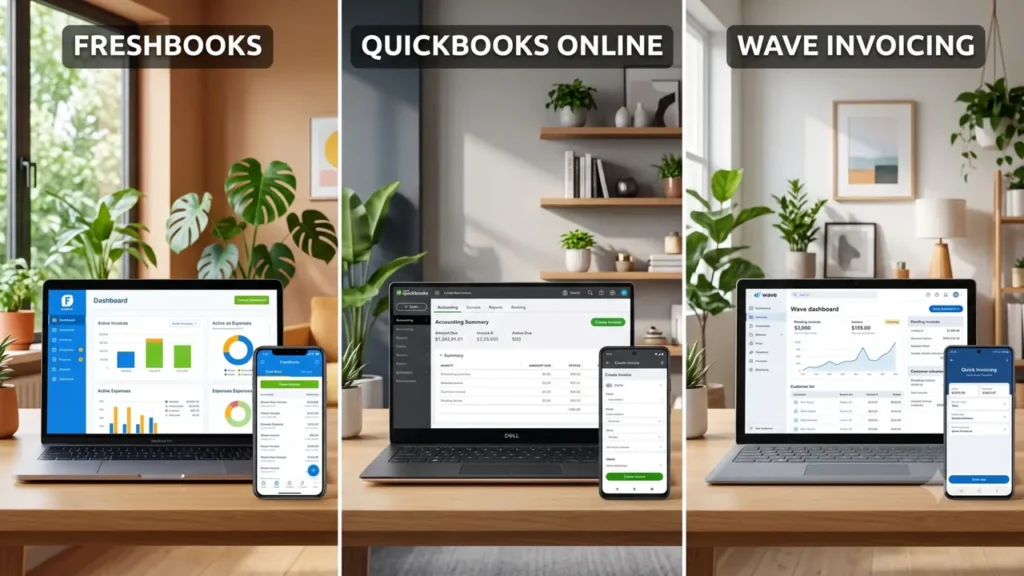
Image Alt Text: “Comparison of best invoicing software for freelancers in the USA interfaces”
Image Title: “Top Invoicing Software Tools for American Freelancers”
Comparison Table: Quick Overview
| Software | Starting Price | Best For | Free Plan? | Time Tracking | Mobile App | Payment Processing |
|---|---|---|---|---|---|---|
| FreshBooks | $17/month | Creative professionals | No | ✅ Yes | ⭐ Excellent | ✅ Built-in |
| QuickBooks Self-Employed | $15/month | Tax-conscious freelancers | No | ✅ Yes | ✅ Good | ✅ Built-in |
| Wave | Free | Budget starters | ✅ Yes | ❌ No | ✅ Good | ✅ Built-in |
| Zoho Invoice | Free (limited) | International clients | ✅ Yes (5 customers) | ✅ Yes | ✅ Good | ✅ Built-in |
| Invoice2go | $5.99/month | Mobile professionals | No | ❌ No | ⭐ Excellent | ✅ Built-in |
| HoneyBook | $16/month | Creative businesses | 7-day trial | ✅ Yes | ✅ Good | ✅ Built-in |
| PayPal | Free | Occasional invoicing | ✅ Yes | ❌ No | ✅ Basic | ✅ PayPal only |
Feature Comparison: What’s Included?
| Feature | FreshBooks | QuickBooks | Wave | Zoho | Invoice2go | HoneyBook |
|---|---|---|---|---|---|---|
| Unlimited invoices | ✅ | ✅ | ✅ | ✅ | ✅ | ✅ |
| Recurring invoices | ✅ | ✅ | ✅ | ✅ | ✅ | ✅ |
| Expense tracking | ✅ | ⭐ Advanced | ✅ | ✅ | ❌ | ✅ |
| Mileage tracking | ❌ | ⭐ Automatic | ❌ | ❌ | ❌ | ❌ |
| Proposals/Contracts | ❌ | ❌ | ❌ | ❌ | ❌ | ⭐ Yes |
| Client portal | ✅ | ✅ | ❌ | ✅ | ❌ | ✅ |
| Multi-currency | ✅ | ✅ | Limited | ⭐ 200+ | ✅ | ✅ |
| Custom branding | ✅ | ✅ | Limited | ✅ | ✅ | ⭐ Advanced |
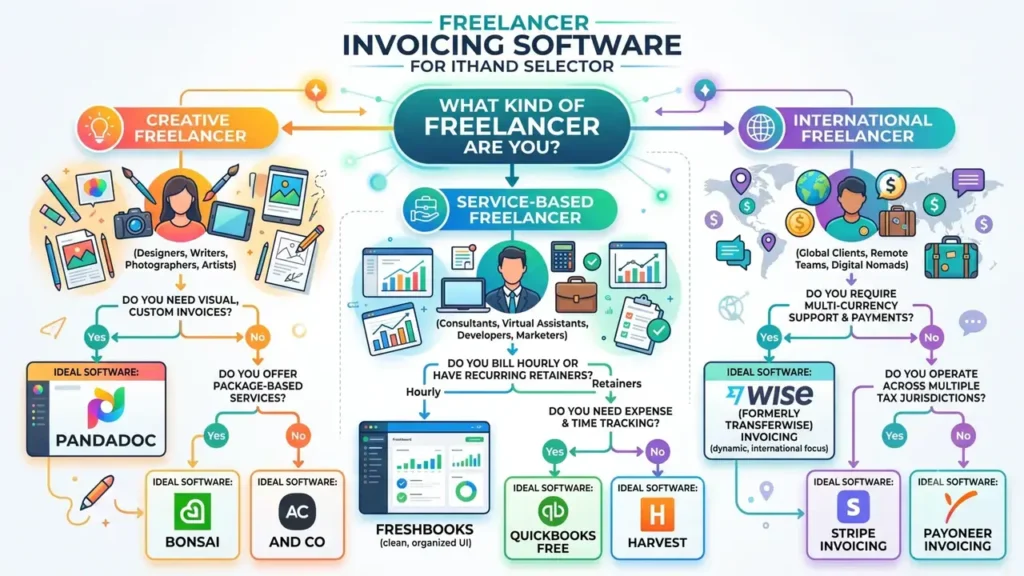
How to Choose the Right Software for Your Needs (Decision Framework)
Okay, so you’ve got options. Maybe too many options.
Let me make this super simple for you.
Choose Based on Your Situation:
If you’re literally just starting and have a $0 budget:
→ Start with Wave. It’s free, it’s professional, and you can upgrade later.
If you’re making $1,000+ per month and want to look professional:
→ Go with FreshBooks. It’s worth the $17/month for the time you’ll save and the credibility boost.
If you dread tax season and want help with deductions:
→ QuickBooks Self-Employed will pay for itself in tax savings.
If you have international clients:
→ Zoho Invoice handles currencies and international payments better than anyone.
If you invoice clients on-site (plumber, contractor, photographer):
→ Invoice2go lets you create and send invoices from your phone in under a minute.
If you want to manage your entire client experience:
→ HoneyBook does proposals, contracts, questionnaires, AND invoicing.
If you need something right now for a one-off project:
→ Just use PayPal Invoicing and call it a day.
Questions to Ask Yourself:
1. How tech-savvy am I?
If you’re not super comfortable with technology, go for Invoice2go or FreshBooks. They’re the easiest to learn.
If you love exploring features and settings, QuickBooks or Zoho gives you more power.
2. How many invoices do I send per month?
Less than 5? Free tools like Wave are perfect.
More than 20? You need automation. FreshBooks or HoneyBook will save your sanity.
3. Do I need to track time?
Yes? Only consider tools with built-in time tracking: FreshBooks, QuickBooks, Zoho, or HoneyBook.
4. Am I invoicing individuals or companies?
Individuals usually pay via PayPal or card (any tool works).
Companies often pay via check or ACH (you’ll want QuickBooks or FreshBooks for this)
Step-by-Step: Setting Up Your First Invoice (Using FreshBooks as Example)
Let me walk you through creating your first professional invoice. I’m using FreshBooks as the example, but the process is similar in most of the best software options.
Step 1: Sign Up and Basic Setup (5 minutes)
- Go to FreshBooks.com and click “Try It Free”
- Enter your email and create a password
- Answer a few questions about your business type
- Add your business name and logo (you can skip the logo for now)
Pro Tip: Use a professional email address (yourname@yourbusiness.com), not johnsmith247@gmail.com. It makes a huge difference.
Step 2: Customise Your Invoice Template (3 minutes)
- Click “Settings” → “Invoice Customisation”
- Choose a template style (I like “Modern”)
- Add your business information:
- Business name
- Address
- Phone number
- Website
- Upload your logo (even a simple text logo works)
- Choose your brand colours
Beginner’s Note: Don’t stress about making it perfect. You can change all this later. Just get something decent up and running.
Step 3: Add Your First Client (2 minutes)
- Click “Clients” → “Add Client”
- Enter their information:
- Company name (or person’s name)
- Contact person
- Email address (super important!)
- Billing address
- Save
Pro Tip: Always get the right email address. Wrong email = invoice goes to spam = you don’t get paid.
Step 4: Create Your First Invoice (5 minutes)
- Click “Invoices” → “New Invoice”
- Select your client from the dropdown
- Add invoice date (today) and due date (I recommend “Net 15” or 15 days)
- Add line items:
- Description of work
- Quantity or hours
- Rate
- The system calculates the total automatically
- Add any applicable taxes
- Include payment terms at the bottom (“Payment due within 15 days”)
Step 5: Set Up Payment Options (10 minutes)
This is where the magic happens. You want to make it STUPID EASY for clients to pay you.
- Click “Settings” → “Accept Online Payments”
- Connect your bank account
- Enable credit card payments (yes, you’ll pay a small fee, but you get paid faster)
- Enable ACH bank transfers (lower fees for big invoices)
- Add PayPal if you want
Real Talk: The 2.9% fee you pay for credit card processing is worth it. Clients who can pay with one click pay 3x faster than clients who have to write a check or do a bank transfer.
Step 6: Send That Invoice! (1 minute)
- Click “Preview” to see what it looks like
- Check for typos (embarrassing, ask me how I know)
- Click “Send”
- FreshBooks emails it automatically
- You get a notification when they open it
Common Mistake: Don’t send invoices late at night or on weekends. Invoices sent Tuesday-Thursday mornings get paid fastest.
Step 7: Set Up Automatic Reminders (2 minutes)
- Go to “Settings” → “Late Payment Reminders”
- Enable automatic reminders
- Set it to remind 3 days before the due date, on the due date, and 3 days after
- Customize the message to sound friendly
Sample message I use:
“Hi [Client Name], just a friendly reminder that invoice #[Number] is due in 3 days. You can pay online with one click using the button below. Thanks for your business!”
Common Mistakes to Avoid:
❌ Waiting until the end of the month to send all invoices
✅ Send invoices immediately after completing work
❌ Vague descriptions like “services rendered”
✅ Specific descriptions: “Website redesign – 15 hours @ $75/hr”
❌ Not including payment instructions
✅ Clear payment button or instructions
❌ Setting due dates too far in the future
✅ Net 15 or Net 30 max
Real-Life Case Study: How Sarah Doubled Her Income with Better Invoicing
Let me tell you about my friend Sarah. She’s a graphic designer in Portland who was making around $3,500/month freelancing.
Her invoicing system? Email with a PDF attachment and her PayPal email at the bottom.
Here’s what was happening:
- Average time to get paid: 35 days
- She’d forget to follow up on late payments
- About 15% of invoices would go completely unpaid
- She spent 6-8 hours per month on invoicing admin
- She looked less professional than her competitors
What Changed:
In January 2023, I convinced her to try FreshBooks (after she complained about unpaid invoices for the hundredth time).
Here’s what she set up:
- Professional invoice templates with her branding
- Automatic payment reminders
- One-click payment buttons
- Time tracking integration
- Late fee automation (2% after 15 days)
The Results After 6 Months:
Payment Speed:
- Average payment time dropped from 35 days to 12 days
- That meant she had $4,000 more cash in her bank at any given time
More Income:
- By getting paid faster, she could take on more projects
- The time tracking revealed she was undercharging by about 30%
- She raised her rates, and clients didn’t blink (because she looked more professional)
- Income went from $3,500/month to $6,800/month
Time Saved:
- Invoicing time went from 6-8 hours/month to 45 minutes/month
- That’s 84 hours saved per year
- She used that time to find better clients
Unpaid Invoices:
- Dropped from 15% to 2%
- Automatic reminders meant clients couldn’t “forget”
- A professional system made her harder to ignore
Her Exact Words:
“I thought invoicing software was just for ‘real’ businesses. Turns out, it made me a real business. I wish I’d started using it two years ago. I literally left tens of thousands of dollars on the table by looking unprofessional and not following up.”
The Lesson:
The best invoicing software for freelancers in the USA isn’t just about sending pretty invoices. It’s about getting paid faster, saving time, and looking professional enough to charge what you’re worth.
Sarah’s story isn’t unique. I’ve seen this pattern dozens of times.
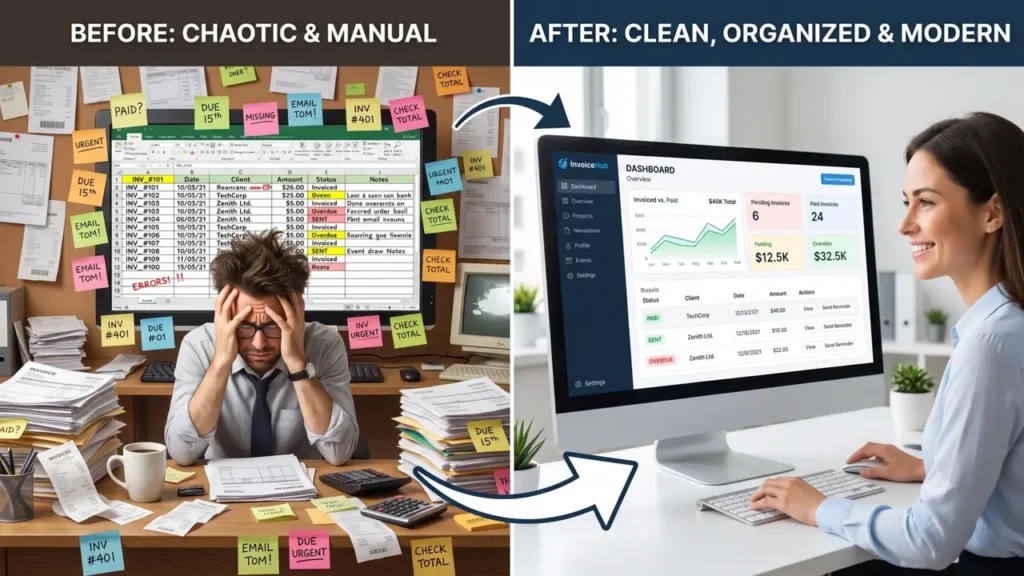
Common Mistakes Freelancers Make with Invoicing (And How to Avoid Them)
I’ve made every one of these mistakes. Let me save you the pain.
Mistake #1: Waiting to Send Invoices
What people do:
Finish a project on Monday, send the invoice on Friday (or worse, next Monday).
Why it’s wrong:
Clients pay based on when they receive the invoice. Every day you wait is another day before you get paid.
Fix:
Send invoices within 24 hours of completing work. Better yet, schedule them to send automatically when you mark a project complete.
Mistake #2: Not Following Up on Late Payments
What people do:
“I don’t want to be annoying…” So they wait weeks before asking about overdue invoices.
Why it’s wrong:
Clients are busy. They’re not intentionally ignoring you. They just forgot. Or your invoice got buried.
Fix:
Use invoicing software for small businesses with automatic reminders. Let the software be the “bad guy.” Set it and forget it.
Mistake #3: Unclear Payment Terms
What people do:
Send an invoice with no due date or vague terms like “pay when you can.”
Why it’s wrong:
Unclear expectations = slow payment. Always.
Fix:
Clear terms: “Payment due within 15 days of invoice date.” Include this on every invoice. In the software settings, make it automatic.
Mistake #4: Making It Hard to Pay You
What people do:
“Mail a check to…” or “Wire transfer to account #…”
Why it’s wrong:
Every extra step reduces the chance sthat omeone will pay quickly. Human nature.
Fix:
One-click payment buttons. Credit cards, PayPal, ACH—make it dead simple. Yes, you’ll pay a small fee. It’s worth it.
Mistake #5: Unprofessional-Looking Invoices
What people do:
Word document invoices, poorly formatted spreadsheets, or just an email with the amount.
Why it’s wrong:
Unprofessional invoices = lower perceived value = clients feel okay paying late (or negotiating down).
Fix:
Use the best software with professional templates. Even the free ones look 100x better than DIY invoices.
Mistake #6: Not Tracking Time Accurately
What people do:
Guesstimate hours at the end of the month: “Hmm, I think I spent about 10 hours on that?”
Why it’s wrong:
You’re almost certainly undercharging. And clients can tell when numbers seem made up.
Fix:
Use software with built-in time tracking. Turn on a timer when you start work. It’s automatic and honest.
Mistake #7: Same Invoice for Every Client Type
What people do:
One generic invoice template for everyone.
Why it’s wrong:
A Fortune 500 company expects different details than a local coffee shop.
Fix:
Good accounting software for small businesses lets you save multiple templates. Use detailed invoices for corporate clients, simpler ones for individuals.
Mistake #8: No Late Fee Policy
What people do:
Hope everyone pays on time (spoiler: they won’t).
Why it’s wrong:
Without consequences, there’s no urgency to pay on time.
Fix:
Add a late fee clause: “Invoices not paid within 15 days are subject to a 2% late fee.” Most good clients will never trigger it, but it creates urgency.
Expert Tips to Get Paid Faster (From 15 Years of Freelancing)
These are the strategies that actually work. Not theory—real results.
Tip #1: Invoice Immediately
The faster you invoice, the faster you get paid. Period.
I set up my best invoicing software for freelancers in the USA to send invoices automatically when I mark a project as complete.
The client gets the invoice while the work is still fresh in their mind. Payment comes faster.
Tip #2: Offer a Small Early Payment Discount
“Pay within 5 days and get 2% off.”
This is psychological magic. Suddenly, paying quickly feels like winning.
I’ve seen payment times drop by 40% just by adding this line.
Tip #3: Send Invoices on Tuesdays
I know this sounds weird, but data backs it up.
- Monday: Everyone’s catching up from the weekend
- Tuesday-Wednesday: Peak response time
- Thursday: People are winding down
- Friday: Nobody wants to deal with payments before the weekend
Tuesday morning invoices get paid fastest.
Tip #4: Use the Right Payment Method for the Invoice Size
Small invoices ($50-500): Credit card/PayPal (speed matters more than fees)
Medium invoices ($500-2,000): Credit card or ACH (whatever’s easier for the client)
Large invoices ($2,000+): ACH bank transfer (save yourself the fees)
Most of the best software options let you enable multiple payment methods. Use them.
Tip #5: Include Project Details
Don’t just write “Consulting services – $1,500”
Write:
- “Website redesign consultation – 3 hours @ $150/hr”
- “Logo design (3 concepts) – $800”
- “Revisions (2 rounds) – $200”
Detailed invoices get questioned less and paid faster.
Tip #6: Thank Them in the Invoice
Small touch: “Thank you for your business! It’s a pleasure working with you.”
Makes the invoice feel less transactional. Clients are more likely to prioritise payment for people they like.
Tip #7: Get a Deposit Upfront
This isn’t about invoicing software specifically, but it’s crucial:
For projects over $500, get 50% upfront.
This does two things:
- Filters out sketchy clients who were never going to pay
- Reduces your risk to 50% instead of 100%
Most good invoicing software for small businesses lets you create deposit invoices easily.
Tip #8: Use Invoice Numbers
Seems small, but it matters.
“Invoice #2401” looks more professional and businesslike than “Invoice for John.”
It also helps you track things. Any good software will do this automatically.
Tip #9: Include Your Photo
Another weird one that works: Include your headshot on your invoice template.
It reminds clients they’re dealing with a real person, not a faceless company.
Personal touch = faster payment.
Tip #10: Connect Your Bank Account
When clients can see a “Paid” status update in real time and you can see deposits automatically, everything moves faster.
Modern accounting software for small businesses makes this seamless.
No more checking your bank app twelve times a day wondering if the payment cleared.
Integration with Other Business Tools (Making Everything Work Together)
Here’s where the best invoicing software for freelancers in the USA really shines.
It’s not just about invoicing. It’s about connecting your whole business.
Best Integrations to Look For:
1. Email Marketing Software
If you’re using tools like Mailchimp or ConvertKit, some invoicing platforms integrate directly.
Why it matters: You can tag clients who paid on time vs. late, segment your email list, and send targeted offers.
2. Best CRM Software
Customer relationship management tools like HubSpot or Pipedrive can sync with your invoicing.
Why it matters: Track the entire client journey from lead to paid invoice in one place.
3. Real Estate CRM (for Property Freelancers)
If you do work for real estate clients, specialised real estate CRM integrations help track property-specific projects and payments.
4. Best Video Editing Software / Creative Tools
Some tools integrate with Adobe Creative Cloud, Final Cut Pro, or other video editing software.
Why it matters: Track time spent in editing software automatically. No more forgetting to start the timer.
5. Best Project Management Tools
Asana, Trello, Monday.com integrations.
Why it matters: When you complete a task, it can trigger an invoice automatically. Total automation.
6. Best Inventory Management Software
If you sell products alongside services, integration with the best inventory management software keeps your product sales and invoicing synced.
7. Best HR Software
Growing your freelance business into a small agency? The best HR software integrations help track contractor payments and 1099s.
8. Construction Accounting Software
For freelancers in construction or contracting, specialised construction accounting software integrations handle job costing and progress billing.
The Power of Integration:
Let me give you a real example from my workflow:
- Client books a discovery call (Calendly)
- Calendly adds them to my CRM (HubSpot)
- After the call, I create a proposal (HoneyBook)
- They sign the proposal digitally
- HoneyBook automatically creates the first invoice (50% deposit)
- Client pays via credit card (Stripe)
- Payment triggers a Slack notification to me
- Payment also triggers an automated welcome email sequence
- When I complete the project, I mark it done in Asana
- Asana triggers the final invoice in FreshBooks
- FreshBooks sends the invoice automatically
- Client pays, and the transaction syncs to QuickBooks for tax tracking
I touch this process maybe twice. The rest is automated.
That’s the power of choosing the best software that integrates well.
Common Integration Questions:
Q: Does integration cost extra?
Sometimes. FreshBooks and QuickBooks include most integrations. Wave’s integrations are limited on the free plan.
Q: Is it hard to set up?
Usually takes 10-30 minutes per integration. Most use Zapier, which is point-and-click.
Q: What if my tool doesn’t integrate directly?
Zapier connects almost everything. It’s like the universal adapter for business software.
Frequently Asked Questions About Invoicing Software for Freelancers
Q1: Do I really need paid invoicing software, or can I just use free options?
Answer: If you’re sending fewer than 5 invoices per month and have literally zero budget, free options like Wave work fine. But once you’re making $1,000+/month, paid software pays for itself in time saved and faster payments. I wasted about $3,000 in my first year by using free tools that didn’t have automation. Don’t make my mistake.
Q2: What’s the best invoicing software for freelancers in the USA who are just starting?
Answer: Wave is the best free option for absolute beginners. If you can afford $17/month, FreshBooks is worth every penny for the professional image and time savings. Start with one of those two, depending on your budget.
Q3: Can invoicing software help me with taxes?
Answer: Yes! Tools like QuickBooks Self-Employed track expenses, calculate quarterly tax estimates, and organise everything for your accountant. Wave and FreshBooks also generate reports that make tax season way easier. This alone can save you hundreds in accountant fees.
Q4: How do I get clients to actually pay the invoices I send?
Answer: Three things make the biggest difference: (1) Make payment stupid easy with one-click buttons, (2) Set up automatic reminders so you don’t have to nag manually, and (3) Include clear due dates and payment terms. The best software handles all three automatically.
Q5: What if my client says the invoice went to spam?
Answer: This happens with DIY email invoices all the time. Professional invoicing platforms have better email deliverability because they’re established senders. FreshBooks, QuickBooks, and others have dedicated IP addresses that ISPs trust. Plus, you can see when someone opens your invoice, so you know if they’re lying about not receiving it.
Q6: Can I use invoicing software on my phone?
Answer: Absolutely. All the tools I recommended have mobile apps. Invoice2go and FreshBooks have the best mobile experiences. I create and send invoices from my phone all the time—it’s incredibly convenient when you’re on-site with a client.
Q7: Is it worth paying for integration with other tools like email marketing software?
Answer: If you’re using multiple business tools, yes. Integrations save ridiculous amounts of time. For example, when my email marketing software is connected to my invoicing, I can automatically tag clients based on payment behaviour and send targeted communications. That level of automation is worth way more than the $10-20/month it might cost.
Q8: What’s the difference between invoicing software and accounting software for small bbusinesses
Answer: Invoicing software focuses on creating and sending invoices, tracking payments, and client management. Accounting software for small business goes deeper into expense tracking, financial reports, tax prep, and bookkeeping. Some tools (like QuickBooks) do both. If you just need invoices, don’t overpay for accounting features you won’t use.
Q9: How do I handle late payments?
Answer: Set up automatic reminders in your software (3 days before the due date, on the due date, 3 days after, 7 days after). Include a late fee policy in your terms (2% is standard). For seriously late payments (30+ days), a personal phone call works better than another automated email.
Q10: Can I customise invoices to match my brand?
Answer: Yes, every tool I recommended lets you customise colours, add your logo, and adjust layouts. FreshBooks and HoneyBook have the most customisation options. Even free tools like Wave let you add basic branding.
Final Thoughts: An Invoicing System is Your Business Foundation.
Sure, I realise that it’s not exciting to hear about invoicing.
Whether you’re a designer, writer, consultant, photographer, or builder, you were thrilled when you first started freelancing and began doing what you love.
No one ever wants to take out an invoice.
That being said, I’ve learned the hard way that your invoicing system is the key to whether you’re a successful freelancer or not.
The top invoicing software for freelancers in the USA is not simply a tool! The difference between:
- Appearance: the difference between an amateur and a pro
- 45 days’ wait for payment compared to 10 days’ payment.
- 8 hours a month to be doing admin as opposed to 30 minutes.
- Every dollar that goes out in unpaid invoices is 15% of your income that you are losing vs. earning 100% of your income for every dollar you spend.
- Stressing about money (rather than having predictable cash flow)
- If you are just now starting, I would recommend:
My recommendation if you’re starting today:
If you have a budget, start with Wave. It’s free and professional.
If you can invest in your business: Get FreshBooks. It’s $17/month and will change your freelance life.
If you need tax help, use QuickBooks Self-Employed.
If you work internationally, go with Zoho Invoice.
The real secret? Just pick one and start using it consistently.
I spent six months “researching” before I finally picked a tool. That procrastination cost me thousands in late payments and wasted time.
Don’t be like me.
Pick one this week. Set up your account. Send your first professional invoice.
Your future self (and your bank account) will thank you.
Action Step for Today:
- Choose one invoicing tool from this guide
- Sign up for the free trial (most offer 30 days)
- Set up your first invoice template
- Send it to your next client
That’s it. Don’t overthink it.
You’ve got this.
If you have found this guide helpful…
If this guide helped, don’t hesitate to pass it on to a friend or coworker who has begun their freelance career or is looking to get started with freelance accounting.
It’s difficult enough to build a successful freelance business without having to do so sustainably. Let’s assist the other person with what should be straightforward.
If you have any queries about the software for invoicing or perhaps if you have your own experience to share, leave a comment below. Read all of these and answer as many as possible.
Happy invoicing! 🎉
1 thought on “Best Invoicing Software for Freelancers in the USA: Your 2024 Guide”