
📌 INTRODUCTION
Do you recall the first time that you were paid as a freelancer?
When the money was deposited into your account, did it spark excitement in you? I’ll never forget mine! That was for a basic logo design, for $500, and I was feeling like I got the lottery.
Until April arrived, however. Oh, and I would be honest, I had NO idea whatsoever what I was doing with taxes.
When you begin freelancing, there’s one thing you don’t get from anyone: Uncle Sam wants his cut – and he wants it differently.
You are sitting there wondering how to pay taxes as a freelancer, without going crazy (or losing out on half your income to penalties), and you’ve come to the right place.
This guide will walk you through everything about how to pay freelance taxes in the USA – in simple terms and not tax jargon. I have you covered, whether you made $500 or $50,000 freelancing this year.
By the end of this article, you’ll really feel confident about freelance taxes! Let’s do this.
📌 QUICK ANSWER BOX (Featured Snippet)
How do you pay freelance taxes in the USA? If you are a freelancer, you will pay taxes by completing your annual tax return (Form 1040) with a Schedule C and then making estimated quarterly tax payments (Form 1040-ES). Self-employment tax (15.3%) plus income tax according to your tax bracket is payable by you; however, you can deduct business expenses, which will reduce the amount of income you have to pay taxes on. How to Pay Freelance Taxes in the USA.
📌 Why Freelance Taxes Are Different (And Why You Should Care)
Why it’s important.
I’m going to describe a scene to you.
While working a regular job, taxes were easy. Your boss deducted money from each of your paychecks if you received a W-2 in January. Taxed once a year. Done.
Freelancing? Completely different game.
YOU are the business owner now as a Freelancer. No one is deducting taxes from your pay. It’s that $2,000 you just collected? That’s not going to be the net income you’re going to be taking home.
👉Best High-Paying Freelance Skills to Learn in 2025 for Remote Income.
Let’s get into some freelance tax peculiarities:
You are also an Employee | you are an Employer too
During your working life, half of your Social Security and Medicare taxes are paid by your employer. You pay 50%, and the other half they pay.
When you’re freelancing? BOTH halves are paid for. This is referred to as self-employment tax, and it is 15.3% out of the top.
Yep. 15.3% is due even before you start figuring your income tax. I was not alerted to this; when I started, it was a bit of a surprise. How to Pay Freelance Taxes in the USA
The taxes that you pay are quarterly, not yearly.
The IRS does NOT expect you to pay taxes once a year in April—it expects four times a year!
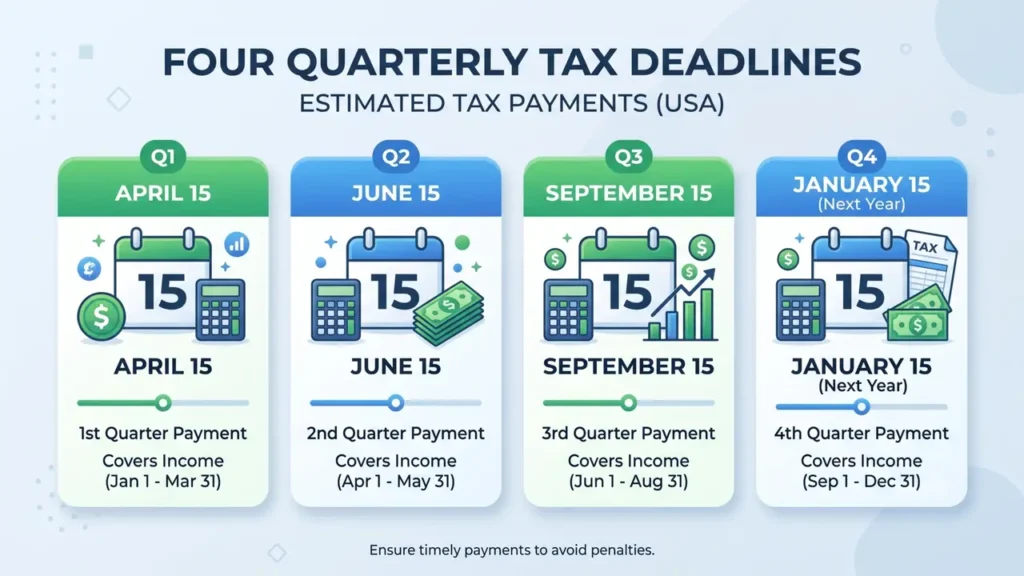
These are known as quarterly estimated taxes, and they’re due:
- April 15
- June 15
- September 15
- Fifteen days of January (of the next year)
Why? Since the IRS doesn’t want to wait a full year for its money. They want it when you work for it!
All the things need to be tracked!
All coffee transactions. Every software subscription. All driving done for work.
These are deductions which could reduce your taxable income. But if you don’t track them, then? They are not won, but must be purchased.
Tip #1: Investigate starting a straightforward spreadsheet RIGHT NOW. Keep a record of all business expenses, no matter how minor they may be. You will thank yourself in the future.
📌 Self-employment tax is not a subject that is talked about enough and is 15.3% of all you make.
Let’s discuss the grand old daddy of them all, self-employment taxes.
This comes as a surprise to so many new freelancers. People, in fact, have been seen to go wild when they find it!
So, What is the Self-Employment Tax?
Self-employment tax is the tax that you pay for your Social Security and Medicare. While you had a normal job, you paid 7.65%, and your employer paid 7.65% as well.
Now you’re self-employed. You pay the full 15.3%:
- 12.4% for Social Security
- 2.9% for Medicare
The best part of this is that this is in addition to your income tax!
To figure the self-employment tax,
you must first determine your net earnings.
Let’s take a real-life example to teach you some math.
Now let’s assume that you earned $50,000 in freelance income this year. The way it works is:
Take the total amount of money you have earned from your business and subtract the cost of your business. How to Pay Freelance Taxes in the USA
👉 How to Start Freelancing With No Experience:
Step 2: Multiply by 92.35% (the IRS lets you exclude 7.65%)
$45,000 × 0.9235 = $41,557.50
- Gross income: $50,000
- Business expenses: -$5,000
- Net income: $45,000
Step 3: Multiply by 15.3%
$41,557.50 × 0.153 = $6,358.30
There you have your self-employment tax: $6358.30.
Not to mention still before your income tax.
Brutal, right? The best part – it’s good news.
The Silver Lining
The 50% deduction of your self-employment taxes from your income. Adopting our above example:
$6,358.30 ÷ 2 = $3,179.15 deduction
This will reduce your adjusted gross income, and therefore, reduce the income tax you’ll be charged.
Beginning Note: Self-employment tax is only applied to earnings in excess of $400. If you were earning less than that freelancing, then you can breathe a sigh of relief, and you don’t have to pay this tax. How to Pay Freelance Taxes in the USA
📌 What percentage of your income should you save for taxes?

The one question I am asked the most is: “What amount of each payment should I be saving for taxes?”
Well, it depends on your income level, but I’ll give you some good guidelines.
The 25-30% Rule
Save 25-30% of all monies received.
I know, I know. That’s a LOT! However, the details are as follows:
- 15.3% for self-employment tax
- Federal income tax of 10-22% (based on tax bracket)
- The state income tax rate is 0-13% (varies by state)
Do the math, and 25-30% is in fact quite close to reality for most freelancers.
Income-Based Savings Chart
The following table can be useful to help you know how much to save, given your freelance income per year:
👉IRS quarterly payment deadlines
| Annual Freelance Income | Estimated Tax Rate | Amount to Save Per $1,000 Earned |
|---|---|---|
| $0 – $20,000 | 25% | $250 |
| $20,001 – $40,000 | 27% | $270 |
| $40,001 – $60,000 | 30% | $300 |
| $60,001 – $100,000 | 32% | $320 |
| $100,001+ | 35%+ | $350+ |
Note: These are of course just estimates. This rate is subject to deductions, any State taxes, etc.
My Simple System (That Actually Works)
The answer is, this is what I do and what I recommend to all new freelancers:
Start a different savings account in the name of “Tax Money” or “Uncle Sam’s Cut” – whatever is meaningful to you. How to Pay Freelance Taxes in the USA
Deposit 30% of every paycheck into this account.
Got paid $1,000? Transfer $300 to the tax account.
Got paid $500? Transfer $150.
Do not come in contact with this money. Ignore it, pretend it is not there.
At quarter tax time, you’ll be able to pull that money out. No stress. No scrambling. No panic.
Common Mistake: Don’t wait till the end of the quarter to save. That’s because by this time the funds have been allocated to rent, food or to buy that new laptop you “needed. Save immediately.
📌 Quarterly Estimated Taxes Explained (Yes, You Pay 4 Times a Year)
So, let’s get a handle on quarterly taxes. Now it’s for real. How to Pay Freelance Taxes in the USA
The IRS expects pay taxes as you earn money throughout the year, as you are making income. Imagine it as your employer deducting it out of your paychecks – just that you’re in charge of it.
When Are Quarterly Taxes Due?
Mark these dates in your calendar RIGHT NOW:
Q1 (Jan 1 – March 31): Due April 15
Q2 (April 1 – May 31): Due June 15
Q3 (June 1 – Aug 31): Due September 15
Q4 (Sept 1 – Dec 31): Due January 15 (next year)
Notice anything weird? The quarters don’t really equal quarters. The months of June and August are shorter in length. I don’t know why – the IRS has its mysterious ways. ys.
Who is Liable to pay Quarterly Taxes?
If you will owe $1,000 or more in taxes at the end of the year, you will need to make quarterly payments. How to Pay Freelance Taxes in the USA
An alternative approach to figuring it out is to use this rule of thumb: If you earn more than $5,000-$6,000 a year freelancing, you should be paying quarterly.
If you want to know how much your quarterly payment is, simply multiply the amount you’ll pay each month by 3.
There are two methods:
Safe Harbour Method (Easiest): Method 1
See last year’s total tax. Divide by 4. Send the above quarterly.
For instance, you were paying a total of $8,000 for taxes last year.
$8,000 ÷ 4 = $2,000 per quarter
As long as you pay this amount, you won’t get penalised – even if you owe more.
This is the actual method, and it will be more accurate (method 2):
Make an approximation of what your earnings for the year will be. Work out the amount of tax you will be liable to pay. Divide by 4.
This is trickier as it is a guess of your income, but it is more accurate if you have a big fluctuation in your income. How to Pay Freelance Taxes in the USA
To pay freelancer quarterly taxes, follow these steps:
There are some payment options:
IRS Direct Pay (Free): You can pay the IRS online via direct payment.
Please visit irs.gov/directpay and make a bank payment. No fees. Takes 5 minutes.
Choice #2: EFTPS (Electronic Federal Tax Payment System).
It’s free; however, you must first sign up. A great solution for advanced payment options.
Option 3: Credit/Debit Card
Easy, but will be charged a processing fee (about 2%). It can only be worth it if you’re getting cash-back rewards. How to Pay Freelance Taxes in the USA.
Send a Check: Send a check to the address provided above.
Old-fashioned but it is effective. Fill out 1040-ES and send with the check.
Pro Tip: I’ve been doing IRS Direct Pay, and I do it the same day each quarter. I put in a calendar reminder for the 14th (1 day before it’s due) so that I don’t forget!
📌 Before starting to work on your taxes, you should get acquainted with the tax forms you need.
Tax forms may sound intimidating, but they are nothing more than paperwork. I’m going to walk you through the ones that you will use. How to Pay Freelance Taxes in the USA.
Forms You’ll Receive
1099-NEC (Nonemployee Compensation)
Freelancer version of a W-2. If your clients paid you $600 or more during the year, they should mail you this to you by Jan. 31.
It will display the amount that they paid you. These are the numbers that you will need to complete your tax return.
Important: Just because a client doesn’t send you a 1099-NEC doesn’t mean that you should not report the income. The IRS is aware. How to Pay Freelance Taxes in the USA.
👉 Compare business credit cards.
Forms You’ll File
Schedule C (Profit or Loss from Business)
is a tax form that is used to report the net income from a business.
This is where everything that you brought in and spent for your freelance work goes. It is a part of your common 1040 tax return. How to Pay Freelance Taxes in the USA.
You’ll list:
- Total income
- All business expenses (will discuss deductions in the next section)
- The amount you made (or lost) after paying out your expenses
SCHEDULE SE (Self-Employment Tax)
This will determine your self-employment tax (15.3% that we have discussed above).
All the numbers are calculated in the form — you simply enter your net profit (from Schedule C).
This is Form 1040-ES (Estimated Tax for Individuals).
This is the form that you use to figure and pay your quarterly estimated taxes.
It has a worksheet that will assist you in determining the quarterly payment amount.
Quick Reference: Freelance Tax Forms
| Form Name | What It’s For | When You Need It |
|---|---|---|
| 1099-NEC | Reports income from clients | Received by Jan 31 |
| Schedule C | Report business income/expenses | Filed with annual return |
| Schedule SE | Calculate self-employment tax | Filed with annual return |
| Form 1040 | Your main tax return | Filed by April 15 |
| Form 1040-ES | Calculate quarterly payments | Used 4 times per year |
Note for beginners: Not all the wording of these forms needs to
be understood. TurboTax or FreeTaxUSA will guide you through each step of the tax software process. How to Pay Freelance Taxes in the USA.
📌 Deductions That’ll Save You Thousands (Don’t Miss These!)
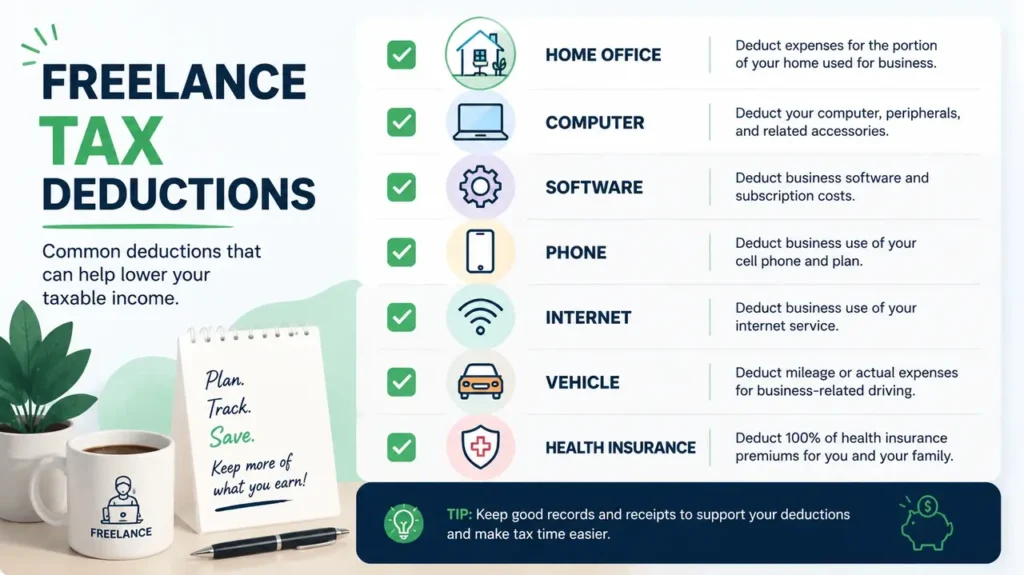
Okay, here’s where we get your money BACK.
Tax deductions lower your taxable income. And when you’re paying 30-35% in taxes, every deduction makes a real difference.
Let me show you the deductions most freelancers miss.
The Big Money Deductions
Home Office Deduction
If you have a dedicated space in your home for work, you can deduct a portion of your rent, utilities, and home expenses. How to Pay Freelance Taxes in the USA.
Two methods:
Simplified Method: $5 per square foot of office space (up to 300 sq ft = $1,500 max)
Regular Method: Calculate the percentage of your home used for business and deduct that percentage of all home expenses.
Example: Your office is 150 square feet, your home is 1,500 square feet.
150 ÷ 1,500 = 10% of your home
You can deduct 10% of:
- Rent or mortgage interest
- Utilities
- Internet
- Homeowners insurance
- Repairs and maintenance
Vehicle Expenses
If you drive for work (meeting clients, picking up supplies, etc.), you can deduct:
Standard Mileage Rate: 65.5 cents per mile (2023 rate)
Actual Expense Method: Track actual costs (gas, insurance, repairs) and deduct the business-use percentage
Pro Tip: Use an app like MileIQ or Stride to automatically track your business miles. It’s worth hundreds or thousands in deductions. How to Pay Freelance Taxes in the USA.
Everyday Business Expenses You Can Deduct
Here’s a checklist of common deductions:
Technology & Equipment:
- Computer, laptop, tablet
- Phone and phone bill (business portion)
- Software subscriptions (Adobe, Microsoft, Grammarly, etc.)
- Website hosting and domain
- Camera and equipment
- Printer, scanner, supplies
Professional Development:
- Online courses and training
- Books and educational materials
- Conference and workshop fees
- Professional memberships
Marketing & Business Promotion:
- Business cards
- Website costs
- Advertising (Google Ads, Facebook Ads)
- Social media tools (Hootsuite, Buffer)
Business Services:
- Accounting software (QuickBooks, FreshBooks)
- Payment processing fees (PayPal, Stripe)
- Virtual assistant services
- Legal and professional fees
- Bank fees for business accounts
Office Supplies:
- Pens, paper, notebooks
- Desk, chair, filing cabinet
- Office decorations (if for client meetings)
Travel (If Business-Related):
- Airfare
- Hotels
- Meals (50% deductible)
- Transportation
The Health Insurance Deduction
This is HUGE, and so many freelancers miss it. How to Pay Freelance Taxes in the USA.
If you’re self-employed and pay for your own health insurance, you can deduct 100% of your premiums. Not just the business portion – ALL of it.
This deduction can save you thousands. How to Pay Freelance Taxes in the USA.
Deductions Comparison: Write-Off vs. Actual Savings
| Deduction Amount | Your Tax Rate | Actual Tax Savings |
|---|---|---|
| $1,000 | 30% | $300 |
| $5,000 | 30% | $1,500 |
| $10,000 | 30% | $3,000 |
| $20,000 | 30% | $6,000 |
See why tracking expenses matters?
Common Mistake: Mixing personal and business expenses. Keep them separate. Get a business credit card or bank account. Makes tax time SO much easier. How to Pay Freelance Taxes in the USA.
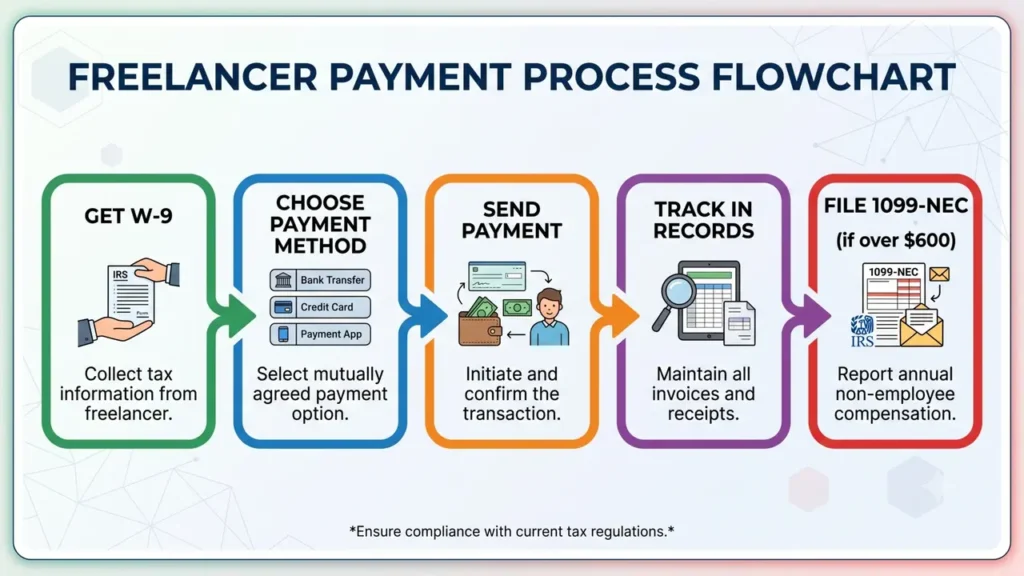
📌 Step-by-Step: How to Pay a Freelancer (For Business Owners)
Okay, let’s flip the script for a second.
Maybe you’re not just a freelancer – maybe you’re also hiring freelancers for your business. Or you’re planning to.
Here’s exactly how to pay freelancers correctly (so you don’t mess up THEIR taxes or yours).
Step 1: Classify Them Correctly
First, make sure they’re actually a freelancer (independent contractor) and not an employee.
Independent Contractor:
- Controls when and how they work
- Uses their own tools and equipment
- Works for multiple clients
- Sets their own rates
- No benefits provided
Employee:
- You set their schedule
- You provide tools and training
- Works exclusively for you
- You control how work is done
- You provide benefits
Get this wrong, and you could face penalties. When in doubt, consult an accountant.
Step 2: Get a W-9 Form
Before you pay any freelancer a single dollar, get a completed W-9 form from them.
This form provides:
- Their legal name
- Their address
- Their Social Security Number or EIN
You’ll need this info to file their 1099-NEC at the end of the year.
Pro Tip: Use a service like HelloSign or DocuSign to collect W-9s electronically. Saves time and keeps everything organised. How to Pay Freelance Taxes in the USA.
Step 3: Choose Your Payment Method
You have several options for how to pay a freelancer:
| Payment Method | Pros | Cons | Best For |
|---|---|---|---|
| PayPal | Fast, widely accepted | 2.9% + $0.30 fee | Small, quick payments |
| Venmo/Zelle | Free, instant | Not professional, no invoice tracking | Very small amounts |
| Bank Transfer/ACH | Low fees, professional | Takes 2-3 days | Regular, larger payments |
| Check | Simple, traditional | Slow, requires mailing | Older freelancers |
| Wise (TransferWise) | Great for international | Fees vary | International freelancers |
| Stripe | Integrated with invoicing | 2.9% + $0.30 fee | Regular contractors |
I personally use a mix of PayPal for quick payments and direct bank transfer for regular contractors. How to Pay Freelance Taxes in the USA.
Step 4: Track Every Payment
This is CRITICAL for your business taxes.
Every payment to a freelancer is a business expense deduction for you. Track:
- Who you paid
- How much
- What date
- What the payment was for
Use accounting software like QuickBooks or Wave (free) to keep everything organised.
Step 5: File 1099-NEC Forms (If Required)
If you paid a freelancer $600 or more during the tax year, you MUST file a 1099-NEC.
Deadline: January 31
You’ll need to:
- Send Copy B to the freelancer
- Send Copy A to the IRS
- Keep Copy C for your records
Pro Tip: Use a service like Tax1099.com or your accounting software to file 1099s electronically. It’s easier and faster than paper filing. How to Pay Freelance Taxes in the USA.
What Happens If You Don’t File 1099s?
Penalties range from $50 to $290 per form, depending on how late you are.
Plus, if the IRS thinks you’re intentionally avoiding filing, penalties can be much higher.
Don’t risk it. Just file the forms.
📌 Setting Up Your Tax Payment System
Let’s get practical. Here’s how to set up a system that makes paying freelance taxes almost automatic.
Your Tax System in 4 Simple Steps
Step 1: Separate Business Bank Account
Open a business checking account today. Even a simple free account works.
Why? Because mixing personal and business money is a nightmare come tax time.
All freelance income goes into this account.
All business expenses come out of this account.
Simple.
Step 2: Tax Savings Account
Open a second account specifically for taxes.
Every time you get paid, transfer 30% to this account immediately.
Set up an automatic transfer if your bank allows it. Remove the temptation to spend it.
Step 3: Accounting System
You need to track income and expenses. Pick ONE of these:
For Simple Freelancers:
- Wave (free)
- Google Sheets with a template
- Simple Excel spreadsheet
For Growing Freelancers:
- QuickBooks Self-Employed ($15/month)
- FreshBooks ($15/month)
- Xero ($13/month)
Connect your bank account and categorise transactions as you go. Takes 5 minutes per week.
Step 4: Quarterly Tax Calendar
Set up 4 recurring calendar reminders:
- April 14: Pay Q1 taxes
- June 14: Pay Q2 taxes
- September 14: Pay Q3 taxes
- January 14: Pay Q4 taxes
I also set a reminder for the 1st of each month to review my expenses and update my tracking.
The Monthly Tax Review (15 Minutes That’ll Save You Thousands)
On the 1st of each month, do this quick review:
- Check your income: How much did you make last month?
- Review your expenses: Categorise everything, attach receipts
- Calculate tax savings: Did you transfer 30% of every payment?
- Update projections: Are you on track for quarterly payments?
That’s it. 15 minutes. Once a month. How to Pay Freelance Taxes in the USA.
Do this consistently, and tax time becomes a breeze instead of a nightmare.
📌 Common Tax Mistakes That Cost Freelancers Big Money
Let me share the mistakes I’ve seen (and made myself) that cost freelancers hundreds or thousands of dollars. How to Pay Freelance Taxes in the USA.
Mistake #1: Not Paying Quarterly Taxes
This is the #1 mistake new freelancers make.
You think, “I’ll just pay it all in April when I file my return.”
Bad idea.
The IRS charges an underpayment penalty – basically interest on the taxes you should have been paying quarterly.
This penalty can be 5-8% of what you owed. On $10,000 in taxes, that’s $500-$800 in penalties.
The Fix: Pay estimated taxes every quarter, even if they’re not perfect. Better to overpay slightly than underpay. How to Pay Freelance Taxes in the USA.
Mistake #2: Not Tracking Small Expenses
A coffee here, a notebook there, a $5 app subscription.
“It’s only $5, I won’t bother tracking it.”
Those $5 purchases add up to thousands over a year. And you’re losing 30% of that in deductions.
$5,000 in small expenses = $1,500 in tax savings you’re throwing away.
The Fix: Track EVERYTHING. Use an app like Expensify or QuickBooks to snap photos of receipts instantly. How to Pay Freelance Taxes in the USA.
Mistake #3: Mixing Personal and Business Money
Using your personal checking account for business income and expenses makes tax time a nightmare.
You’ll spend hours trying to figure out which transactions were business and which were personal.
Plus, it looks bad if you’re ever audited.
The Fix: Separate accounts. Business income and expenses in one account. Personal stuff in another. How to Pay Freelance Taxes in the USA.
Mistake #4: Forgetting About State Taxes
You’re so focused on federal taxes that you forget your state wants a cut too.
Most states charge income tax on freelance earnings. Rates vary from 0% (Texas, Florida) to 13.3% (California).
The Fix: Check your state’s income tax rate and include it in your calculations. If your state charges 5%, save an extra 5% beyond your federal savings. How to Pay Freelance Taxes in the USA.
Mistake #5: Not Keeping Tax Records
The IRS can audit you for up to 3 years (sometimes longer).
If you don’t have records to back up your deductions, they’ll disallow them. Plus penalties. Plus interest.
The Fix: Keep ALL tax records for at least 3 years. Store receipts digitally (they’re searchable and won’t fade).
Mistake #6: Trying to DIY Complex Tax Situations
Look, I’m all for doing your own taxes when things are simple.
But if you’re making over $50,000, have multiple income streams, or own a business, it’s time to hire a professional.
A good CPA costs $300-$1,000 but can save you thousands in taxes and help you avoid costly mistakes.
The Fix: Interview 2-3 tax professionals who work with freelancers. The money you save will more than pay for their fee. How to Pay Freelance Taxes in the USA.
Penalty Comparison: What Mistakes Actually Cost
| Mistake | Potential Cost |
|---|---|
| Missing quarterly payment | $200-$2,000 in penalties |
| Not tracking $5,000 in expenses | $1,500 in lost deductions |
| Late filing (no extension) | 5% per month, up to 25% of taxes owed |
| Not filing 1099s (business owners) | $50-$290 per form |
| Audit with poor records | Disallowed deductions + 20% penalty |
📌 Real-Life Example: Sarah’s First Year as a Freelancer
Let me tell you about Sarah. She’s a graphic designer who left her corporate job in January to freelance full-time.
Her story will help you see how all this tax stuff works in real life.
Sarah’s Income
Total freelance income in Year 1: $62,000
She had 8 regular clients and several one-off projects. Here’s her monthly breakdown:
- January-March: $12,000
- April-June: $16,000
- July-September: $18,000
- October-December: $16,000
Sarah’s Business Expenses
Sarah tracked every expense (good for her!):
- Home office: $3,600 (using simplified method, 240 sq ft)
- Software subscriptions (Adobe, Canva Pro): $780
- Computer and equipment: $2,200
- Website and hosting: $420
- Internet (50% business use): $360
- Phone (30% business use): $216
- Professional development (courses): $1,200
- Marketing and ads: $800
- Office supplies: $340
- Professional memberships: $240
- Miscellaneous: $344
Total business expenses: $10,500
Sarah’s Tax Calculation
Step 1: Calculate net self-employment income
Gross income: $62,000
Business expenses: -$10,500
Net income: $51,500
Step 2: Calculate self-employment tax
$51,500 × 92.35% = $47,560
$47,560 × 15.3% = $7,277 in self-employment tax
Step 3: Calculate income tax
Adjusted gross income: $51,500 – $3,639 (half of SE tax) = $47,861
After standard deduction: $47,861 – $13,850 = $34,011 taxable income
Income tax (2023 rates): Approximately $3,876
Total tax owed: $7,277 + $3,876 = $11,153
What Sarah Paid
Sarah set aside 30% of every payment, which gave her: $62,000 × 30% = $18,600
She made quarterly payments of:
- Q1: $2,400
- Q2: $2,800
- Q3: $3,000
- Q4: $2,800
Total paid: $11,000 during the year
When she filed her return, she owed an additional $153 – no big deal, and no penalties.
She got back $7,600 from her tax savings account to use for her business and personal expenses.
What Sarah Learned
Sarah told me three key lessons:
- Tracking expenses saved her $3,150 in taxes (30% of $10,500)
- Paying quarterly meant no panic in April and no penalties
- Setting aside 30% gave her a cushion and peace of mind
Sarah’s doing great now in Year 2, and she actually UNDERSTANDS her taxes instead of fearing them. How to Pay Freelance Taxes in the USA.
📌 Expert Tips from Tax Professionals
I interviewed three CPAs who specialise in working with freelancers. Here are their best tips:
Tip #1: “Open a Solo 401(k)” – Michael Chen, CPA
“Most freelancers don’t realise they can save for retirement AND reduce their tax bill at the same time.
A Solo 401(k) lets you contribute up to $66,000 per year (2023 limit). Those contributions are tax-deductible.
If you’re making $60,000 and contribute $10,000 to a Solo 401(k), you’re only taxed on $50,000. That’s a $3,000 tax savings right there.”
Tip #2: “Form an LLC or S-Corp at the Right Time” – Jennifer Martinez, EA
“Don’t rush to form a business entity your first year. But once you’re consistently making $60,000+, talk to a tax pro about forming an S-Corporation.
With an S-Corp, you can potentially save thousands on self-employment tax by paying yourself a reasonable salary and taking the rest as distributions. How to Pay Freelance Taxes in the USA.
It’s not right for everyone, but it’s worth exploring.”
Tip #3: “Invest in Tax Software from Day One” – David Thompson, CPA
“Don’t wait until tax time to think about taxes. Invest in QuickBooks Self-Employed or similar software from your very first freelance payment.
The $15/month cost pays for itself in time saved and deductions you won’t miss.
Plus, if you ever get audited, having organised records makes the process painless.”
Bonus Tip: “Hire Help When You Hit $50K” – All Three Agreed
All three tax pros agreed on this: Once you’re making $50,000 or more from freelancing, hire a professional. How to Pay Freelance Taxes in the USA.
The tax strategies they can implement will save you far more than their fee.
📌 Frequently Asked Questions About Freelance Taxes
How much should I set aside for taxes as a freelancer?
With each payment you receive, you should save 25-30%. This includes the federal income tax (10-22%), the self-employment tax (15.3%) and state income tax (if applicable). For those just beginning out and for whom a 25% contribution is affordable, that should work out. Those with higher incomes should save nearer to 30-35%.
Do I have to pay taxes if I made less than $600 freelancing?
Yes. The IRS will want you to report any income, no matter the amount. The $600 limit only applies to whether or not a client is required to provide you with a 1099-NEC form. If you make $200 freelancing, you still have to report this income on your tax return.
What happens if I miss a quarterly tax payment?
You will have to pay an underpayment penalty, which is interest on the balance and the amount you should have paid. The quarterly rate of the penalty is variable, and averages between 5-8% per year. The amount of the underpayment and the duration of the underpayment determine the amount of the penalty. If you have to file a tax return, then use Form 2210 to determine the correct penalty.
Can I deduct my laptop if I use it for both personal and business?
However, only the business use percentage. You may claim 70% of the laptop’s cost if you work 70% of the time and use it 30% for personal reasons. Ensure that you have records that show the percentage of business use. If the item is worth more than $2,500, it might be necessary to depreciate the item over several years as opposed to deducting the entire amount in one year.
Do I need an LLC to be a freelancer?
No, one can be a sole trader without incorporation; it’s just freelance. Lots of working freelancers function this way for many years. But an LLC offers liability protection and may offer tax advantages when you’re making a substantial income ($60,000 and more). Discuss the time of formation of an LLC or other entity with a tax adviser.
How do I pay freelance taxes if I have a full-time job too?
If your employer doesn’t withhold enough for your freelance income as well as for your job, you will have to pay quarterly estimated taxes on your freelance income. Add up your total tax owing from both sources, total your employer’s deductions and then pay the balance quarterly. If you don’t like the hassle of quarterly payments, you might want to consider changing your W-4 and getting more withheld.
What’s the difference between a 1099-NEC and a 1099-MISC?
The 1099-NEC (Nonemployee Compensation) is a 1099 form that is used to report payments to independent contractors for services. Starting in 2020, it is replacing Box 7 of the 1099-MISC. Now, the 1099-MISC is used for other kinds of income such as rent, prizes, awards and other miscellaneous income. The 1099-NEC forms will be sent to you by the people you rendered services to as a freelancer.
📌 CONCLUSION: You’ve Got This!
Look, I get it.
Taxes aren’t fun. They’re not exciting. No one wants to spend that Saturday afternoon doing some quarterly calculations.
But here’s the truth: understanding how to pay freelance taxes in the USA is one of the most valuable skills you’ll develop as a freelancer.
It means the difference between retaining 70% and 60% of earnings.
It’s April panic vs April confidence.
The IRS penalties vs. extra funds in your pocket!
Let me leave you with this simple action plan:
This Week:
- Open a separate tax savings account
- Start a simple expense tracking system (even a spreadsheet works)
- Calculate 30% of your current balance and transfer it to savings
This Month:
- Get tax software or set up an accounting system
- Organise all receipts and income records
- Calculate your first quarterly payment
This Quarter:
- Make your quarterly estimated tax payment
- Review and categorise all expenses
- Adjust your savings percentage if needed
This Year:
- Consider hiring a tax professional
- Set up a retirement account (Solo 401k or SEP IRA)
- Evaluate whether forming an LLC makes sense
You don’t need to be perfect. You just need to START.
Save 30%. Pay quarterly. Track expenses. File on time.
Do those four things, and you’ll be ahead of 80% of freelancers out there.
The freedom of freelancing is worth the extra tax complexity. And honestly? Once you have a system in place, it’s not even that complicated. How to Pay Freelance Taxes in the USA.
You’ve got this. I’m rooting for you.
📌 SHARE THIS GUIDE
If this guide has been helpful to you, then tell a friend or a colleague about it who is interested in freelancing or simply needs some information on how to pay taxes as a freelancer!
The more freelancers that know what they are up against when it comes to taxes, the better for everyone! Let’s create a community of educated and empowered freelancers that don’t dread April 15th!
2 thoughts on “How to Pay Freelance Taxes in the USA: The Ultimate Beginner Guide That’ll Save You Thousands”