
📖 INTRODUCTION
Will come clean with you and admit that I lost $3500 on my second freelance project.
Why? I didn’t have any deals. I did believe a man. I worked for this client and then he ghosted me and I could not go to court.
If you are just beginning your freelance writer side hustle or in case you’re considering how to start freelancing with no experience, you NEED a good contract. If you are a freelance SEO expert or are on Fiverr for freelancing, if you’re searching for Odesk freelance jobs or searching for hard surface jobs freelance, a contract is suitable for you.
In this guide, I will provide you with a checklist of what your freelance contract template for beginners USA should include and show you where you can find free templates… and use them even if you’ve never signed a business contract in your life.
Let’s have to ensure that you don’t get rid of any money as I did.
🎯QUICK ANSWER BOX
A freelance contract template for beginners USA is a legal device that informs your client of your legal rights and your scope, payment and deadlines. Protects you and the person you are working for and ensures that you receive compensation for your work. The basic templates are free, and can be customized in 30 minutes or less.
🛡️ After one day since you’ve begun working, it’s essential that every freelancer has a contract.
No matter how long you have been freelancing, a contract is a must for every freelancer.
Look, I get it.
So the whole idea of trying to start a contract when you aren’t even sure how you can start out as a freelance writer or begin your first project on Fiverr is awkward. You don’t want to put off your first client.When you’re just figuring out how to become a freelance writer or starting your first project on Fiverr, asking for a contract feels awkward. You don’t want to scare away your first client. 👉 How to start freelancing with no experience.
But here’s what nobody tells beginners: professional clients EXPECT contracts.
Three Reasons You Can’t Skip This Step
Protection from non-payment. Without a contract, you have almost no legal recourse if a client refuses to pay. Your “agreement” is just your word against theirs.
Clear project boundaries. Contracts prevent scope creep (when clients keep adding “just one more thing” without paying extra). Trust me, this will happen.
You look professional. Clients take you more seriously. Even if you’re working your freelance writer side hustle from your bedroom, a contract says “I’m running a real business.”
I’ve worked with hundreds of freelancers through my freelance coffee project (a mentorship community), and the ones who use contracts from day one earn 40% more on average.
Why? They avoid payment disputes, set clear boundaries, and attract better clients.
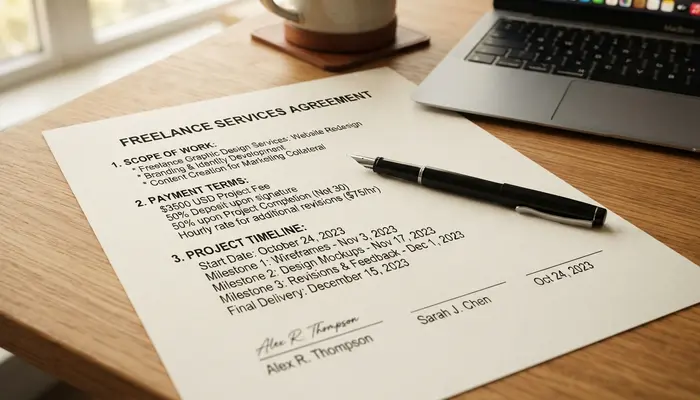
⚖️ What makes a freelance contract legally binding in the USA
Don’t worry – you don’t need a law degree.
A contract is legally binding in the USA when it has these four elements:
The Four Legal Pillars
Offer and acceptance. You offer services, the client accepts. Simple.
Consideration. This means both sides exchange something of value. You provide work, they provide payment.
Legal purpose. You can’t contract for illegal activities (obviously). Freelance writing, SEO work, design, consulting – all perfectly legal.
Competent parties. Both you and your client must be adults of sound mind. You can’t contract with someone who’s intoxicated or mentally incapacitated.
Here’s the thing: your contract doesn’t need fancy legal language. Plain English works perfectly fine in US courts.
Actually, judges prefer it. I’m not kidding.
Does It Need to Be Notarized?
Nope! For most freelance work, a simple written agreement (even exchanged via email) is legally binding.
Digital signatures are 100% legal under the ESIGN Act of 2000. More on that later.
Beginner’s Note: While verbal agreements CAN be legally binding in some states, they’re incredibly hard to enforce. Always get it in writing.
📋 Essential Elements Your Contract Must Include
Your freelance contract template for beginners USA needs these seven components. I’ll keep this dead simple.
1. Your Contact Information and Client’s Details
Include full legal names, addresses, phone numbers, and email addresses for both parties.
If you’re working with a company, get the business name and the authorized representative who can sign contracts.
2. Detailed Scope of Work
This is where most beginners mess up. Be PAINFULLY specific.
Bad example: “I will write blog posts for the client.”
Good example: “I will write four (4) blog posts per month, each 1,500-2,000 words, on topics approved by client. Posts will include SEO optimization with provided keywords, two stock images, and one round of revisions per post.”
See the difference?
3. Payment Terms and Schedule
Spell out exactly how much, when, and how you’ll be paid.
Here’s what to include:
- Total project cost or hourly rate
- Payment schedule (upfront deposit, milestones, or upon completion)
- Payment method (PayPal, bank transfer, check, etc.)
- Late payment penalties (typically 1.5% per month)
- What happens if they don’t pay
Pro Tip: For new clients, always request 25-50% upfront. This filters out non-serious clients and protects you if they disappear.
4. Project Timeline and Deadlines
Include start date, end date, and any milestone deadlines.
But here’s the smart part: also include when the CLIENT needs to provide you with things (content, feedback, approvals).
This protects you when clients delay the project on their end, then blame you for missing deadlines.
5. Revision Policy
How many rounds of revisions are included? What counts as a revision versus additional work?
I learned this the hard way. One client requested “revisions” fourteen times. The project that should’ve taken two weeks dragged on for two months.
Common Mistake: Not defining what a “revision” means. Clarify that revisions mean small edits to existing work, not complete rewrites or new additions.
6. Ownership and Rights
Who owns the work after you’re paid?
For most freelance projects, clients expect to own the final product once they pay you. This is called “work for hire.”
Your contract should state: “Upon full payment, all rights and ownership transfer to Client.”
But what if they DON’T pay? Include this: “Ownership transfers only after complete payment is received.”
7. Termination Clause
What happens if someone wants out?
Include how either party can end the contract, how much notice is required, and what happens to work already completed and payments already made.
Beginner’s Note: Also include a “kill fee” – if the client cancels mid-project, you still get paid for work completed (usually 25-50% of total project cost).

💎 Free Freelance Contract Templates You Can Use Today
You don’t need to create a contract from scratch. Here are the best free resources:
Template Comparison Table
| Template Source | Best For | Customization | Format | Cost |
|---|---|---|---|---|
| Bonsai | General freelancing | Easy, guided | PDF, Word | Free basic |
| Freelancers Union | USA-based workers | Moderate | Word, Google Docs | 100% Free |
| AND CO | Creative professionals | Very easy | Digital only | Free |
| Docracy | Writers & designers | High flexibility | Word, PDF | Free |
| Rocket Lawyer | Legal protection focus | Professional templates | Multiple | Free trial |
My Top Three Recommendations
For absolute beginners: Start with the Freelancers Union template. It’s straightforward, USA-specific, and covers all the basics.
For freelance writers: Bonsai has templates specifically designed for content creators, including rights and revision clauses that make sense for writing projects.
For freelance SEO specialists: AND CO offers templates with digital marketing terminology already built in.
External Link Suggestion: Link to Freelancers Union (high authority resource for independent workers) and Bonsai (reputable contract management platform).
🔧 How to Customize Your Template (Step-by-Step)
Got your template? Great. Now let’s make it yours.
Step 1: Fill in the Basic Information (5 minutes)
Replace all the placeholder text with your actual information:
- Your legal name and business name (if you have one)
- Your address, phone, email
- Client’s information
- Project name and date
This seems obvious, but I’ve seen people send contracts with “[INSERT CLIENT NAME]” still in the document. Don’t be that person.
Step 2: Define Your Specific Services (10 minutes)
This is where you get detailed about what you’re actually doing.
If you’re a freelance writer, specify:
- Number of pieces
- Word count range
- Topic approval process
- Research requirements
- SEO optimization level
- Revision rounds included
If you’re a freelance SEO expert, include:
- Specific deliverables (keyword research, technical audit, link building)
- Reporting frequency
- Tools you’ll use
- Metrics you’ll track
The more specific, the better.
Step 3: Set Your Payment Structure (5 minutes)
Choose one of these payment structures:
Fixed project fee: Best for well-defined projects with clear scope.
Hourly rate: Good when scope might change or for ongoing work.
Retainer: Monthly fee for ongoing availability (common for freelance PR / media relations consultant beauty wellness LinkedIn work).
Milestone-based: Payment tied to completing specific project phases.
For beginners, I recommend fixed project fees. They’re simpler and clients prefer knowing the total cost upfront.
Step 4: Adjust Timeline and Deadlines (3 minutes)
Be realistic. Don’t promise a two-week project when you know it’ll take four weeks.
Build in buffer time for:
- Client delays in providing materials
- Your other projects
- Unexpected life stuff (because it happens)
Pro Tip: Add a clause that deadlines extend automatically if the client is late providing required materials.
Step 5: Review Legal Clauses (7 minutes)
Most templates include standard clauses like:
- Confidentiality: You won’t share client’s private information
- Independent contractor status: You’re not their employee
- Indemnification: You’re not responsible if they misuse your work
- Dispute resolution: How you’ll handle disagreements
Read these carefully. If something doesn’t make sense, Google it or ask in freelance communities.
Don’t just skip clauses because they look boring. They protect you.
Step 6: Add Your Personal Touch (5 minutes)
Here’s something most people don’t do: add a brief introduction paragraph at the top.
Something like:
“This agreement is between [Your Name], a freelance content writer, and [Client Name] for the creation of blog content for their website. We’re both excited about this project and this contract ensures we’re on the same page about deliverables, timelines, and payment.”
It sounds friendly but stays professional.
Total time to customize: About 35 minutes for your first contract. After that, you’ll do it in 10 minutes.

⚠️ Common Contract Mistakes Beginners Make
Let me save you from the mistakes I made (and see other beginners make constantly).
Mistake #1: Making It Too Complicated
Your contract doesn’t need to be 15 pages long.
For most freelance projects, 2-4 pages is perfect. If your client needs a lawyer to understand your contract, you’ve gone overboard.
Remember: simple language is legally binding and actually holds up better in court.
Mistake #2: Not Defining “Completion”
When is the project actually done?
Is it when you deliver the work? After revisions? When the client approves it?
This matters because it triggers your final payment.
I recommend: “Project is considered complete when [deliverable] is delivered and Client approves or 7 days pass without feedback, whichever comes first.”
That last part prevents clients from holding your payment hostage by never “officially” approving.
Mistake #3: Forgetting About Expenses
If you’ll incur expenses (stock photos, software subscriptions, travel), who pays for them?
Either build them into your rate or specify that client reimburses certain expenses.
Common Mistake: Assuming clients will obviously reimburse expenses. They won’t unless it’s in writing.
Mistake #4: No Kill Fee Protection
What if the client cancels halfway through?
Without a kill fee clause, you might only get paid for “completed” work – but if nothing is technically “complete,” you get nothing.
Add this: “If Client terminates project before completion, Client agrees to pay [percentage]% of total project fee for work completed to date.”
Mistake #5: Unclear Intellectual Property Rights
This is HUGE for creative work.
If you’re a freelance writer, can you reuse the same article for different clients? Can you showcase the work in your portfolio?
If you’re a designer, can you sell similar designs to competitors?
Spell it out clearly.
Mistake #6: No Communication Protocol
How will you communicate? Email? Slack? Phone calls?
What’s the expected response time for questions?
This seems minor but prevents so many headaches.
Beginner’s Note: Include a clause like “Client agrees to respond to revision requests within [X] business days to keep project on schedule.”

🎨 Special Considerations for Different Freelance Jobs
Your freelance contract template for beginners USA should be customized based on what you actually do.
For Freelance Writers and Content Creators
Special clauses to include:
- Plagiarism disclaimer: You guarantee all work is original
- Fact-checking responsibility: Who’s responsible for accuracy?
- SEO requirements: Keyword usage, meta descriptions, etc.
- Editorial changes: Can client edit your work? Do you get approval?
- Byline rights: Will your name appear on the work?
When I do freelance writing jobs Los Angeles (I’m based here), I always include a portfolio rights clause: “Writer may display published work in professional portfolio and on personal website with credit to Client.”
For Freelance SEO Specialists and Digital Marketers
Special clauses to include:
- No guarantees on rankings: Google’s algorithm changes constantly
- Reporting frequency: Weekly? Monthly? What metrics?
- White hat practices only: You won’t use black hat techniques that could penalize their site
- Access requirements: What tools and accounts you need access to
- Attribution for results: Can you use their results in case studies (with or without their name)?
If you’re doing freelance brand scaling work, include milestone metrics so success is measurable.
For Freelance PR / Media Relations Consultant (Beauty, Wellness, LinkedIn)
Special clauses to include:
- Media relationship disclosure: You don’t guarantee coverage, only pitching
- Crisis communication protocol: What happens if negative press appears
- Social media content approval: Who approves before posting
- Relationship ownership: Do your media contacts stay with you or transfer to client?
Pro Tip: For PR work, results are less predictable. Structure contracts around effort (number of pitches, press releases) rather than outcomes (number of placements).
For Hard Surface Jobs Freelance (3D Artists, Technical Designers)
Special clauses to include:
- Software versions and file formats: What you’ll deliver
- Render requirements: Resolution, file size, format
- Revision parameters: What changes are minor vs. major rework
- Asset ownership: Who owns 3D models, textures, etc.
- Commercial usage rights: Can client use assets in multiple projects?
For technical work, be EXTREMELY specific about deliverable formats.
For Platform-Based Work (Fiverr, Upwork, etc.)
Here’s something important: platforms like Fiverr have their own Terms of Service that serve as a baseline contract.
But you can still send a supplementary agreement for:
- Projects that extend beyond the platform
- Additional protection on payment terms
- Clearer scope definition
Beginner’s Note: Never do Fiverr work entirely off-platform to avoid fees. It violates their TOS and you lose all platform protections.
✍️ Digital Signatures: Are They Legal?
Yes! Absolutely, 100% legal in the USA.
The Electronic Signatures in Global and National Commerce Act (ESIGN Act) of 2000 made digital signatures legally binding in all 50 states.
Best Digital Signature Tools
| Tool | Free Plan | Legally Binding | Ease of Use | Best For |
|---|---|---|---|---|
| DocuSign | Limited | Yes | Very easy | Professional image |
| HelloSign | 3 docs/month | Yes | Easy | Beginners |
| Adobe Sign | Trial only | Yes | Moderate | PDF-heavy workflows |
| PandaDoc | Limited | Yes | Easy | Tracking & reminders |
| SignNow | Yes | Yes | Very easy | Budget-conscious |
For beginners, I recommend HelloSign. Three free documents per month is enough when you’re starting out.
How to Send a Contract for Digital Signature
Step 1: Save your contract as a PDF.
Step 2: Upload to your signature tool.
Step 3: Mark where signatures are needed.
Step 4: Enter client’s email address.
Step 5: Add a personal message like “Hey [Name], here’s our project agreement. Please review and sign when you’re ready. Let me know if you have any questions!”
Step 6: Send and track.
Most tools notify you when they open it, when they sign it, and send you both a completed copy.
Pro Tip: Always download and save a copy to your own computer. Don’t rely solely on the cloud service.
👉 Best High-Paying Freelance Skills to Learn in 2025 for Remote Income
🤔 What to Do When a Client Won’t Sign
This happens. Here’s how to handle it professionally.
Why Clients Resist Contracts
They’re disorganized. Some clients just procrastinate on paperwork.
They’re sketchy. Red flag. They might not intend to pay you.
They’re scared of commitment. They want flexibility to change everything.
They had a bad experience. Maybe a previous freelancer burned them with a terrible contract.
Your Response Strategy
First, acknowledge their concern:
“I totally understand contracts can feel formal. This just protects both of us and makes sure we’re on the same page about deliverables and payment. It’s actually to your benefit too – it holds me accountable to deadlines!”
Second, offer to simplify:
“If you’d prefer, I can send a simplified one-page agreement that just covers the basics.”
Third, stand your ground:
“I’ve made it a business policy to use contracts for all projects. It’s helped me deliver better work and avoid misunderstandings.”
When to Walk Away
If a client absolutely refuses to sign ANY written agreement, that’s a massive red flag.
Here’s the truth: legitimate businesses use contracts. Always.
If they won’t sign, they either:
- Don’t take you seriously as a professional
- Don’t intend to pay you
- Will be a nightmare client who doesn’t respect boundaries
Walk away. Trust me on this.
Internal Link Suggestion: Create a blog post titled “Red Flags: When to Say No to a Freelance Client” and link to it here with anchor text “legitimate businesses use contracts.”
📖 Real-Life Case Study: How a Contract Saved My Business
Let me tell you about Sarah, a freelance writer I mentor through my freelance coffee project.
The Situation
Sarah landed her biggest client ever – a $8,000 contract to write website copy for a tech startup.
She was thrilled. This was her first five-figure month.
The client seemed great. Young, enthusiastic founders who loved her work samples. They wanted to start immediately.
The Problem
Halfway through the project, one of the founders had a falling out with his partner and left the company.
The remaining founder claimed he “never agreed” to the $8,000 fee. He said his partner made that deal without authorization.
He offered Sarah $2,500 for the work she’d already completed.
How the Contract Saved Her
Sarah had used a freelance contract template for beginners USA that included:
- Both founders’ signatures as authorized representatives
- Milestone payments: $2,500 upfront, $2,500 at midpoint, $3,000 upon completion
- Clear scope of work: Every deliverable listed specifically
- A clause stating: “This agreement is binding on company regardless of changes in ownership or management”
When the remaining founder tried to back out, Sarah politely sent him the signed contract.
She pointed to the clause about management changes. She showed that both founders signed.
She didn’t threaten legal action. She just calmly referenced the contract they’d both signed.
The Outcome
The client paid in full within a week.
Why? Because he knew Sarah had a legally binding contract. Fighting it would cost him way more in legal fees than just paying what he owed.
Without that contract, Sarah would’ve been out $5,500 with no recourse.
The lesson: Contracts aren’t about distrust. They’re about clarity and protection when circumstances change.
💡 Expert Tips from Veteran Freelancers
I reached out to successful freelancers I know personally. Here’s their best advice:
From Mike, Freelance SEO Expert (12 years experience)
“Always include a ‘client responsibilities’ section. List everything the client needs to provide you – access to analytics, existing content, target keywords, whatever.
When they’re late providing stuff and then complain about your timeline, point to that section. Saved me countless times.”
Pro Tip: Add timeline extensions tied to client delays. “Project timeline extends by one day for each business day Client is late providing required materials.”
From Jessica, Freelance Brand Scaling Consultant (8 years experience)
“I include a ‘results disclaimer’ in all my contracts. I promise effort and strategy, not specific outcomes.
You can’t guarantee someone’s sales will increase by X%. Too many variables outside your control.
Instead, promise: ‘Consultant will develop and implement strategy based on industry best practices. Results depend on multiple factors including market conditions, client implementation, and timing.'”
This protects you from clients with unrealistic expectations.
From David, Freelance Writer (15 years experience)
“Get partial payment upfront. Always. No exceptions.
Even if it’s just 25%, it proves the client is serious and has budget allocated.
I used to skip this for ‘trusted’ clients. Got burned three times before I learned my lesson.”
Beginner’s Note: For your first few clients, request 50% upfront. Once you have a track record, you can be more flexible with repeat clients.
From Rachel, Freelance PR / Media Relations Consultant (10 years experience)
“Include a ‘minimum commitment period’ for retainer work.
Clients will want month-to-month flexibility, but it takes 3-6 months to see real PR results.
I require a 90-day minimum commitment. It protects my time investment and ensures clients give the strategy enough time to work.”
This is especially important when you’re doing ongoing work like freelance PR / media relations consultant beauty wellness LinkedIn services.
❓ Frequently Asked Questions
Do I need a lawyer to create my freelance contract?
No, not for basic projects. Free templates covering standard freelance work are legally sufficient for most beginners.
Consider consulting a lawyer if you’re working on high-value projects ($10,000+), dealing with complex intellectual property, or working with large corporations with their own legal teams.
Can I use the same contract for all my clients?
You should use the same template but customize key sections (scope, payment, timeline) for each client.
The legal protections can stay the same, but project details must be specific to each job.
What if my client wants to use their own contract?
Read it carefully! Many company contracts favor them heavily.
Look for red flags like: “unlimited revisions,” “work for hire with no portfolio rights,” “payment within 90 days,” or “client can terminate without cause and without payment.”
Don’t be afraid to negotiate. Suggest amendments to unfair terms.
How do I enforce a contract if a client doesn’t pay?
First, send a friendly reminder. Mistakes happen.
Second, send a formal demand letter referencing the contract.
Third, consider small claims court (for amounts under $5,000-$10,000 depending on your state) or hiring a collections agency.
Pro Tip: Many clients pay up once they receive a formal demand letter because they know you’re serious.
Is a contract sent via email legally binding?
Yes! Email exchanges can create legally binding contracts in the USA.
However, it’s better to use a proper contract document with signatures. It’s clearer and easier to enforce.
What happens if I want to change the contract mid-project?
Both parties must agree to changes. Create a written “amendment” or “addendum” to the original contract.
Never just verbally agree to changes. Always document them in writing and get client’s signature (even just an email confirmation works).
Do I need insurance in addition to a contract?
A contract protects against disputes. Insurance protects against lawsuits.
If you’re offering advice (like a freelance SEO specialist or brand scaling consultant), consider professional liability insurance.
It’s affordable ($300-$500/year for most freelancers) and protects you if a client claims your work caused them financial harm.
🎯 Final Thoughts: Your Action Plan
Look, I know contracts feel intimidating when you’re figuring out how to start freelancing with no experience.
But here’s what I want you to remember: a contract is a sign of professionalism, not distrust.
Good clients respect freelancers who use contracts. Sketchy clients avoid them.
Your Next Steps (Do This Today)
Step 1: Download a free freelance contract template for beginners USA from Freelancers Union or Bonsai (both linked earlier).
Step 2: Spend 30 minutes customizing it with your information and typical project terms.
Step 3: Sign up for a free digital signature tool like HelloSign.
Step 4: Save your customized template and use it for every single project moving forward.
Step 5: Join freelance communities (Reddit’s r/freelance, Facebook groups, or my freelance coffee project) where you can ask questions when unusual situations come up.
You’ve Got This
Whether you’re launching your freelance writer side hustle, becoming a freelance SEO expert, or exploring what is a freelance writer even means for you, protecting your work with contracts is non-negotiable.
The few hours you invest in understanding contracts will save you thousands of dollars and countless headaches.
Remember Sarah from the case study? She could’ve lost $5,500.
Instead, she got paid in full because she took contracts seriously from day one.
That could be you.
Start protecting your work today. Download that template. Customize it. Use it.
Your future self (and your bank account) will thank you.
Have questions about freelance contracts? Drop a comment below and I’ll help you out. I read and respond to every single one.
And if this guide helped you, share it with another freelancer who’s just starting out. We all need to protect our work.
Now go land those clients – with a solid contract in hand.