
📌 INTRODUCTION
Did you ever get a message saying it would pay you $500 to do a two-hour writing job, only to find out that it was too good to be true?
You’re not alone. More than 47,000 Americans lost more than 68 million to freelance and employment scams last year, the Federal Trade Commission reports. It’s a life savings, college money or rent money for somebody.
The reality is that freelancing can be an amazing experience in terms of getting paid, be it you are plunging into freelance copywriting work, venturing into freelance writing side jobs, or pursuing your career as a freelance SEO expert. However, the Internet is also full of fraudsters who target novices in particular.
I have worked as a freelancer for more than 10 years, and I have been everywhere. I have avoided bad checks, phishing emails, and job opportunities posing as scams, and I have seen my friends lose hundreds of dollars to scammers.
I will demonstrate in this guide that you can easily prevent freelance scams in the USA, save your hard-earned money, and develop a legitimate freelance career and not trap into scams. Whether you are trying to get a side hustleasg a freelance writer or are seeking video editing jobs, you will know the red flags, the safety measures, and the smart moves that would keep you safe.
Let’s get started.
📌 QUICK ANSWER BOX (Featured Snippet Target)
How do you avoid freelance scams in the USA?
The best ways to prevent falling prey to a freelance scam include not paying advance fees, checking the legitimacy of clients using reputable sites such as Upwork or Fiverr, being wary of the check scam, checking the backgrounds of companies, never giving out banking information before contracts are signed, and never trusting your intuition when an offer sounds too good to be true. Never use unsafe payment strategies or unrecorded contracts.
📌 Why Freelance Scams Are Exploding in the USA
May I tell you truthfully?
Never has freelancing been more in favor. The gig economy is in full swing, and there are more than 73 million Americans freelancing in 2023. Almost half the workforce!
With the number of people who have been searching for how to start freelancing like never before, it is an ocean of opportunity for scammers. They are aware that beginners are enthusiastic, usually desperate, and are unaware of the danger signals.
The following is what makes freelancing a target:
Working at a distance is accepted. No one is surprised when a company is interested in employing you without seeing you. This provides scammers with ease in concealing themselves under false identities and stolen logos.
Financial pressure. Novices and students are in need of money. Scammers take advantage of this rush by offering easy money to do menial jobs.
Easy entry barriers. Contrary to conventional employment, freelancing does not involve intensive background checks and face-to-face inquiries. All the scammers require is an address of Gmail and a fake name of a company.
The scaling of freelance brands, freelance SEO, and freelance SEO consultantshase provided a valid opportunity, yet has opened the floodgates to fraud.
But what do you do to defend yourself?
📌 Most Common Freelance Scams (And How They Work)
The first step to defending yourself is to learn how scammers work.
I would like to discuss with you the most prevalent scams against freelancers in the USA at the moment.
The Fake Check Scam
The big daddy of freelance scams.
The following is the process: You are hired by a client to work on a project and are given a check for more than the agreed price. Their apologies that it was a mistake and request that you deposit the check and wire the balance back.
Deposit the check. It clears (or appears to). You can send the money back. Then a week later, your bank informs you that the check was counterfeit, and that you are now indebted to themfor the entire amount.
Pro Tip: Do not take a check as payment by new clients. When one insists, then it is a check scam. Walk away immediately.
The Advance Fee Scam
A company offers you a great position as a freelance SEO specialist or freelance copywriting job. But first, you need to pay for:
- Background checks
- Training materials
- Software licenses
- Certification fees
They promise to reimburse you later. Spoiler alert: they won’t.
Legitimate clients never ask you to pay upfront for the privilege of working for them.
The Personal Information Phishing Scam
You receive an offer for video editing employment or freelance writing side jobs. The “employer” sends you a long application form asking for:
- Social Security Number
- Bank account details
- Driver’s license photos
- Credit card information
They claim it’s for payroll setup or background verification.
Don’t fall for it. This is identity theft in disguise. These scam images of official-looking forms are designed to steal your information.
The Reshipping Scam
This one’s sneaky.
You’re “hired” to receive packages at your home and reship them to another address. You’re told you’re working as a logistics coordinator or package inspector.
Reality? You’re helping criminals move stolen goods. You could face legal consequences even though you’re a victim.
The Pyramid Scheme Disguised as Freelancing
You see ads promising to teach you “how to start freelancing” with guaranteed income. You just need to recruit others and buy their course first.
If the money comes from recruiting rather than actual work, it’s not freelancing—it’s a pyramid scheme.
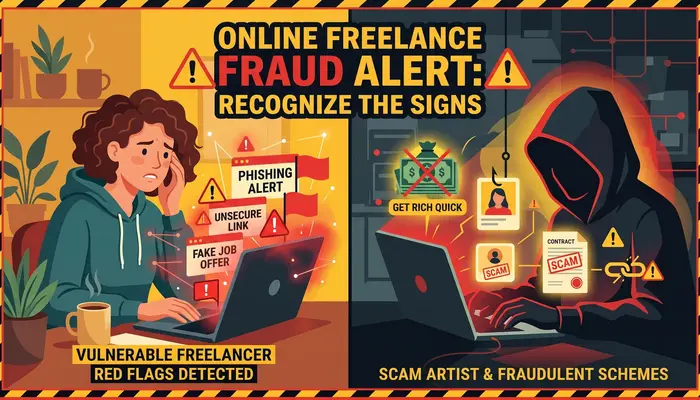
📌 Red Flags That Scream “Scam”
Your gut is not as dumb as you believe it to be.
When it does not feel right, it is likely to be so. But here are some red flags to be on the lookout for when considering freelance opportunities.
🚩 The Offer Is Too Good to Be True
Make $5,000/week working only 2 hours a day!
No experience required, join now!
When someone is trying to hire you as a freelancer and they are willing to pay you a salary higher than that of a senior with no experience, flee.
🚩 Poor Communication Quality
Professional communication is employed in legitimate businesses. Watch for:
- Emails full of spelling and grammar mistakes
- Generic greetings like “Dear Applicant”
- Mismatched company names and email domains
- Communication only through text or messaging apps
If a supposed Fortune 500 company contacts you from a Gmail account, that’s suspicious.
🚩 Pressure to Act Immediately
“We need someone TODAY!”
“This position closes in 2 hours!”
Scammers create artificial urgency to prevent you from thinking clearly or doing research.
🚩 Vague Job Descriptions
There are clear deliverables in legitimate freelance SEO specialists as well as freelance copywriting jobs. If the job description is unrealistically ambiguous, beware regarding real duties.
🚩 Requests for Money or Personal Information Upfront
I can not emphasize it enough: Real clients PAY you and not the other way around.
Anyone who requests money, bank information, or your Social Security Number without you signing a contract or completing work is probably a scam.
🚩 No Online Presence
Not able to locate the company on LinkedIn? No website? No Google reviews?
That is a gigantic red flag. There is a digital presence for even small businesses in 2024.
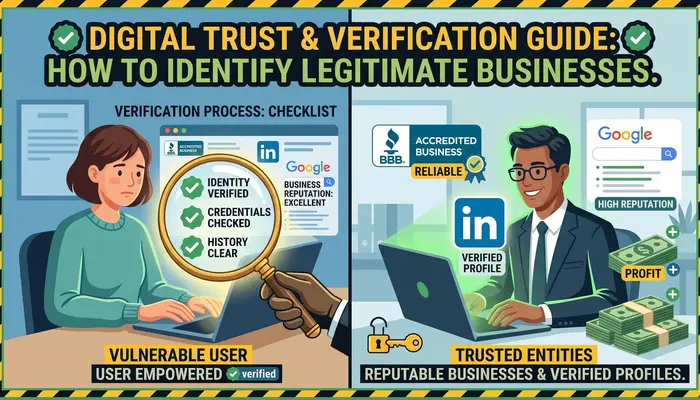
📌 How to Research and Verify Clients
Believe me on this: the time you spend researching a client for 15 minutes can save you weeks of a headache (and hundreds of dollars).
The following is mystep-by-stepp verification process.
Google Everything
Start with a simple Google search of:
- Company name
- Contact person’s name
- Email address
- Phone number
Add “scam” or “review” to your search terms.
If other freelancers have been burned, you’ll find warnings.
Check the Company Website
A legitimate business has a professional website. Look for:
- Contact information (real address and phone)
- About page with team photos
- Portfolio or case studies
- Blog or recent updates
Common Mistake: Scammers sometimes copy real company websites. Check the URL carefully for slight misspellings.
Verify on Social Media
Search for the company on:
- LinkedIn (most important for B2B)
- Twitter/X
Are there recent posts? Real employees? Engagement from real people?
Search Business Registries
Use the Better Business Bureau (BBB) or your state’s Secretary of State business registry to verify the company is legally registered.
Ask for References
Professional clients won’t hesitate to provide references or examples of previous work with other freelancers.
If they refuse or make excuses, that’s suspicious.
Reverse Image Search
If you’re looking at scam images on a job posting or company profile, do a reverse Google image search. Scammers often steal photos from legitimate businesses.
📌 Safe Freelance Platforms to Use
Look, I get it. You would like to get clients quickly.
However, beginning with reputable sites will massively decrease your risk of scams, particularly in the case when you are new to the freelancing business.
The following are the most secure sites for US-based freelancers:
Top Platforms for Beginners
| Platform | Best For | Safety Features | Fee Structure |
|---|---|---|---|
| Upwork | All freelance types, especially freelance SEO specialists and writers | Escrow payment, verified clients, dispute resolution | 10-20% commission |
| Fiverr | Quick gigs, freelance copywriting jobs, creative services | Payment protection, seller levels, review system | 20% commission |
| Freelancer.com | Various categories including tech and writing | Milestone payments, identity verification | 10% commission or membership |
| Toptal | High-end freelance SEO consultants and developers | Rigorous screening, vetted clients | Platform takes percentage |
| Guru | Freelance writing side jobs, design, programming | SafePay escrow, work agreements | 5-9% commission |
| FlexJobs | Vetted remote jobs, including video editing employment | All listings screened for scams | Membership fee ($14.95/mo) |
Why Platforms Are Safer
These platforms offer:
✅ Payment protection – Money is held in escrow until work is approved
✅ Dispute resolution – Mediators help if conflicts arise
✅ Client reviews – See what other freelancers experienced
✅ Identity verification – Clients must prove who they are
✅ Scam reporting – Bad actors get banned
Beginner’s Note: Yes, platforms take a commission, but think of it as insurance against getting scammed. That 10-20% fee is worth the protection when you’re starting out.
What About Social Media and Job Boards?
You can find legitimate work on LinkedIn, Facebook groups, or Craigslist, but you need to be extra careful.
Apply ALL the verification steps I mentioned earlier. Never skip due diligence just because you’re excited about an opportunity.
📌 Payment Methods: What’s Safe and What’s Not
How you get paid matters just as much as how much you get paid.
Let me break down payment methods from safest to riskiest.
✅ SAFE Payment Methods
PayPal (Goods & Services)
- Offers buyer and seller protection
- Widely accepted globally
- Creates payment records
- Allows disputes
Platform escrow systems (Upwork, Fiverr, etc.)
- Money held until work approved
- Built-in protection
- Automatic documentation
Direct deposit to bank (after contract)
- Safe once you’ve verified the client
- Professional and trackable
- Get everything in writing first
Wise (formerly TransferWise)
- Good for international clients
- Lower fees than PayPal
- Legitimate and secure
⚠️ USE WITH CAUTION
Venmo/Cash App
- No business protection
- Hard to dispute transactions
- Only use with verified, trusted clients
- Not recommended for beginners
Checks
- Risk of check scam (fake checks)
- Can take weeks to truly clear
- If accepting, wait 2-3 weeks before considering payment final
🚫 NEVER USE
Wire transfers (Western Union, MoneyGram)
- Favorite method of scammers
- Impossible to reverse
- No protection
- Major red flag if requested for upfront fees
Cryptocurrency (from new clients)
- Irreversible transactions
- No consumer protection
- Often requested by scammers
- Too risky for freelance beginners
Prepaid cards or gift cards
- Absolute scam territory
- No legitimate client pays this way
- If someone asks for this, block immediately
Pro Tip: If a client insists on an unsafe payment method and refuses alternatives, walk away. There are plenty of legitimate clients who’ll pay you safely.
Payment Red Flags
Watch for these warning signs:
🚩 Client wants to pay you MORE than agreed and asks for money back
🚩 Payment arrives before you’ve done any work (especially checks)
🚩 Client asks for your bank login credentials “for direct deposit”
🚩 Payment method keeps changing or client seems confused about how to pay
🚩 Client asks you to purchase supplies/equipment and promises reimbursement
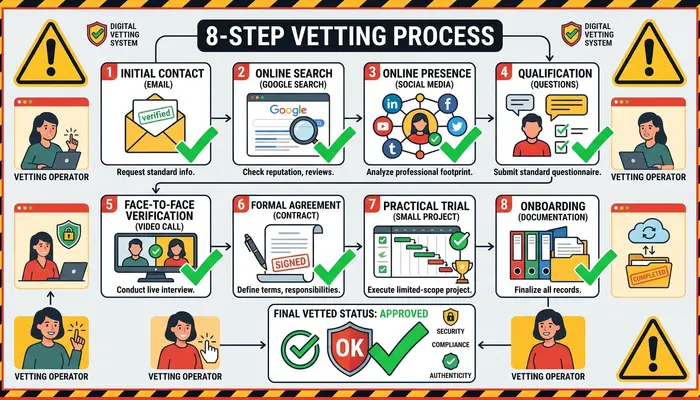
📌 Step-by-Step Guide to Vetting a Freelance Job
Okay, you’ve found an opportunity that looks promising. Now what?
Here’s my exact process for evaluating whether a freelance opportunity is legitimate or a scam.
Step 1: Initial Email/Message Review (2 minutes)
Read the initial contact carefully.
Ask yourself:
- Is it personalized or generic?
- Does it mention specific skills from my profile?
- Is the grammar professional?
- Does the sender’s profile look real?
If it fails these basics, delete and move on.
Step 2: Google Research (5 minutes)
Open a new browser tab and search:
- Company name + “scam”
- Company name + “reviews”
- Contact person’s name
- Email domain
Check their website. Does it load? Look professional? Have recent content?
Step 3: Social Media Verification (5 minutes)
Find the company on:
- LinkedIn (check number of employees, posts, activity)
- Facebook/Instagram (real businesses have followers and engagement)
Search for the hiring manager. Do they actually work there according to LinkedIn?
Step 4: Ask Qualifying Questions (Email exchange)
Send a professional response asking:
“Thank you for reaching out! I’m interested in learning more. Could you please provide:
- Detailed project scope and deliverables
- Expected timeline
- Your budget range
- Payment terms and method
- A few examples of previous work with freelancers”
How they respond tells you everything. Scammers get vague or pushy. Real clients provide details.
Step 5: Video Call Request (Essential!)
Before accepting any job, insist on a video call.
Say: “I’d love to discuss the project in detail. Are you available for a brief Zoom/Google Meet call this week?”
Scammers almost always refuse video calls or make excuses.
Common Mistake: Don’t skip the video call just because you’re excited about the project. This single step prevents 90% of scams.
Step 6: Contract Review (Critical)
Never start work without a written agreement that includes:
- Scope of work
- Deadlines
- Payment amount
- Payment schedule
- Revision policy
- Cancellation terms
If they refuse to provide a contract, that’s a deal-breaker.
Step 7: Start Small
Even with verified clients, start with a small paid test project.
Don’t commit to months of work upfront. Build trust gradually.
Step 8: Document Everything
Save all emails, messages, contracts, and work files.
Use tools like:
- Google Docs for proposals and contracts
- Email for all communication (not just texts)
- Time tracking tools (Toggl, Clockify)
- Invoice software (Wave, FreshBooks)
Documentation protects you if disputes arise.
📌 Real-Life Scam Story: What Sarah Learned the Hard Way
There was a Sara, I shall tell you about.
Sarah, a 24-year-old Ohio college graduate, had a side hustle of becoming a freelance writer as she looked for a job. She had studied content writing over the internet and was willing to make some additional cash.
A message was sent to her by LinkedIn on one Tuesday afternoon, when she was contacted by what seemed to be a mid-size tech company in California, the author of which was the Marketing Director. The message was businesslike, praised her writing samples, and paid $800 to write 5 blog posts — an excellent price to start with.
Sarah was thrilled.
The client submittedthe above topics and guidelines through emails. Everything looked legitimate. They even possessed a professionally looking website and social accounts.
When Sarah delivered the first 3 articles, the client made a payment of $2,400, three times the amount that was agreed to. The email profusely apologized for the accounting mistake and requested that Sarah reimburse the check and wire the money back to Western Union to the tune of $1,600.
It is at this point that Sarah committed a very crucial error.
The check was found to clear in two days. The money was displayed in her bank account. She had a desire to be useful and professional and thus sent the $1,600 wire transfer.
Her bank told her that the check was fraudulent 5 days later. Sarah now had to pay the entire amount of $2,400, as well as overdraft charges.
She lost money. She lost time. And she was humiliated and dismayed.
What Sarah Learned
Looking back, Sarah now recognizes the red flags she missed:
❌ She never had a video call with the client
❌ The payment method changed suddenly (they initially mentioned PayPal)
❌ The “accounting error” was a classic check scam setup
❌ The company’s website was only 3 months old (she didn’t check the domain age)
❌ The LinkedIn profile of the “hiring manager” had been created just 6 weeks before
Sarah’s Recovery and Success
Sarah reported the scam to:
- Her local police department
- The FBI’s Internet Crime Complaint Center (IC3)
- LinkedIn (the profile was removed)
She didn’t get her money back, but she helped prevent others from falling victim.
Today, Sarah runs a successful freelance copywriting business earning $6,000+ monthly. She now:
✅ Only accepts clients through Upwork until trust is established
✅ Requires video calls for all new clients
✅ Never accepts checks for payment
✅ Researches every client thoroughly
✅ Trusts her instincts when something feels off
Beginner’s Note: Don’t let scam stories scare you away from freelancing. Learn from them instead. Sarah’s nightmare turned into wisdom that now protects her and helps others.
📌 How to Report Freelance Scams
In the event that you meet a scammer (or even become a victim of one), it is important to report it.
It may be too late to reclaim your money, but you will aid in saving other people and also assist in law enforcement efforts.
Where to Report in the USA
Federal Trade Commission (FTC)
Website: ReportFraud.ftc.gov
What for: All types of scam,s including tech scams, employment frauand d, and identity theft
The FTC collects reports and uses them to investigate and prosecute scammers.
FBI Internet Crime Complaint Center (IC3)
Website: ic3.gov
What for: Internet-related scams, especially when money crosses state lines
IC3 is especially helpful for larger scams or organized fraud operations.
Better Business Bureau Scam Tracker
Website: bbb.org/scamtracker
What for: Warning other consumers and businesses
Your report appears in public searches, helping others avoid the same scammer.
Your State Attorney General
Find yours: naag.org
What for: State-level consumer protection
Each state has consumer protection divisions that investigate local scams.
Local Police Department
What for: Creating a police report for your records
This documentation helps with bank disputes and insurance claims.
The Platform Where You Found the Scam
If you encountered the scammer on:
- Upwork, Fiverr, Freelancer.com: Report through platform support
- LinkedIn: Report the profile directly
- Facebook/Instagram: Use the “Report” feature
- Craigslist: Flag the post
What Information to Provide
When reporting, gather:
📋 All email correspondence
📋 Phone numbers and email addresses used
📋 Company names and websites
📋 Scam images or screenshots
📋 Payment records (invoices, receipts, transaction IDs)
📋 Timeline of events
📋 Financial loss amount
The more detailed your report, the better chance authorities have of taking action.
📌 Building Your Legitimate Freelance Career Safely
Now that you understand how to avoid freelance scams in the USA, we should discuss creating something authentic and long-lasting.
You did not come here only to avoid fraud; you want to become a real success in your profession of being a freelancer.
Start With Reputable Platforms
I know I sound like a broken record, but this is crucial for beginners.
Start your freelance journey on:
- Upwork (best for freelance SEO specialists, writers, VAs)
- Fiverr (great for building a portfolio quickly)
- FlexJobs (vetted opportunities, worth the membership)
Build your reputation there first. Get reviews. Establish credibility.
Once you have 10-20 successful projects, you can branch out to direct clients with confidence.
Create a Professional Online Presence
Even if you’re starting a freelance writer side hustle, treat it like a real business.
Set up:
👉 A LinkedIn profile that clearly states your services (Example: “Freelance SEO Specialist | Helping Small Businesses Rank Higher”)
A simple portfolio website (Use Wix, Squarespace, or WordPress.com—nothing fancy needed)
Professional email (yourname@gmail.com is fine when starting; avoid cutesy addresses)
Social media presence related to your niche
This makes you searchable and credible when potential clients vet YOU.
Specialize in High-Demand Skills
The freelancers making real money aren’t generalists—they specialize.
Consider focusing on:
📌 Freelance SEO Specialist – Businesses always need SEO help (SEO freelancers and freelance SEO consultants are in high demand)
📌 Freelance Copywriting Jobs – Sales pages, email sequences, website copy
📌 Video Editing Employment – YouTube, social media content, corporate videos
📌 SEO Services Freelance – Local SEO, technical SEO, content optimization
📌 Freelance Brand Scaling – Social media management, content strategy
Pick ONE to start. Get good at it. Build case studies. Then expand.
Set Realistic Rates
Don’t undercharge out of desperation (scammers love targeting desperate freelancers).
Research market rates:
- Freelance writing: $50-$200+ per article
- SEO services freelance: $50-$150+ per hour
- Video editing: $30-$100+ per hour
- Freelance copywriting: $100-$500+ per project
Start slightly below market rate to build experience, but never work for pennies.
Your time has value.
Network Legitimately
Join real communities:
- Facebook groups for freelance writers, SEO freelancers, etc.
- Reddit communities (r/freelance, r/freelancewriters)
- Local business networking groups
- Industry-specific Slack channels
These connections lead to referrals and legitimate opportunities.
Keep Learning
The most successful freelancers never stop improving.
Invest in:
- Skills training (copywriting courses, SEO certifications)
- Industry news and trends
- Tools that make you more efficient
- Your portfolio and case studies
👉 “Best SEO Tools for Freelancers”
Safety Habits to Maintain Forever
Even as you grow, keep these habits:
✅ Vet every new client (yes, even after years of freelancing)
✅ Use contracts always
✅ Require deposits for large projects (but YOU receive the deposit, never pay one)
✅ Keep financial records organized
✅ Maintain separate business and personal finances
✅ Save 25-30% of income for taxes
✅ Trust your instincts
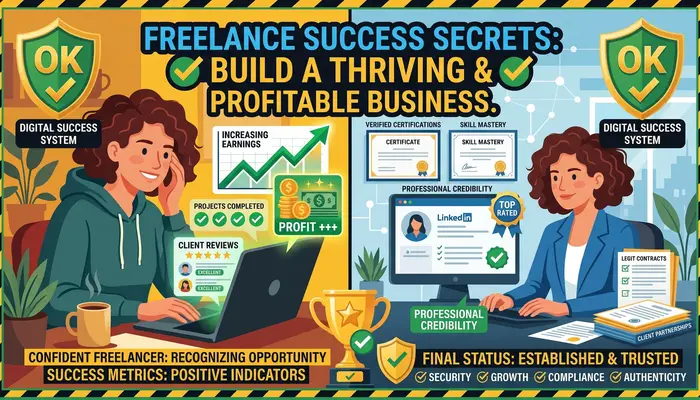
📌 Expert Tips from Successful Freelancers
I reached out to several six-figure freelancers to get their best scam-avoidance advice.
Here’s what they shared:
Marcus Chen – SEO Consultant (freelance) ($12K/month)
Protecting yourself by having more than enough clients to be choosy. The best scam defense is to have enough clients so that you can be picky. When I first got into freelance SEO specialist business, I was desperate and almost fell into two scams. Now I have a waiting list, so I can thoroughly screen everyone. Train your abundance mentality by always marketing yourself, even when you are busy.
Jennifer Rodriguez -Freelance Copywriter ($8K/month)
I have a new client checklist, which I do not neglect: video call, contract, 50 percent deposit (PayPal only), and a mutual NDA. Once a client declines at least one of the aforementioned, I simply decline. This has saved me at least 5-6 occasions when it turned out that a clienwasis a scammer. The actual clients never have any issues with going through professional procedures.
Video Editor: David Thompson ($10K/month)
It could have cost me a Social Security Number when I was seeking video editing work, but a fake producer almost took my money by pretending to be a production company. What saved me? I dialed the number on their official website and received an incoherent business owner who had never heard of the job advert. Never rely on one channel, and always be sure to check out the job advert in more than one source.
Priya Patel – Brand Strategist, freelance (15K/month)
To freelance brand scaling clients, I will first always ask whether they already have real customers or not. I will request to view their current advertising, social media, or marketing materials. Scammers are unlikely to be able to create actual business assets.
Key Takeaway Across All Experts
Every successful freelancer I spoke with had encountered scams early in their career.
What separated them from victims?
- They learned to recognize patterns
- They never rushed into opportunities
- They maintained professional standards even when desperate for money
- They joined communities where they could ask “Is this legit?” before proceeding
You can do the same.
📌 Frequently Asked Questions
Q1: How can I tell if a freelance job posting is a scam?
Red flags to look out for include: vague job descriptions, payment or personal information beforehand, excessive good-to-be-true pay rates, bad grammar in messages, insistence on immediate response, and insistence on not having a video call. Never give out any personal information without first doing personal research on the company and ensuring that they are legitimate.
Q2: What should I do if I’ve already fallen for a freelance scam?
Contact your bank immediately, in case you have transferred money or financial information. Report the scam to the FTC at ReportFraud.ftc.gov, the FBI IC3 at ic3.gov, andfile a police report. Record all (emails, messages, payment records). In case you have used some service such as Upwork or PayPal, call their support. Change the passwords in case you shared any of the logins.
Q3: Are all freelance opportunities that pay via check scams?
Check scams are very prevalent, but not all are in freelancing. Checks can be used by legitimate established companies, but can be taken with a lot of care when dealing with new clients. Do not accept a check and send money back via wire. Allow 2-3 weeks before checks clear (not necessarily deposited in your account). More suitable alternative methods to be used by new freelancers are PayPal, platform escrow, or direct deposit, once a trust is created.
Q4: Can I make good money freelancing without getting scammed?
Absolutely! Freelancing is a means of earning legitimate income for millions of Americans. The secret lies in commencing on reliable websites such as Upwork, Fiverr, or FlexJobs, scrutinizing the customers, employing risk-free payment procedures, upholding professionalism, and following your gut. Specialize in skills in the field of high demand such as freelance SEO services, copywriting, or video editing.
Q5: How do I protect my personal information when applying for freelance jobs?
Always do not give your Social Security Number, bank account, or credit card information unless you are sure that the client is legitimate and you have signed a contract. Have a special email addressforo freelancing. Do not share passwords or log-ins. Do not use applications that require too much of your personal information. The only reason why legitimate clients require your SSN is when you have completed work, which is tax-related.
Q6: What payment methods are safest for freelance beginners?
Platform escrows (Upwork, Fiverr), PayPal Goods and Services, and trusted payment processors such as Stripe are the safest payment methods wthatbeginners can use. When you have completely vetted a customer, direct deposit and other services, such as Wise, are safe. Do not use wire transfers, prepaid cards, checks from new customers, and cryptocurrency until you are more conversant with identifying legitimate customers.
Q7: How long should I research a client before accepting a freelance project?
Take a minimum of 15-30 minutes to research any new client. This will involve Googling the name of the company and the contact person, analyzing their webpage and their use of social media, checking business registration, reading reviews by other freelancers, and having a video conversation. Invest even more time in larger projects. Such a minor time investment would bring you out of a big financial loss and waste.
📌 Final Thoughts: Your Freelance Journey Starts Now
This is this that I want you to remember.
One of the most gratifying methods to make money, have flexibility, and create your own career is freelancing. It can be freelance copywriting work, becoming a freelance SEO expert, or considering video editing work; the prospects are numerous and promising.
But the scams are, too.
The good news? You now have the knowledge that is not possessed by most beginners. You are familiar with the red flags to avoid, how to check clients, secure ways of payment, and develop your career on a sound basis.
Don’t be afraid of scammers, start. Be awakened, be awakened.
You should remember Sarah—she was scammed, but she did not give up. Today she’s thriving. You can be wise by the examples of her mistakes.
Your Action Plan This Week
The next thing is to do the following:
Day 1-2: Create profiles on Upwork and Fiverr (or FlexJobs in case you want to work with vetted jobs)
Day 3-4: Design a basic portfolio site or LinkedIn profile demonstrating your talents.
Day 5-6: Submit 5-10 opportunities that are real to the process of vetting that I taught you.
Day 7: Find 2-3 Facebook or Reddit communities of freelancers.
Start small. Build safely. Grow confidently.
It is really possible to live a freelance life you desire — but now you know how to do it without getting into traps of scams in the process.
📢 Share This Guide
In case you have found this guide useful, you can share it with a friend or a colleague who wants to begin his or her path in freelancing or create online revenue without any risks. Your contribution would help save a hundred dollars that a person would lose to a scam.
With our combined efforts, we will be able to make the freelancing world a safer place.