
Introduction: The Harsh Truth About Freelancing in America
Let me be honest with you.
I observed my friend Sarah last year leave a well-paying marketing job with a salary of 65,000 to go and become a freelancer. She would dream about being able to work in coffee shops, have her own schedule, and get six figures.
Six months later? She was once again job-seeking, frustrated and penniless.
The crazy thing is the following: 73% of freelancers in the USA fail within their first year. It is not because freelancing does not work. This is because they commit the same foreseeable errors that cripple their success, even before they begin.
And now the good part;: all these failures can be fixed.
In this guide, I will demonstrate to you why freelancers fail in the USA and how to fix it with the help of those strategies that really work in 2024. You may be asking yourself how to start freelancing, or you may balready behaving a hard time; this article shall provide you with the very blueprint on how to make it.
Essential Question: Why do the majority of freelancers fail?
The failure of freelancers in the USA is mainly due to improper pricing strategy, failure to attract clients regularly, failure to plan finances, and looking at freelancing as a hobby and not a business. To be a successful freelancer, it is important to approach it as a business that has proper systems and is marketed regularly, has emergency savings, and has specialized skills that fetch high rates.
What Is Freelance Work and Why It’s Booming in the USA
So, what is freelance exactly?
Imagine it in the following way: rather than reporting to one boss and being paid after two weeks, you will have a number of clients that pay you based on certain projects or services. And you are a one-man business.
What is freelance work? In the real world, what is the definition of freelance? It is about selling your expertise, be it writing, design, code writing, marketing, consulting, anything that you are good at, to companies and individuals who require your assistance but do not wish to have full-time employees.
This is why it is going off at the moment:
- 59 million Americans freelanced in 2023 (that’s 36% of the workforce!)
- The freelance economy contributed $1.27 trillion to the US economy last year
- Remote work normalized freelancing for companies that were previously hesitant
- AI tools made it easier than ever to deliver high-quality work quickly
But here’s the thing nobody talks about: just because it’s popular doesn’t mean it’s easy.

The 7 largest reasons why freelancers fail in the USA.
Now we shall speak of the ugly reality. I have studied the failures of hundreds of freelance careers and have found that there are seven patterns that continually recur
1. They do not take it as a Business but a Side Hustle.
This is the most deadly killer.
You would not start a restaurant and go to check it twice a week, would you? However, that is what the majority of unsuccessful freelancers do. They make a profile on Upwork, send 5 proposals, and then feel disheartened when they do not receive any response.
The fix: Make up your mind whether you are serious or not. If yes, then do it as it is a business. Set business hours. Track your time. Invoice professionally. Make quarterly tax payments.
2. Underpricing of their services to Death.
I observe this all the time. A person provides logo design at $50 when it should cost at least 500-2000 in the market.
Their logic? I have to be competitive!
This is what really happens: They get nightmare clients who do not respect them; they work 80 hours for poverty wages and leave their jobs after several months.
The solution: Find out what the well-established freelancers in your field charge. Price yourself at 70% of that rate in the beginninn. Minimum wage in the USA is not less than 50/hour of the skilled labor (75-150/hour required to earn a living in most cities).
3. No Cohesive Marketing or Lead Generating System.
You know what difference is between successful freelancers and failures?
The successful ones are even marketing at a busy time. When desperate, failures are the only ones that seek clients.
This gives the feast-or-famine phenomenon crushing freelance careers.
The solution: Marketing, 10 hours a week, each week. This involves: networking, content creation and cold outreach, updating your portfolio, referral requests, and staying visible.
4. Zero Financial Cushion/ Planning.
Sarah, my friend whom I have just told you about? She retired and had savings of 2000.
Majority of the financial advisors suggest between 6-12 months of living costs before becoming a full-time freelancer. Sarah had a period of three weeks.
She freaked out and acted out of desperation when her first two months were not as good (which is perfectly normal).
The solution: Continue to earn a salary in your present job, but use the time to develop freelance earnings to $3K-5K/month, or save a lot of money and then jump ship. And deduct 30 per cent of each payment towards taxes and emergencies.
5. Being a Specialist in aGeneralist’ss World.
I am a graphic designer, Web developer, content writer, social media, and video editor!
What clients hear is? I am not good at anything, in particular.
Experts earn over $10,0K by the freelance do-noters. The independent SEO consultant who simply/only does technical audits of SEO. The conversion copywriter who is a sales page-only writer. The Shopify developer who merely constructions ecommerce sites.
The fix: Choose one thing that you are really good at. Become insanely skilled at it. Get to be known for it. You may enlarge afterwards.
6. Awful Communication and Pro.
Missing deadlines. Disappearing for days. Providing work with typos. Feeling protective of feedback.
These are the fundamental ones, yet they are simply appalling when it comes to unsuccessful freelancers.
The resolution: Reply within 24 hours (even a reply of got your message; will send details tomorrow). Give birth at the earliest time. Be amenable to work with. This is all that will put you in the top 20%.
7. No Systems/ Processes.
Each project is new as though you are starting afresh. You losesightd of what you promised clients. You spend hours on administration.
The solution: Design templates of all the things—proposals, contracts, invoices, project briefs. Work on project management software such as Trello or Asana. Automate to the extent possible.
| Why Freelancers Fail | How to Fix It | Timeline to Implement |
|---|---|---|
| Treating it like a hobby | Create business structure & schedule | Week 1 |
| Underpricing services | Research rates & reprice | Week 1-2 |
| No marketing system | Dedicate 10hrs/week to marketing | Ongoing |
| Poor financial planning | Build 6-month emergency fund | 3-6 months before quitting job |
| Being too general | Choose one specialty | Week 1 |
| Bad communication | Set response time standards | Immediate |
| No systems | Create templates & workflows | Week 2-4 |
How to Start Freelancing: The Right Foundation
So you’re ready to learn how to start freelancing without becoming part of that 73% failure statistic?
Let’s build this correctly from day one.
Step 1: Identify Your Marketable Skill
What are you already good at that people will pay for?
Don’t say “nothing.” Can you:
- Write clear emails and reports?
- Design basic graphics?
- Manage social media accounts?
- Code websites?
- Analyze data?
- Manage projects?
- Edit videos?
- Provide virtual assistance?
Pick the skill where you have both competence and interest.
Step 2: Validate There’s Demand
Before you build your whole business, spend a few hours on:
- Upwork (search your skill and see how many jobs are posted)
- Fiverr (check if others are selling similar services)
- LinkedIn (search “[Your Skill] freelancer” and see who’s hiring)
- Google Trends (make sure interest isn’t declining)
If you see hundreds of active job posts and successful freelancers, you’re good.
Step 3: Create Your Minimum Viable Portfolio
You don’t need a fancy website yet. You need proof you can do the work.
Do 2-3 projects:
- Offer free/discounted work to nonprofits or local businesses
- Create spec work (unsolicited samples showing what you can do)
- Showcase personal projects
Document everything with before/after results if possible.
Step 4: Set Up Your Business Legally
Yes, even as a beginner. Here’s the minimum:
- Register your business name (sole proprietorship is fine to start)
- Get a business bank account (keeps finances separate)
- Set up a simple invoicing system (Wave or PayPal work great)
- Understand your tax obligations (quarterly estimated taxes in most cases)
👉How to Automate Freelance Business Using AI in 2025 (Easy Guide)
Step 5: Choose Your Primary Platform
Where will you find your first clients?
For beginners, I recommend:
- Upwork (most diverse opportunities, great for building reviews)
- LinkedIn (best for B2B services and networking)
- Freelancer.com (good for tech skills)
- Direct outreach (email 50 potential clients in your niche)
Pick TWO platforms and go deep rather than spreading yourself thin across ten.
Step 6: Make Irresistible Profiles/Pitches.
The questions that must be addressed by your profile are: What is my specific problem solution,n and who is it for?
Bad: I am a good writer; I have 5 years of experience.
Good: “I assist SaaS businesses in converting blog traffic into email subscribers using conversion-oriented articles on my content my articles have an average opt-in rate that is 42% above the industry average.
See the difference?
📊 Common Beginner Mistakes When Starting:
❌ Spending weeks perfecting a website before getting any clients
❌ Taking every project regardless of fit
❌ Not having a contract for “small” projects
❌ Forgetting to ask for testimonials after successful projects
❌ Quitting too early (most need 3-6 months to gain traction)
✅ Do This Instead: Get your first paid client within 2 weeks, even if it’s small. Build from there.
Pricing Mistakes That Kill Freelance Careers
Let’s talk money. This is where good freelancers go to die.
The Race to the Bottom
When you compete on price, you’ve already lost.
There’s always someone in a lower cost-of-living country who can undercut you. Always.
Instead, compete on:
- Speed of delivery
- Quality and attention to detail
- Specialization in a specific niche
- Your unique approach or methodology
- Communication and reliability
How to Price Your Services (Real Numbers)
Here’s a framework that actually works:
Calculate your minimum viable hourly rate:
- What do you need to earn monthly? (Let’s say $5,000 to live comfortably)
- Add 30% for taxes and business expenses ($1,500)
- Total needed: $6,500/month
- Divide by realistic billable hours (100 hours/month when starting)
- Your minimum rate: $65/hour
That’s your floor. Never go below it.
Now, look at market rates:
- Entry-level freelancers in your niche: $X
- Mid-level: $Y
- Expert-level: $Z
Price yourself between entry and mid-level when starting, then raise rates every 3-6 months as you gain experience and testimonials.
Package Pricing vs. Hourly
Here’s a secret: successful freelancers rarely charge hourly.
They create packages:
Instead of: “$75/hour for writing”
Try: “Blog Content Package – $1,500/month includes 4 SEO-optimized articles, keyword research, and meta descriptions”
Why this works:
- Clients know exactly what they’re paying
- You can work efficiently and increase your effective hourly rate
- It feels less expensive psychologically
- You can upsell additional services
| Pricing Model | Best For | Pros | Cons |
|---|---|---|---|
| Hourly | Unpredictable work, consulting | Paid for all time | Penalized for efficiency |
| Project-based | Defined scope work | Predictable income | Risk of scope creep |
| Monthly retainer | Ongoing services | Reliable income | Need consistent availability |
| Value-based | High-impact results | Highest earnings potential | Requires proven track record |
💡 Pro Tip: Increase your rates by 15-20 percent with each workload that you have had more than you can handle. This can easily sieve out better customers, and your revenue can be boosted without having to work harder.
The Client Acquisition Problem (And How to Solve It)
Getting clients is the #1 struggle for freelancers. Let’s fix that.
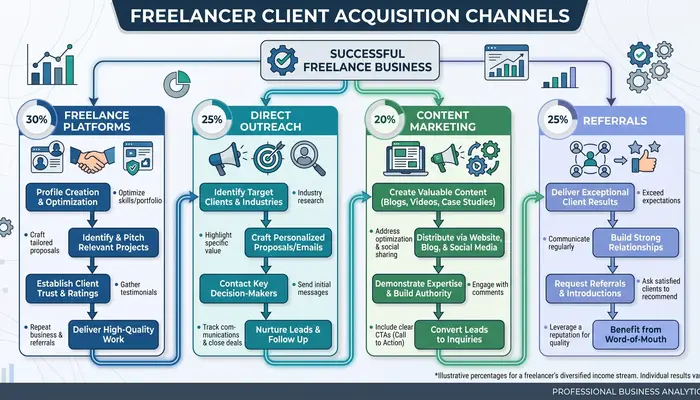
The 4-Channel Client Acquisition System
Don’t rely on one source for clients. You need multiple channels:
Channel 1: Freelance Platforms (30% of effort)
- Upwork, Fiverr, Freelancer.com
- Send 10-15 quality proposals per week
- Focus on clients with verified payment history
- Customize every single proposal (no templates)
Channel 2: Direct Outreach (30% of effort)
- Identify 50 ideal clients in your niche
- Find decision-makers on LinkedIn
- Send personalized, value-first messages
- Offer a free audit or quick win
Channel 3: Content Marketing (20% of effort)
- Start a simple blog or LinkedIn content
- Share insights about your industry
- Position yourself as an expert
- This is a long game but has the highest ROI
Channel 4: Referrals and Networking (20% of effort)
- Join industry-specific Facebook groups
- Attend virtual networking events
- Ask every happy client for introductions
- Create a referral incentive program
The “Cold Email That Actually Works” Template
Here’s a cold outreach template that gets 20-30% response rates:
Subject: Quick question about [Their Company]’s [Specific Thing]
Hi [Name],
I was checking out [Their Company] and noticed [specific observation about their business/website/content].
I specialize in [Your Specialty] for [Their Industry] companies, and I’ve helped similar businesses [specific result – “increase organic traffic by 200%” or “reduce content production time by 40%”].
Would you be open to a quick 15-minute call where I can share [specific valuable thing] that could help [solve their specific problem]?
No pressure if the timing isn’t right.
Best,
[Your Name]
See how this works? You’re leading with value and specificity, not “I’m a freelancer looking for work.”
👉 Reference a high-authority site like HubSpot’s guide on cold email best practices.
Financial Management: Where Most Freelancers Crash and Burn
You can be the best freelancer in the world, but if you can’t manage money, you’ll fail.
The 3-Account System
Open three separate bank accounts:
Account 1: Business Operating
All client payments go here. Pay business expenses from here.
Account 2: Tax Savings
Transfer 30% of every payment immediately. Never touch this except to pay quarterly taxes.
Account 3: Personal Income
Pay yourself a consistent “salary” from the business account bi-weekly or monthly.
This separation saves you from the biggest financial disasters freelancers face.
Pricing for Profitability
Your freelance rate needs to cover:
- Your desired personal income
- Income taxes (15-35% depending on bracket)
- Self-employment tax (15.3%)
- Health insurance
- Retirement savings
- Business expenses (software, equipment, marketing)
- Unpaid time (vacation, sick days, admin work)
If you’re charging $50/hour thinking that’s good money, you might actually be netting $22/hour after everything. Not so great.
The Emergency Fund That Saves Careers
Build this in layers:
Layer 1: $2,000 starter emergency fund (covers most unexpected expenses)
Layer 2: One month of expenses
Layer 3: Three months of expenses
Layer 4: Six months of expenses (the gold standard)
Start with Layer 1, then build up. Every time you get paid, put 10% toward this until you hit your target.
When a slow month hits (and it will), you won’t panic and make desperate decisions.
💰 Financial Milestone Checklist:
□ Separate business bank account opened
□ Accounting software set up (QuickBooks, Wave, or FreshBooks)
□ Tax savings account automated
□ Quarterly tax payment dates in calendar
□ $2,000 emergency fund saved
□ Health insurance sorted
□ Retirement account opened (Solo 401k or SEP IRA)
□ Disability insurance considered
How to Become a Freelancer That Really Succeeds.
We will discuss the attitude and behaviors that make the difference between the 27% of who succeed and the 73% who do not.
Think Like a Business Owner, Not an Employee
All this is change.
Employees reason: I worked my 8 hours today.
Business owners believe: “Did I take my business a step in a direction today?
Things come to the minds of employees: My client is a pain.
Business owners ask themselves: “How can I serve this client in a better manner, or can I substitute him or her with a more suitable one?
All the employees believe: I should be paid more because of my experience.
Business owners reason: What outcomes can I create that will warrant high prices?
The Skill Stack That Makes You Valuable
To become a freelancer who thrives, you need more than your core skill.
You need:
Your Primary Skill (60% of your value)
The thing you’re hired to do—writing, design, coding, etc.
Business Skills (25% of your value)
- Basic marketing
- Sales and negotiation
- Project management
- Client communication
- Basic finance
Tech Proficiency (15% of your value)
- AI tools (ChatGPT, Midjourney, etc.)
- Project management software
- Industry-specific tools
- Basic automation
The freelancers making $150K+ aren’t just better at their core skill. They’re better at the entire package.
Build a Personal Brand (Even If You Hate Marketing)
I get it. You just want to do the work, not “be an influencer.”
But here’s reality: freelancing is a reputation business.
Your personal brand doesn’t mean posting selfies. It means:
- Showing up consistently with helpful content
- Being known for something specific
- Having a point of view
- Making it easy for ideal clients to find you
Start simple:
- Post one valuable insight on LinkedIn each week
- Answer questions in your industry’s online communities
- Share client wins (with permission)
- Document what you’re learning
Do this for 6 months and watch what happens to your inbound inquiries.

Real-Life Case Study: From Failure to $8K/Month in 7 Months
I would like to tell you a real-life story of one of my mentees, a man by the name of Marcus.
The Failure Phase (Months 1-3)
Marcus has left his job oincustomer service to become a social media manager.
He did all the errors we have considered:
- Charged $200/month per client (way too low)
- Took on anyone who would pay him
- Had no emergency fund
- No systems or processes
- Worked 70 hours a week for poverty wages
After three months, he’d made $2,400 total and was completely burned out.
The Pivot (Month 4)
We sat down and rebuilt his freelance business from scratch.
Changes we made:
- Specialized: Instead of “social media manager,” he became “Instagram growth specialist for local fitness businesses”
- Researched pricing: We discovered fitness businesses were paying $800-2,500/month for Instagram management
- Created packages:
- Basic: $1,200/month (3 posts/week, stories, engagement)
- Premium: $2,000/month (above + reels, influencer outreach)
- Fired bad clients: He let go of the $200/month clients (scary but necessary)
- Built a system: Created content templates, batch-worked everything, used scheduling tools
- Focused marketing: Only reached out to fitness businesses, spoke their language
The Results (Months 5-7)
- Month 5: Landed 2 new clients at $1,200/month ($2,400)
- Month 6: Added 2 more clients, one upgraded to premium ($5,200)
- Month 7: One more client, plus project fees ($8,100)
His actual working hours? Down to 35 per week.
His effective hourly rate? Jumped from $8/hour to $58/hour.
What Made the Difference?
Marcus didn’t become a better social media manager overnight. He made better business decisions:
- A specific niche meant better marketing and higher perceived value
- Proper pricing meant he could afford tools and outsource admin work
- Systems meant he wasn’t reinventing the wheel for every client
- Firing bad clients freed up mental energy for better opportunities
This is what fixing why freelancers fail actually looks like in practice.
Freelance SEO Specialist: A Profitable Niche Example
Let’s zoom into a specific example: becoming a freelance SEO specialist.
This is one of the most profitable and in-demand freelance niches in 2024.
Why SEO Freelancing Works
- Every business with a website needs SEO
- Results are measurable (rankings, traffic, leads)
- High perceived value (ROI is clear)
- Technical enough to command premium rates
- Can be done 100% remotely
How to Break Into SEO Freelancing
Step 1: Choose Your SEO Specialty
Don’t be a “general SEO consultant.” Pick a lane:
- Local SEO for service businesses
- Technical SEO audits for enterprise
- Content SEO for SaaS companies
- E-commerce SEO for online stores
- SEO for specific industries (medical, legal, real estate)
Step 2: Get Educated (Free Resources)
- Google’s SEO Starter Guide
- Moz Beginner’s Guide to SEO
- Ahrefs Blog and YouTube channel
- SEO courses on Coursera (many free to audit)
Spend 2-3 months learning intensively.
Step 3: Build Your Portfolio
- Optimize your own website or blog
- Do SEO for 2-3 local businesses (charge low to build case studies)
- Document every result with screenshots
Step 4: Get Your First Paying Clients
Local businesses are the easiest starting point:
- They desperately need help
- Decision-making is faster
- You can meet in person if needed
- They’ll pay $500-2,000/month
Google “dentist [your city]” or “plumber [your city]” and find businesses with terrible websites. That’s your goldmine.
SEO Freelancer Pricing Guide (USA Market)
| Service Type | Beginner Rate | Intermediate | Expert |
|---|---|---|---|
| Local SEO (monthly retainer) | $800-1,200 | $1,500-3,000 | $3,500-7,000 |
| Technical SEO audit | $500-1,000 | $1,500-3,500 | $5,000-15,000 |
| Content SEO strategy | $600-1,200 | $2,000-4,000 | $5,000-10,000 |
| Link building (monthly) | $1,000-2,000 | $2,500-5,000 | $6,000-12,000 |
| Full-service SEO | $2,000-4,000 | $5,000-10,000 | $12,000-30,000 |
Tools You’ll Need
Free tier to start:
- Google Search Console
- Google Analytics
- Google Keyword Planner
- Screaming Frog (free up to 500 URLs)
When you land your first few clients, invest in:
- Ahrefs or SEMrush ($99-199/month)
- Surfer SEO ($89/month)
- Rank tracking software
👉 Ahrefs as an authoritative source on SEO tools and education.

Your 90-Day Success Action Plan
Ok, you have all the know-how. Now we shall make it a reality.
This is what you should do in the first 90 days so as not to end up as one of the failure statistics.
Days 1-30: Foundation Building
Week 1:
- Choose your specific niche and service
- Research market rates and set your pricing
- Open a separate business bank account
- Create or update LinkedIn profile
- Build a simple portfolio (3 sample projects)
Week 2:
- Set up invoicing system
- Create proposal template
- Create contract template
- Register business legally
- Set up simple website or portfolio page
Week 3:
- Join 5 relevant online communities
- Create profiles on 2 freelance platforms
- Make a list of 50 potential clients
- Draft your outreach message template
- Create your service packages
Week 4:
- Send 20 cold outreach emails
- Submit 10 proposals on freelance platforms
- Post first piece of content on LinkedIn
- Reach out to personal network
- Set up basic tracking system for applications
Days 31-60: Client Acquisition
Week 5:
- Follow up on all previous outreach
- Send 20 new outreach emails
- Submit 10 more proposals
- Attend 2 virtual networking events
- Post value content 2x this week
Week 6:
- Optimize your pitches based on responses
- Do free value-add for promising prospect
- Update portfolio with any new work
- Join industry-specific groups
- Create lead magnet or free resource
Week 7:
- Continue outreach (20 emails)
- Follow up with all conversations
- Land your first paid client (even if small!)
- Ask for testimonial after delivery
- Refine your process based on first project
Week 8:
- Double down on what’s working
- Stop activities that aren’t working
- Aim for 2-3 active clients
- Document your processes
- Create FAQ based on client questions
Days 61-90: Scale and Systematize
Week 9:
- Raise your rates for new clients
- Create client onboarding system
- Set up project management workflow
- Build email templates for common situations
- Ask existing clients for referrals
Week 10:
- Aim for $2,000+ in monthly revenue
- Start building emergency fund
- Automate repetitive tasks
- Create content calendar
- Join a mastermind or accountability group
Week 11:
- Evaluate client quality (fire bad fits)
- Pursue 2-3 dream clients specifically
- Update portfolio with results
- Plan next quarter’s goals
- Invest in one key tool or course
Week 12:
- Review all metrics (income, hours, conversion rates)
- Identify biggest bottleneck
- Set Q2 revenue goal
- Create 90-day plan for next quarter
- Celebrate wins!
🎯 Success Metrics to Track:
Track these weekly:
- Number of proposals/pitches sent
- Response rate
- Conversion rate
- Average project value
- Total revenue
- Effective hourly rate
- Number of testimonials collected
Common Fallacies to Avoid (Caution to the layman)
With a good plan, beware of the following traps:
❌ Shiny Object Syndrome.
Switching niche to niche each and every month because you are not achieving immediate results. Allow 90 days for your area of specialty.
❌ Freeze of the Imposter Syndrome.
Waiting till you are ready to increase rates or sell larger customers. You’ll never be prepared. Do it anyway.
❌ Scope Creep Spiral.
Performing an extra little thing free of charge to clients. This conditions them to believe that they should work for free and kills your limits.
❌ The Platform Dependency
Secondly, establishing your whole business on Upwork or Fiverr without developing other sources of clients. Rules may be transformable on the platforms overnight.
❌ The Isolation Trap
Laboring on your own without any community and peer support. Be part of a mastermind or community of freelancers. Working as a freelancer is lonely by itself and that too when it is being done in isolation.
Special Advice on How to Become a 6-Figure Freelancer.
I contacted a number of freelancers who made over 100K a year. These are some of the things they would have liked to know when they first started:
💡 From Jennifer, Content Strategist ($180K/year):
“I wasted two years being a generalist. The moment I niched down to ‘content strategy for B2B SaaS companies,’ my income tripled. Specificity is magnetic to ideal clients.”
💡 From David, Freelance Developer ($240K/year):
“Stop selling time. Start selling transformation. I went from ‘$100/hour for coding’ to ‘$15K to build a lead-generating website.’ Same work, 3x the money.”
💡 From Priya, Freelance SEO Specialist ($150K/year):
“Build your business to work without you grinding 60 hours. I created systems, templates, and eventually hired a VA. Now I work 25 hours a week and earn more than when I was working 50.”
💡 From Marcus (yes, our case study!):
“Fire bad clients faster. Every hour you spend with someone who drains you is an hour you can’t spend finding someone who energizes you and pays better.”
The Mindset Shifts That Change Everything
Success in freelancing isn’t just tactics. It’s mindset.
From Scarcity to Abundance
Failing freelancers think: “I better take this terrible client because I need the money.”
Successful freelancers think: “Saying no to bad fits creates space for great opportunities.”
From Reactive to Proactive
Failing freelancers wait for clients to come to them and hope for the best.
Successful freelancers actively create opportunities through consistent marketing and relationship building.
From Perfectionism to Progress
Failing freelancers spend weeks creating the perfect website before getting their first client.
Successful freelancers launch imperfect and improve based on real feedback.
From Employee to Entrepreneur
This is the big one.
You’re not trading time for money anymore. You’re building an asset. Your business, your reputation, your systems—these are assets that grow in value.
Think 5 years ahead. What do you want your freelance business to look like? Start building toward that, not just toward next month’s rent.
👉 How to Price Freelance Services in the USA: The Real Guide Nobody Tells You.
Frequently Asked Questions About Why Freelancers Fail
1. What is the actual percentage of failures of freelancers in the USA?
In the USA, the failure rate of freelancers is about 73 percent in the first year. The main causes are the wrong pricing strategy, inconsistency in marketing, lack of proper pfinancial lanning of finances, and considering freelancing as a leisure activity and not a business. But freelancers who make it a business and have systems in place tend to make it in the long-term.
2. What is the amount of money that I will require to save before I join the full-time freelancer?
According to financial experts, it is advisable to save between 6-12 months of living costs to quit your job to become a full-time freelancer. Alternatively, develop your freelance business to $3,000-5,000 a month steadily as you maintain your day job, before switching. This cushion will help in avoiding desperate decision-making when there are slow periods that are inevitable.
3. What is the mean income of freelancers in the USA?
As per recent statistics, the average freelance earnings in the USA are about 39,000 yearly, and this differs radically based on specialization. Freelance SEO specialists, developers, or consultants (often called specialists) frequently make between $75,000 and $200,000 (or more), and generalists generally have a hard time earning more than $30,000. The point of difference is specialization.
4. What is the time span to begin to make money as a freelancer?
The majority of freelancers find their first customer in 2-8 weeks if they actively promote themselves. But it will take 3-6 months of their daily work to build up to a sustainable full-time income (between 4,000 and 6,000/month). The timeline will greatly rely on your niche, consistency in marketing, and whether you are using existing networks.
5. Can I go through freelance sites such as Upwork, or can I create my own customer base?
Both. Initiall,y use platforms such as Upwork to develop reviews, testimonials, and experience (invest 30% of the marketing efforts). At the same time, develop direct customer relationships via outreach and content marketing (70% of work). Gradually, transition to 90% direct customers since platform charges will cannibalize profit,s and you develop a reputation.
6. What should I charge being a new freelancer?
Divide the minimum rate you can take (Monthly expenses + 30% for taxes) by the number of billable hours per month. Next find out the rates of research in your field and area. When starting out,t price yourself at 60-70% of the rates of more experienced freelancers. Rivalry should never be on the basis of being the cheapest; rival on the basis of quality, speed, and specialization.
7. What is the difference between freelance work and contract work?
Working as a freelancer usually implies that you work with several clients at the same tim,d work according to your own schedule, and determine the way work is done. Working under a contract is often a predetermined time with a particular company and, sometimes, with a given number of hours or with a particular procedure. Both are typically treated as self-employment in the USA and subject to the same tax treatment.
Final Thoughts: Your Freelance Success Starts Today
Well, I am not going to candy coat it.
Freelancing is hard. It takes hard work, good planning, and commitment to create a successful freelance business.
But what I do know after observing hundreds of people go through this experience is:
The ones who succeed aren’t smarter or more talented.
They’re just more strategic, more consistent, and more willing to learn from mistakes.
You now know exactly why freelancers fail in USA and how to fix it. You understand the seven deadly mistakes. You have a 90-day action plan. You know how to price, how to find clients, how to manage money.
The question isn’t “Can you succeed?”
The question is “Will you actually implement this?”
Because that’s the final reason most freelancers fail: they consume information but never take action.
Don’t be that person.
Pick ONE thing from this guide and do it today. Not tomorrow. Today.
Send five cold emails. Create your first package pricing. Open that business bank account. Whatever it is, just start.
Your freelance success story begins with one imperfect action.
Go make it happen.
In case you enjoyed working through this guide, send it to a friend or colleague who would like to begin their freelancing career or develop a sustainable online income. Their portion might be the very thing to help them avoid the pitfalls they often find themselves in and create something wonderful.
Additional Resources for US Freelancers
Recommended Tools for Beginners:
Financial Management:
- Wave (free accounting software)
- QuickBooks Self-Employed ($15/month)
- Gusto (payroll and tax services)
Client Management:
- HoneyBook (client management, $40/month)
- Dubsado (contracts and proposals, $35/month)
- Calendly (scheduling, free tier available)
Project Management:
- Trello (free)
- Asana (free for individuals)
- ClickUp (generous free tier)
Communication:
- Slack (team communication)
- Loom (video messages)
- Zoom (client calls)
Communities to Join:
- Freelancers Union (advocacy and community)
- Location Rebel (freelancer community and courses)
- Reddit r/freelance (free advice and support)
- LinkedIn Groups specific to your industry
- Local freelancer meetups on Meetup.com
Continuing Education:
- Coursera (professional certificates)
- LinkedIn Learning (unlimited learning for $29/month)
- Skillshare (creative skills)
- Industry-specific conferences (attend virtually to save money)

Key Takeaway Summary
Keep in mind these fundamental principles to become a part of the 73% failure rate:
✅ Specialize in one valuable skill for one specific audience
✅ Price properly based on value and living costs, not fear
✅ Market consistently 10 hours per week, every week
✅ Build systems that let you work smarter, not harder
✅ Manage money like a business owner with separate accounts
✅ Think long-term and build assets, not just trade time
✅ Stay consistent for at least 90 days before pivoting
Failing freelancers are those who do not take these basics into account.
Those who are successful make them non-negotiable.
Which shall thou be?