
Introduction: Let’s Talk Real Money While You Study
So you may not hear this before you go to college: books are far more expensive than food, and ramen becomes tedious very quickly.
I can’t help but recall sitting in my dorm room during my junior year, looking at my bank account balance of $47.23. I had to listen to my roomie order pizza, and I couldn’t even contribute. That’s when I realised – I had to get money, but I had to get money where it came from; I had to pass my classes.
Sound familiar?
You’re not alone. In 2026, almost 70% of college students are working while in college, and… The clever ones are doing it in their pyjamas using their laptop.
In this guide, we will be talking about the best online side jobs for college students in the USA in 2026, which won’t ruin your GPA or leave you unable to eat. We’re not talking about flexible work that’s made to fit your work schedule; we’re talking about flexible work that’s fit to your work schedule.
At the end of this article, you’ll be able to tell which online jobs for college students are good for you, the amount of money you can make and how you can get started this week.
Let’s get you paid.
Quick Answer: What Are the Best Online Side Jobs for College Students in 2026?
Freelance writing, virtual assistant, online tutoring, social media management and content creation are the top online side jobs for college students in the USA in 2026. These are remote jobs for college students that have a flexible schedule, little to no experience and a $15-$50 per hour salary depending on their skills.
Why Online Side Jobs Are Perfect for College Students
Boy, I need to be honest with you.
Old-fashioned jobs for college students near me, such as retail or burger flipping, just aren’t good for your schedule. Are you taking classes on Tuesday & Thursday? Sadly, they’re calling on Saturday at 6 AM!
Here everything changes when it comes to jobs for college students that can be done remotely.
The Real Benefits Nobody Talks About
Flexibility that is under YOUR control!
Work between classes. If you are a night owl, then work at 2 AM. Do not take any finals during finals week. Schedule is your schedule, rules are yours.
More Study Time = No Commute
The commute to the office is just 30 minutes away? Gone. You’ll have an hour more a day to study, sleep or watch something that you actually find interesting.
Skills that Matter After Graduation
What employers are looking for in 2026 is digital marketing, working remotely, and creating content. With online jobs for college students, what do you think you’re studying? Exactly those skills.
Earning more than the normal pay rate per hour.
College student jobs typically are paid $12-15 an hour for those that are physically on-site. Online work? This is $20-$50 an hour after you’re up and running.
One Pro Tip: it’s best to start an online side job now, not when you are running dangerously close to not being able to pay rent next month, because it takes at least 2-3 weeks to build a client base.
👉 Top Remote Jobs in the USA without a Degree: No Degree is required to earn.
Top 15 Online Side Jobs for College Students in 2026
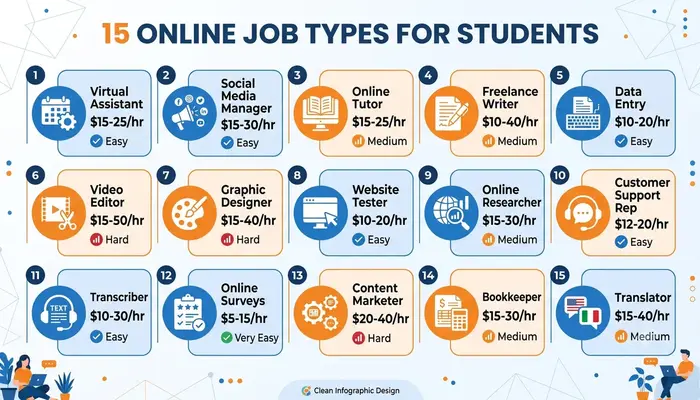
Let’s go over the good stuff. They are not only in the order of highest to lowest rewards, but they are also ranked based on how easy they are to use and how beginner-friendly they are.
1. Freelance Writing and Content Creation
Average Pay: $25-100 per article
These are the essential skills required to participate in this activity: Basic writing skills.
This course is best suited for English majors, communication students and others who do not despise writing.
You’ve gone through the process of googling “how to fix my laptop”, and you have read those blog posts? Someone is paid to write those! It may be YOU!
You can find a platform such as Upwork, Fiverr and Contently which will link the writer with businesses that are in urgent need of content. Keep it simple; use it for simple blog posts, product descriptions, or even social media captions.
What You’ll Actually Do:
- Write blog articles (like this one!)
- Create website copy
- Draft email newsletters
- Write product descriptions for e-commerce stores
Common Mistake: Starting with rates too low. Don’t write 2000-word articles for $10. Value your time at a minimum of $20/hour.
2. Virtual Assistant (VA) Work
Average Pay: $15-30/hour
Skills Required: Organising abilities, computer skills – basic level
For students who are detail-oriented and prefer to check items off a list
Virtual assistants are essentially a solution that aids busy individuals in getting their act together remotely.
Typical Tasks:
- Managing emails and calendars
- Scheduling social media posts
- Data entry and organization
- Customer service responses
- Basic research
Websites like Belay, Time Etc, and Fancy Hands hire VAs constantly. Many 👉 remote jobs for college students with no experience fall into this category.
Beginner’s Note: You don’t need fancy skills. If you can manage your own Google Calendar and send professional emails, you can be a VA.
3. Online Tutoring
Average Pay: $15-60/hour
Experience Needed: Knowledge in specific subjects
Best For: Students strong in particular subjects (math, science, languages)
Here’s the thing about tutoring – you already know more than high school students. That’s literally the only qualification needed to start.
Top Platforms for 2026:
- Tutor.com
- Chegg Tutors
- Wyzant
- VIPKid (teaching English to Chinese students)
- Course Hero
I knew a sophomore who made $800/month just tutoring algebra to middle schoolers for 10 hours weekly. She literally watched Netflix during sessions while students worked through problems.
Pro Tip: Specialise. “Math tutor” is crowded. “Calculus tutor for engineering students” gets premium rates.
4. Social Media Management
Average Pay: $20-50/hour
Experience Needed: Understanding of Instagram, TikTok, Twitter/X
Best For: Students who already spend too much time on social media (might as well get paid for it)
Small businesses need social media help desperately. They know Instagram matters, but they don’t know what “engagement rate” means or why their posts flop.
You do. Because you’re on Instagram 3 hours daily anyway.
What You’ll Manage:
- Creating and scheduling posts
- Responding to comments and DMs
- Growing follower counts
- Creating simple graphics (Canva makes this stupid easy)
- Reporting analytics
Start with local businesses – coffee shops, boutiques, fitness trainers. They’re everywhere,e and most have terrible social media.
👉 How to Make Money With ChatGPT in USA Legally (2024 Guide)
5. Graphic Design and Canva Work
Average Pay: $25-75 per design
Experience Needed: Basic design sense, Canva skills
Best For: Creative students, art majors, anyone with an eye for aesthetics
You don’t need Adobe Creative Suite expertise. Seriously.
Canva has made design so accessible that if you can make your Instagram stories look good, you can design for clients.
Popular Design Jobs:
- Social media graphics
- Presentation templates
- Simple logos
- Flyers and posters
- eBook covers
- YouTube thumbnails
Fiverr and 99designs are goldmines for beginner designers. I’ve seen students charge $50 for a logo that took them 45 minutes in Canva.
Common Mistake: Overthinking it. Clients want clean and professional, not groundbreaking art.
6. Data Entry and Transcription
Average Pay: $12-25/hour
Experience Needed: Typing speed, attention to detail
Best For: Students who can listen/type while half-watching lectures (we won’t tell)
This is the definition of 👉 easy jobs for college students. It’s not glamorous, but it’s steady money.
Transcription = listening to audio and typing what you hear
Data Entry = inputting information into spreadsheets or databases
Platforms to Check:
- Rev.com (transcription)
- TranscribeMe
- Clickworker
- Amazon MTurk (Mechanical Turk)
The work is straightforward. Pop in headphones, type, get paid. Perfect for multitasking during boring online lectures.
7. Online Survey and User Testing
Average Pay: $5-60 per test/survey
Experience Needed: Literally zero
Best For: Making beer money between classes
Let’s be real – this won’t pay your rent. But 20 minutes testing a website for $10? That’s decent coffee money.
Legitimate Sites:
- UserTesting ($10 per 20-minute test)
- Respondent.io (pays up to $140/hour for specialised surveys)
- Survey Junkie
- Swagbucks
Pro Tip: Sign up for multiple platforms. You’ll get more opportunities, and it adds up faster than you think.
8. Content Moderation
Average Pay: $15-22/hour
Experience Needed: Basic judgment, internet literacy
Best For: Night owls (many shifts are evening/overnight)
Companies need people to review user-generated content – comments, posts, images – and remove anything inappropriate.
It’s basically getting paid to enforce community guidelines. If you’ve ever reported a spam comment, you already get it.
Warning: Some content moderation involves reviewing disturbing material. Read job descriptions carefully.
9. E-commerce and Dropshipping
Average Pay: $100-5000+/month (highly variable)
Experience Needed: Marketing knowledge, startup capital ($100-500)
Best For: Entrepreneurial students willing to learn and experiment
This is more of a side hustle for college students than a traditional job.
Dropshipping means selling products online without holding inventory. When someone buys from your store, the supplier ships directly to them.
Platforms:
- Shopify (most popular)
- Etsy (for handmade/vintage items)
- Amazon FBA
I won’t sugarcoat it – this takes more work upfront and has risk. But I know students pulling $2000/month after their third month.
Beginner’s Note: Start small. Test one product. Learn Facebook ads basics. Scale what works.
10. YouTube Content Creation
Average Pay: $0-10,000+/month (extremely variable)
Experience Needed: Video editing basics, consistency
Best For: Students comfortable on camera, niche experts
Before you roll your eyes – you don’t need millions of subscribers to make money.
Channels with 10,000 subscribers in specific niches (college tips, budget cooking, study methods) make $500-2000 monthly through ads, sponsorships, and affiliate links.
Realistic Timeline:
- Months 1-3: Learn filming/editing, find your niche
- Months 4-6: Grow to 1000 subscribers (monetisation threshold)
- Months 7-12: Build to 5000-10000 subscribers, start earning real money
Pro Tip: Document your college journey. “Day in the life” content performs incredibly well, and you’re living it anyway.
11. Affiliate Marketing
Average Pay: $50-3000+/month
Experience Needed: Basic marketing, content creation
Best For: Students with blogs, YouTube channels, or TikTok followings
Affiliate marketing = recommending products and earning commission when people buy through your link.
Got 2000 TikTok followers who trust your dorm room organisation tips? Recommend products on Amazon with affiliate links. Every purchase earns you 3-10%.
Top Affiliate Programs:
- Amazon Associates
- ShareASale
- ClickBank
- CJ Affiliate
My roommate made $600 his first month doing Amazon affiliate links for gaming equipment reviews. He already games 4 hours daily – just started filming it.
12. Resume Writing and Career Coaching
Average Pay: $30-150 per resume
Experience Needed: Strong writing, understanding of job market
Best For: Upperclassmen, career-focused students
Career centres are backed up. Students need help now.
If you’ve successfully landed internships or jobs, you can help others do the same. Write resumes, review cover letters, do mock interviews.
Where to Find Clients:
- Fiverr
- Upwork
- Campus job boards
- Word of mouth
Pro Tip: Specialise by major. “Engineering resume expert” charges 3x more than “resume writer.”
13. Podcast Editing
Average Pay: $25-100 per episode
Experience Needed: Audio editing basics (Audacity, GarageBand)
Best For: Audio-savvy students, music majors
Podcasting exploded. There are 5 million podcasts in 2026, and most creators hate editing.
Learn basic audio editing – removing “umms,” adjusting levels, adding intro music –, and you’ve got a valuable skill.
How to Learn:
- YouTube tutorials (free)
- Skillshare courses ($10-30)
- Practice on your own podcast episodes
Charge $50 per episode to start. Edit 2 weekly shows = $400/month.
14. Stock Photography and Videography
Average Pay: $0.25-5 per download (passive income)
Experience Needed: Decent camera or smartphone
Best For: Photography students, campus life documenters
Take your campus photos and sell them on stock sites.
Every business needs images. Your photo of “diverse students studying in library” could sell 50 times at $2 each. That’s $100 for one photo you took between classes.
Top Stock Sites:
- Shutterstock
- Adobe Stock
- iStock
- Pexels (free, but builds portfolio)
Pro Tip: Search trending topics on stock sites. Shoot what’s in demand, not just what you think is cool.
15. Programming and Web Development
Average Pay: $30-150/hour
Experience Needed: Coding skills (HTML, CSS, JavaScript, Python)
Best For: CS majors, coding bootcamp students
If you’re learning to code anyway, monetise it now.
Small businesses need simple websites. Startups need basic apps. You don’t need 10 years of experience – you need enough skill to solve their specific problem.
Entry-Level Coding Jobs:
- WordPress customization
- Shopify theme editing
- Simple web scraping scripts
- Chrome extension creation
- Landing page development
Platforms:
- Upwork
- Toptal (more advanced)
- Gun.io
- College job boards
Comparison Table: Best Online Side Jobs for College Students
| Job Type | Avg Pay/Hour | Experience Needed | Time to Start Earning | Flexibility Rating |
|---|---|---|---|---|
| Freelance Writing | $25-50 | Basic writing | 1-2 weeks | ⭐⭐⭐⭐⭐ |
| Virtual Assistant | $15-30 | Organization skills | 1 week | ⭐⭐⭐⭐⭐ |
| Online Tutoring | $20-60 | Subject knowledge | 3-5 days | ⭐⭐⭐⭐ |
| Social Media Management | $20-50 | Social media savvy | 2-3 weeks | ⭐⭐⭐⭐⭐ |
| Graphic Design | $25-75 | Canva skills | 1 week | ⭐⭐⭐⭐⭐ |
| Data Entry | $12-25 | Typing speed | 1-3 days | ⭐⭐⭐⭐⭐ |
| User Testing | $10-40 | None | Immediate | ⭐⭐⭐⭐⭐ |
| YouTube Creation | Variable | Video editing | 2-6 months | ⭐⭐⭐ |
| Programming | $30-150 | Coding skills | 1-2 weeks | ⭐⭐⭐⭐ |
Best Remote Jobs for College Students With No Experience
Here’s the truth – “entry-level requires 3 years experience” is nonsense.
These remote jobs for college students with no experience actually mean it:
User Testing (Literally Zero Experience)
Sign up, test websites, get paid. That’s it.
Virtual Assistant (Organisation is Your Only Skill)
If you can manage your own life (sort of), you can be a VA.
Social Media Management (You Already Use Instagram)
Your daily scrolling is now “market research.”
Transcription (Can You Type and Listen?)
That’s the whole job.
Content Moderation (Internet Literacy Counts)
You know what spam looks like. Congrats, you’re qualified.
Beginner’s Action Plan:
- Week 1: Sign up for 3 platforms (UserTesting, Rev.com, Fiverr)
- Week 2: Complete profiles, take any skill tests
- Week 3: Apply to 10 beginner-friendly gigs
- Week 4: Land first job, deliver amazing work, get a review
Common Mistake: Waiting until you’re “ready.” You’re ready enough right now.
Side Hustles for College Students That Pay Well
Let’s talk about the difference between jobs and hustles.
Jobs = trading time for money
Side hustles = building something that can grow
Print-on-Demand Products
Design t-shirts, mugs, phone cases. When someone orders, the company prints and ships. You just design and market.
Platforms:
- Printful
- Redbubble
- Teespring
- Merch by Amazon
My friend Sarah made $1400 in two months selling “biology major” themed shirts on Redbubble. She spent 5 hours total designing 20 products.
Digital Products and Templates
Create once, sell forever.
Ideas:
- Study guide templates
- Notion templates for students
- Resume templates
- Budget spreadsheets
- Class note templates
Sell on Etsy or Gumroad. Price at $5-25. Sell 100 = $500-2500 with zero ongoing work.
Flipping Items Online
Buy underpriced items, resell for profit.
Best Categories:
- Textbooks (buy after semester ends, sell before next semester)
- Electronics
- Vintage clothing
- Collectibles
- Furniture (if you have storage/transport)
Platforms:
- Facebook Marketplace
- eBay
- Poshmark (clothing)
- OfferUp
Pro Tip: Start with textbooks. You already know the market, and margins are insane. Buy a $200 textbook for $50 used, resell for $140.
Course Creation
Did you ace Organic Chemistry? Create a $50 study course.
Platforms:
- Udemy
- Teachable
- Skillshare
- Your own website
This takes upfront work (20-40 hours creating content) but can generate $200-1000 monthly passively.
Comparison Table: Jobs vs. Side Hustles
| Factor | Traditional Online Jobs | Side Hustles |
|---|---|---|
| Income Potential | Capped by hours available | Unlimited scalability |
| Time Investment | Hourly rate | High upfront, minimal ongoing |
| Startup Costs | $0 | $0-500 |
| Risk Level | None (guaranteed pay) | Medium (may not sell) |
| Skill Building | Moderate | High |
| Best For | Immediate cash needs | Long-term wealth building |
Honest Advice: Do both. Use jobs for reliable income. Use hustles for upside potential.
How to Make Money as a College Student: Getting Started This Week
Enough theory. Let’s get you earning.
Step 1: Self-Assessment (20 Minutes)
Answer honestly:
What skills do you actually have?
- Writing: Yes/No
- Design sense: Yes/No
- Tech-savvy: Yes/No
- Subject expertise: What?
- Social media understanding: Yes/No
How much time can you realistically commit?
- 5 hours/week = $75-200/month
- 10 hours/week = $150-500/month
- 20 hours/week = $400-1500/month
What’s your primary goal?
- Quick cash for this weekend
- Consistent monthly income
- Building long-term skills
- All of the above
Step 2: Choose Your First Platform (10 Minutes)
Based on your answers above:
Need money THIS WEEK:
- UserTesting.com
- Rev.com (transcription)
- Amazon MTurk
- Respondent.io
Want sustainable income:
- Upwork (writing, VA, design)
- Fiverr (any service)
- Wyzant (tutoring)
- Fancy Hands (VA work)
Building long-term:
- YouTube
- Course creation
- Affiliate marketing
- Print-on-demand
Step 3: Create Your Profile (1-2 Hours)
This matters more than you think.
Profile Photo:
Use a clear, friendly photo. Not a party pic. Not a selfie. Ask someone to take a professional-ish photo with good lighting.
Headline:
Not: “College Student Looking for Work”
Yes: “Detail-Oriented Virtual Assistant | Data Entry Specialist”
Description:
Not: “I’m a hardworking student who needs money”
Yes: “I help busy entrepreneurs save 10 hours weekly by managing their inbox, calendar, and admin tasks. Fast turnaround, clear communication, reliable.”
Pro Tip: Steal from successful profiles. Search your category, find top-rated people, see what they’re doing differently.
Step 4: Apply Strategically (This Week)
Quality > Quantity
Don’t send 50 generic applications. Send 10 personalised ones.
Winning Application Formula:
- Acknowledge their specific need
- Explain why you’re the solution
- Show you understand their business
- Include a mini proposal
- End with a clear next step
Example:
“Hi Sarah,
I saw you need Instagram content for your boutique. I checked out your current feed – love the aesthetic, especially the flat-lays.
I can create 20 posts monthly (designed in Canva, captions written, hashtags researched) that match your brand while improving engagement. My strategy focuses on story-driven captions that convert browsers into buyers.
I’ve attached 3 sample posts I created for a similar boutique. Their engagement jumped 47% in two months.
Can we schedule a 15-minute call this week to discuss your goals?
Best,
[Your Name]”
See the difference from “I want this job, hire me”?
Step 5: Deliver Your First Job Perfectly
Your first review matters 10x more than anything else.
Over-deliver:
- Deliver early
- Exceed expectations
- Communicate clearly
- Ask for feedback
- Request a review (politely)
That 5-star review is your golden ticket to more work.
Time Management: Balancing Jobs and Classes
Let’s address the elephant in the room – you’re already busy.
Here’s how students actually make this work without failing out:
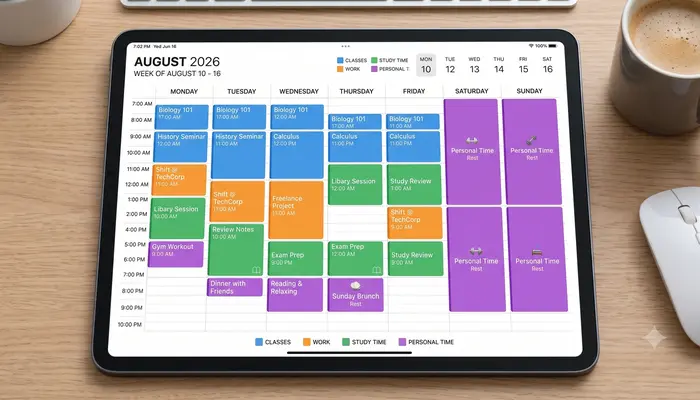
The Time-Blocking Method
Monday-Friday:
- 8 AM – 3 PM: Classes (assuming typical schedule)
- 3 PM – 5 PM: Work block #1
- 5 PM – 7 PM: Dinner, gym, break
- 7 PM – 9 PM: Homework
- 9 PM – 11 PM: Work block #2 (if needed)
Weekends:
- Saturday morning: 3-hour work block
- Sunday afternoon: 2-hour work block
Total work time: 15-20 hours weekly
Potential earnings: $300-800/month
The Class-Specific Strategy
Not all class time requires 100% attention (sorry professors).
Use during:
- Large lecture halls where attendance = showing up
- Boring gen-eds you’re acing anyway
- Classes you’re watching recorded anyway
Don’t use during:
- Labs
- Small seminars
- Difficult major courses
- Exam review sessions
What to do: Data entry, transcription, survey sites – work that doesn’t require deep focus.
Beginner’s Note: This is morally grey territory. Only you can decide if it’s worth it. I’m just telling you what students actually do.
The Seasonal Approach
Fall/Spring Semesters:
Lower work hours (10-12 weekly). Focus on grades.
Summer/Winter Breaks:
Ramp up to 30-40 hours weekly. Build your client base and bank account.
Finals Weeks:
Pause client work or be upfront about reduced availability. Good clients understand.
Pro Tip: Tell clients your schedule upfront. “I’m a full-time student, so I work evenings and weekends. I’ll deliver Friday-Sunday consistently.” Honesty builds trust.
Real Success Stories from Student Earners
These are real people I’ve known or interviewed. Names changed, numbers accurate.
Case Study 1: Jessica – Freelance Writer
Background: Junior, English major, zero experience
Started: September 2024
Platform: Upwork
Current earnings: $1200-1800/month
Her Strategy:
Started with $15 articles. Delivered early with zero typos. Built 10 five-star reviews in month one. Raised rates to $30/article. Now has 3 retainer clients paying $400-600 monthly each.
Works 12 hours weekly, usually Sunday mornings and Tuesday/Thursday evenings.
Her Advice: “Stop waiting to be ‘good enough.’ I still cringe reading my first articles. But I got paid, got better, and now I’m booked solid.”
Case Study 2: Marcus – YouTube Creator
Background: Sophomore, business major, camera-shy
Started: January 2025
Platform: YouTube
Current earnings: $800-1400/month
His Strategy:
Started a “budget college student” channel. Posted weekly videos about eating for $30/week, thrifting dorm furniture, etc. Hit monetisation (1000 subs) in 4 months. Now has 35,000 subscribers.
Earns from:
- Ad revenue: $300-500
- Affiliate links: $200-400
- Sponsorships: $300-500
Time investment: 6-8 hours weekly filming and editing.
His Advice: “I almost quit at video 15 when I had 200 subscribers. Video 16 went viral with 300K views. You never know which one hits. Keep posting.”
Case Study 3: Priya – Virtual Assistant
Background: First-gen college student, needed money immediately
Started: August 2025
Platform: Fancy Hands + direct clients
Current earnings: $900-1200/month
Her Strategy:
Started with Fancy Hands doing random micro-tasks ($3-7 each). Built reputation. Client reached out for dedicated 10 hours weekly at $20/hour. Now has 2 regular clients.
Works during class gaps, late evenings, Sunday mornings.
Her Advice: “As a first-generation college student, I had zero connections and no safety net. VA work saved me. Anyone can do this – you just need to be reliable and communicate well.”
What is a first-generation college student? Someone whose parents didn’t earn a 4-year degree. They often face unique financial challenges and limited career guidance – which makes flexible online income even more valuable.
Common Mistakes to Avoid (Learn From Others’ Pain)
Mistake #1: Underpricing Your Work
I see this constantly. Students charging $5 for work that should be $50.
Why it happens: Imposter syndrome. “I’m just a student.”
Why it’s wrong: Your time has value. Period.
Fix: Research market rates. Charge at the lower end if you must, but never insultingly low.
Mistake #2: Not Treating It Like a Real Business
Signs you’re making this mistake:
- Missing deadlines
- Poor communication
- Unprofessional emails
- No contract/agreement
Fix: You don’t need an LLC, but you need professionalism. Respond within 24 hours. Deliver on time. Use complete sentences.
Mistake #3: Putting All Eggs in One Basket
Had one great client? Awesome. What happens when they pause work or disappear?
Fix: Maintain 3-5 clients minimum. Diversify income sources.
Mistake #4: Ignoring Taxes
Surprise! That $3000 you made freelancing? The IRS wants their cut.
Fix: Set aside 20-25% of earnings for taxes. Track everything in a spreadsheet. Look into quarterly estimated tax payments if earning $5000+/year.
Pro Tip: Talk to your university’s free accounting help (many have this). Twenty minutes now saves hundreds in penalties later.
Mistake #5: Sacrificing Grades for Money
Here’s some tough love: failing Organic Chemistry to make an extra $200 is a terrible trade.
Fix: Set a firm boundary. GPA comes first. Work is supplementary.
Tools and Resources You’ll Actually Use
Essential (Free) Tools:
Communication:
- Gmail (professional email address)
- Calendly (scheduling meetings)
- Zoom (client calls)
Project Management:
- Notion (organising everything)
- Trello (task tracking)
- Google Sheets (time and earnings tracking)
Design:
- Canva (graphic design)
- Remove.bg (background removal)
- Coolors (colour palette generator)
Writing:
- Grammarly (catching typos)
- Hemingway Editor (clarity checking)
- Google Docs (collaboration)
Time Tracking:
- Toggl (automatic time tracking)
- RescueTime (productivity monitoring)
Paid Tools Worth It:
Canva Pro: $13/month – Unlocks premium templates and features. Worth it if doing design work.
Grammarly Premium: $12/month – Advanced grammar checking. Essential for writers.
Notion AI: $10/month – AI assistance for organisation and content.
Learning Resources:
Free:
- YouTube (literally everything)
- Coursera (audit courses free)
- HubSpot Academy (marketing certifications)
Paid but Worth It:
- Skillshare: $32/month (thousands of classes)
- LinkedIn Learning: Free with many .edu emails
Internal Linking Suggestions:
- Link to: “Best Productivity Apps for College Students 2026” (anchor: “project management tools”)
- Link to: “How to File Taxes as a Student Freelancer” (anchor: “track everything in a spreadsheet”)
- Link to: “Time Management Strategies for Busy Students” (anchor: “time-blocking method”)
External Linking Suggestions:
- Link to: IRS.gov self-employment tax guide (anchor: “quarterly estimated tax payments”)
- Link to: Bureau of Labour Statistics (anchor: “remote work statistics”)
- Link to: Upwork’s 2026 Freelancing Report (anchor: “70% of college students work while studying”)
Expert Tips for Maximising Your Online Income
Tip #1: Niche Down Aggressively
“Freelance writer” = competing with millions
“Freelance writer for SaaS companies in cybersecurity” = competing with dozens
Specificity sells. Pick a narrow niche, become the go-to person.
Tip #2: Build in Public
Share your journey on Twitter, LinkedIn, or Instagram.
Post:
- “Just landed my first $100 client!”
- “Here’s what I learned writing 50 articles”
- “3 mistakes I made as a student freelancer”
This builds credibility and attracts clients organically.
Tip #3: Create a Simple Portfolio
You don’t need a fancy website.
Google Sites, Wix, or even a Notion page works. Include:
- 3-5 best work samples
- Brief about you
- How to contact you
- Testimonials (once you have them)
Pro Tip: Even with zero experience, create mock projects. Design 3 sample Instagram posts. Write 2 sample blog articles on topics you care about. Now you have portfolio pieces.
Tip #4: Ask for Testimonials Strategically
After delivering great work:
“I’m so glad you’re happy with the results! Would you be willing to write a quick testimonial I can share with future clients? Even 2-3 sentences would be incredibly helpful.”
Most people say yes. Now you’ve got social proof.
Tip #5: Raise Rates Regularly
Every 3 months or every 10 clients, raise your rates by 10-20%.
Scared of losing clients? Good ones stay. Bad ones leave. You make more money for the same work.
Summer Jobs for College Students: Maximising Break Time
Summer is your secret weapon.
No classes = 40-50 hours weekly available = $2000-5000/month potential.
Best Summer Strategy:
May: Line up 3-5 clients. Start at 20 hours/week.
June-July: Ramp to 40 hours/week. Bank as much as possible.
August: Reduce to 15 hours/week, transition reliable clients into fall semester part-time work.
Summer-Specific Opportunities:
Internship + Side Hustle Combo:
Do a 9-5 internship for experience. Do freelance work evenings/weekends for money.
Intensive Skill Building:
Spend June learning a high-value skill (coding, advanced Excel, video editing). Monetise in July-August.
Summer Camp Virtual Work:
Some camps hire remote admin help. Combines summer jobs for college students with remote flexibility.
How Much Can You Realistically Earn?
Let’s set real expectations.
Month 1: $100-400
You’re learning, building profiles, getting first clients. Earnings are low. That’s normal.
Months 2-3: $400-1000
You’ve got systems, regular clients, better rates. Income stabilises.
Months 4-6: $800-2000
You’re established. You know your worth. You’re getting referrals.
Months 7-12: $1200-3500
You might have retainer clients, passive income streams, premium rates.
Earnings by Hours Per Week:
| Hours/Week | Conservative | Moderate | Optimistic |
|---|---|---|---|
| 5 hours | $75 | $125 | $200 |
| 10 hours | $150 | $300 | $500 |
| 15 hours | $250 | $500 | $900 |
| 20 hours | $400 | $800 | $1500 |
| 30 hours | $700 | $1400 | $2500 |
Variables:
- Your skills and niche
- How well you sell yourself
- Your rates
- Client quality
- Consistency
Beginner’s Note: Start with conservative estimates. Getting $150/month your first month is a WIN. Don’t compare yourself to outliers making $5000 their first month.
The Mindset Shift You Need
Here’s what separates students who make $200/month from those making $2000/month:
They believe they’re worth it.
You’re not “just a student.” You’re solving real business problems. That has value.
They’re consistent.
One week of hustle doesn’t work. 10 weeks of steady effort build income.
They don’t wait for perfect.
Done is better than perfect. Ship it, learn, improve.
They treat rejection as data.
Didn’t get hired? Cool, apply to 9 more. Someone will say yes.
They invest in themselves.
Spending $30 on a course that teaches a $50/hour skill is a no-brainer.
Legal and Tax Considerations (Boring but Important)
Do You Need an LLC?
No. Not as a student making $1000-3000/month. You can operate as a sole proprietor under your own name.
Tax Obligations
If you earn over $600 from any single client: They’ll send a 1099 form. Report it on your taxes.
If you earn under $600 from multiple clients: You still need to report all income. The IRS doesn’t care that you didn’t get a form.
Self-Employment Tax: Roughly 15.3% on earnings. Plus your regular income tax bracket.
Estimated Quarterly Taxes: If earning $5000+/year freelancing, you’re supposed to pay quarterly. Most students don’t do it their first year and just pay the penalty (not advice, just reality).
What to Track:
Income: Every payment, date, client, amount
Expenses: Equipment, software subscriptions, internet percentage, education/courses
Mileage: If meeting clients in person
Home Office: Probably not worth claiming as a student in a dorm
Pro Tip: Open a separate checking account for business income/expenses. Makes tax time infinitely easier.
The Frequently Asked Questions (FAQ Schema Ready) feature enables users to view the frequently asked questions.
Which are the best side jobs to do online in the USA in 2026 for college students?
Freelance writing, virtual assistant, online tutoring, social media management and graphic design are the best online side jobs for college students in the USA in 2026. These allow for flexibility, good pay ($15-$50 an hour), and are easy to get started with and require little experience.
What are the best ways to get some cash from the web without having any experience as a college student?
User testing ($10-$40 per test), data entry and transcription ($12-$25 per hour), virtual assistant and content moderation are some of the ways college students can earn money online without experience. The jobs are remote, and they don’t demand any particular skills besides basic computer skills and reliability – meaning, these are entry-level jobs.
What is the average amount of money that a college student can earn from an Internet side job?
The monthly income from online side jobs is usually $400 to $2000, which is dependent on the time investment and abilities of the individual. Typically, the hours worked per week will range between 10 and 15, which will earn you $300-$800 per month, or more if you work 20 to 30 hours per week with the right clients and pricing.
Which are the right jobs to do in the summertime as a college student?
Best summer jobs for college students are intensive freelancing (40 hours/week potential); creating online courses; creating YouTube content; dropshipping businesses; and being a full-time virtual assistant. Summer breaks provide opportunities for students to make the most of their time at the job, with 30-50 weekly hours.
Are college students liable for taxes on income from their side jobs online?
Yes, any amounts earned from online side work must be reported on a tax return, even if it is a small amount, for college students. Be sure to save 20-25% for taxes, record all income and expenses and make quarterly estimated tax payments (if you make more than $5000 per year from freelance or self-employment).
What is the time management of college students who do online work?
There are various ways for college students to use time-blocking to manage to work online and attend class, including finding flexible jobs that have no set schedule, cutting back on work during the final weeks of classes, planning with clients and communicating effectively about the student assignment schedule and availability.
So what kind of tools will college students need with regard to online side work?
The majority of online college student side jobs use popular software like Google Docs, Zoom and simply a trustworthy laptop and internet connection. There is a high-quality microphone ($30-50) available for tutoring/calls if you wish, Canva Pro ($13/month) available for design work if you wish, and Grammarly Premium ($12/month) available for writing if you wish.
Final Thoughts: Your Next Move
You have just read 3000+ words on how to get online side jobs for college students in the USA in 2026.
What really counts is what you do within the next 48 hours.
Your Action Plan (Do This Week):
Today:
- Choose 2 job types that match your skills
- Sign up for 2 relevant platforms
- Create your basic profile
Tomorrow:
- Complete your profiles professionally
- Take any platform skill tests
- Research market rates for your services
This Week:
- Apply to 5 beginner-friendly jobs with personalised proposals
- Set up a simple portfolio (even if it’s just mock work)
- Track your time and applications in a spreadsheet
This Month:
- Land first paying client
- Deliver exceptional work
- Get your first 5-star review
- Start building monthly income
Look, I get it. You’re busy. You’re overwhelmed. You don’t know whether or not this will be effective.
However, the point is, all the success stories in this article began right here where you are now. Wishing they were rich, they didn’t know what to do, they read articles trying to find answers.
The difference? Nevertheless, they went ahead and did it.
Flaws are okay! There is no need to make special connections. No special equipment is required, nor years of experience.
You don’t have to do anything other than just get started.
One last thing:
If you’ve found this guide useful, pass it along to a friend or colleague who is interested in taking steps in their quest to earn online as a college student. The more students that are aware of these opportunities available, the better we all do.
You will thank yourself after a month if you get an additional $1000 in your pocket, and you will have useful skills.
Finally, close this tab and head to sign up for the first platform.
You’ve got this.
About This Guide:
College students in the USA in 2026 have access to a whole host of side jobs that they can do from home, ranging from those that require no experience to those that are more complex and require more skill. From simple ways for college students to earn extra cash fast to smart career moves for the years in college, this guide suggests ways to make money as a college student without sacrificing a high GPA and losing your sanity, along with some real-life success stories and honest advice.
If you’ve found this guide useful, spread the word with a friend or colleague who is interested in taking the first steps towards beginning AI freelancing or online income.